Friday, November 1, 2013

How new NHS boss helped ruin health services on two continents


SOLOMON HUGHES introduces new NHS chief executive Simon Stevens – a man with a dubious history of undermining public health on both sides of the pond

In the past, interviews for top jobs were all about what school tie you wore. 

Middle management positions were decided on funny handshakes and golf club membership. For rank-and-file jobs, turning up was half the battle. 

But competition for jobs has got fiercer. The concept of human resources has expanded. Interview panels are more complicated, wrestling with lists of “essential qualities for candidates.”

So what happened at the interview for the new head of the NHS? 

Did the panel have a piece of paper reading: “Wasted billions of health money — Desirable. Lobbied against public health care in the US — Essential.”?

Because they have appointed a man who did that and more.

The new NHS chief executive Simon Stevens has screwed up the health service on two continents. 

He successfully fought off the growth of public health care in the US, killing a key component of “Obamacare.” 

While in Britain he fought to get a slice of the NHS pie stuffed into the gobs of private health firms, wasting billions in the process.

Stevens was health adviser to both Labour health secretary Alan Milburn and prime minister Tony Blair. He was intimately involved in Blair’s privatisations.

He is the main author of the “NHS Plan” launched in 2000. The plan took NHS-funded operations out of NHS hospitals, handing them over to private companies. 

This was a bonanza for health companies and private equity firms behind them. It built a whole industry of firms sucking up NHS cash. Paying their profits wasted NHS cash and resources. 

For example, under Stevens’s plan the NHS gave up buying its own MRI scanners. It paid a private company to do the scans from the back of lorries in hospital car parks instead. 

A company called Alliance Medical was paid for all the scans in the contract, even though it only did 80 per cent of the work. The Royal College of Radiologists and the NHS Clinical Guardian didn’t trust the quality of the work, so hospitals had to duplicate many of the scans anyway. 

The same plan meant the NHS bought hundreds of thousands of minor operations from private clinics called “independent-sector treatment centres” (ISTCs). 

Under Stevens’s plan, the NHS paid private firms like Care UK 15 per cent above the NHS rate to encourage the growth of a “market.” 

It also paid firms whether the operations was done or not. Estimates by Professor Allyson Pollock, an academic critic of the scheme, suggest that up to £1.6 billion may have been wasted on phantom operations.

The NHS was stuck with training costs and “difficult” cases, while the private sector creamed off easy work and profits. 

Still, Stevens’s old boss Milburn has a new job with private equity firm Bridgepoint Capital, which owned Alliance Medical and now owns Care UK — the companies profiting from the crazy scheme. 

Stevens was central to one of the worst NHS financial disasters. He helped to run the 2002 Prime Minister’s Seminar on NHS Information Systems which launched Connecting for Health. 

This NHS-wide computer system was supposed to create electronic patient records. It has cost between £12bn and £20bn pounds but basically doesn’t work. 

Newspapers usually write the Connecting for Health story as a “wasteful Labour government in computer cock-up” tale. 

But Connecting for Health was actually driven by new Labour’s determination to hand over NHS cash to private firms.  

Stevens’s record of the seminar says: “The key was to use stronger central direction to accelerate the pace of change and make more use of partnerships with the private sector.” 

So Stevens helped Labour centrally direct the NHS to sign partnerships with IT firms. The result was a disastrous waste of cash. 

Connecting for Health was actually a double privatisation. First, it meant handing over NHS money to the IT contractors. 

Second, the whole system was designed to hand over operations to the private sector. 

Transferring electronic patient records was meant to make transferring NHS patients to private hospitals easier.

In 2004 Stevens left Britain to join private US health firm UnitedHealth, becoming executive vice-president at a firm winning NHS work from his NHS Plan. 

There is a persistent link between Stevens and computers and funny business with money. 

In 2009 UnitedHealth, the firm Stevens helped to lead, paid a $350 million court settlement. 

UnitedHealth used a computer database to systematically cheat its customers. 

The American Medical Association said UnitedHealth’s payments database was a “corrupt system” and “intentionally manipulated” and “rigged.” 

Patients who went to see a doctor outside UnitedHealth’s business associates were deliberately given less of their UnitedHealth insurance money for medical treatments, leaving patients with bigger bills. 

Stevens wasn’t satisfied with just working for a scandal-hit US health firm.  

He worked to screw up the US national health system as well. In Britain Stevens tried to make the NHS more like the private health system that fails so many US citizens.  

In the US President Barack Obama made tentative steps towards a European-style health system. So Stevens did all he could to obstruct Obamacare.

Obama’s scheme offers private health-care plans for most people in the US, with some government backing. 
However, in 2008 he also proposed a “public option.” In the original Obamacare, a small publicly run health insurance scheme would compete with private firms like UnitedHealth. 

The public option would curb private insurance profiteering. The idea of having to compete with the public option was too much for Stevens, who ran UnitedHealth’s political lobbying in the US, and he organised a pincer movement against it.

First, in 2009 UnitedHealth sent its staff to the town hall meetings where Tea Party types attacked Obama’s reforms as “socialist.” 

UnitedHealth mobilised advocacy specialists, priming staff with “talking points” like: “A government-run health plan would be a roadblock to meaningful health-care reform.” 

UnitedHealth staff were mobilised during working hours to attack Obama’s reforms.

While Stevens sent his staff to join the barmy right-wing town hall meetings alongside crazy Republicans, he personally lobbied right-wing Democrats — known as “Blue Dog Democrats” — to kill the public option. Stevens’s campaign won and the public option of Obamacare died.

So having introduced profiteering into the NHS, Stevens then fought to keep the government out of health care in the US. 

By putting Stevens in charge of the NHS, the government has put a self-destruct mechanism in the centre of our health service.


Energy rip-off: Swindling the very poorest


Energy companies are yelping after having been exposed by Ofgem as pushing up tariffs imposed on consumers far beyond the increases in wholesale costs.

This is not what the big six expect from Ofgem, which has traditionally acted as a fig leaf to cover their rampant profiteering.

But such is the public anger that even Ofgem feels the need to distance itself as far as practical from the thieves’ cartel milking working-class domestic consumers.

David Cameron attempts to dodge the issue by asserting that “it is for the energy companies to explain the decisions they have taken around bills to their customers.”

Of course it’s nothing to do with him. He’s only the Prime Minister. What can he do to change the situation?
The reality is that Cameron and his acolytes have no desire to effect any change. 

They see nothing wrong with an oligopoly holding working people to ransom and forcing pensioners, claimants and the low-paid to choose between heating their homes and filling their bellies.

It’s what makes Tories tick. It’s their idea of how the world goes round.

Billionaire tax exiles blackmail entire regions with factory closure and mass poverty to get their way, banks are bailed out by the public purse, workers’ pay, pensions and services are slashed, the richest 1 per cent receive tax handouts and thousands of old people face death this winter because a handful of utilities companies have the power to extort fortunes from the poorest people in society.

These policy highlights pose no problem to the coalition government, which has encouraged that process, misrepresenting a private banking catastrophe as a crisis created by excessive public expenditure.

Caroline Flint points out the dishonesty of the energy companies, lying about the effect of wholesale prices and boosting their profits by driving up domestic energy bills.

But what is the Labour shadow energy secretary’s battle cry at a time when around two-thirds of the electorate is demanding that the electricity and gas industries be returned to public ownership?

“Labour would freeze energy bills for 20 months and create a tough new watchdog with the power to force energy companies to cut their prices when the cost of energy falls,” she says.

The average combined gas and electricity bill is at present £1,267, which is available for people able to pay monthly standing order payments.

Poorer people unable to make such payments will pay higher rates.

But Labour’s 20-month freeze would bring a one-off respite of just £120 for gas and electricity company customers, for which the energy cartel members have already begun preparing by overcharging them this winter.

No-one should doubt that they will do precisely the same next year and at any other time before or after a Labour government temporary tariff freeze.

Flint’s suggestion that “a tough new watchdog” will cut energy prices when the cost of energy falls will not be taken seriously by anyone.

Regulators are an essential part of the privatisation swindle. They are symbols of government abdication of responsibility for working people’s living standards.

Labour makes much at present of its determination to place the cost of living at the centre of its general election campaign.

It will not be taken seriously — nor deserve to — unless it moves beyond a marginal one-off price freeze to tackle the privatisation scandal decisively by backing public ownership.

Benefit claimants ‘on brink of suicide’


Centre staff offered training to deal with vulnerable

Staff at a benefits advice centre in north-west England are being given “suicide awareness training” because increasing numbers of clients are threatening to kill themselves.

The centre says media vilification of benefits recipients is adding to the pressure and worry caused by the government’s welfare cuts to the area’s most vulnerable people.

Salford Trade Union Council Unemployed and Community Resource Centre said it was the first time in the centre’s 33-year history that suicide training had been necessary.

Centre staff have also taken up the case of a local disabled woman maligned in the gutter press as a “scrounger” because she suffers allergies which cause her severe and painful eczema.

Tracy Kenny, 45, has been unable to work for 24 years because her skin blisters severely when in contact with rubber, glue, nickel and other substances. One effect is that she cannot wear shoes.

For 24 years doctors have monitored the problem.

But she was called to a 10-minute cursory examination by Department of Work and Pensions inspectors who deemed her fit for work.

The gutter press were tipped off about her case.

The result was a series of appalling but typical attacks by the Sun, Daily Mail, Daily Star and even the Daily Telegraph.

The Daily Star set the pace with: “Benefit scrounger hasn’t worked for 24 years because she’s allergic to SHOES.” The ever-imaginative Sun said: “Claiming benefeets.”

Ms Kenny said: “I feel awful and in the last two weeks the media have definitely made me feel worse. I am frightened to leave home and this has just increased the stress and pressure on me. It’s not my fault that I have these allergic reactions. I need understanding and help, not vilification.”

The TUC centre is now helping and representing her.

Manager Alec McFadden said: “We will provide advice and representation. However, the media have stepped in to attack and vilify a disabled person. The irresponsible journalism of these national newspapers has made Tracy’s life hell for the past two weeks and increased hatred and discrimination against individual people with several physical or mental health problems.”

Cameron 'not practising what he preaches' on open government


As the UK hosts an Open Government Partnership summit in London today (31 October). David Cameron is criticised for"not practising what he preaches".


The UK is hosting an Open Government Partnership summit (OGP) in London today (31 October). More than 1,000 delegates from 73 countries, including the 61 current OGP partners will share experiences, discuss progress and show how openness and transparency are making a difference to their citizens.

Commenting on the Prime Minister’s speech to today’s summit, in which he says “When we talk about transparency elsewhere, we’ve got to show it at home too,” and claimed that “Over the past three and a half years the Government I lead has been unprecedented in the information we’ve released,” Clare Algar, the Executive Director of the legal charity Reprieve, said: “David Cameron is right that we need transparency at home – but sadly, he isn’t practicing what he preaches.

“His Government is carrying out a wide-ranging assault on the public’s ability to hold it accountable through the courts – cutting back judicial review and legal aid, while introducing secret courts which see the citizen shut out of their own case.

“Just last week, lawyers for Mr Cameron were desperately trying to shut down a case brought by Libyan torture victims, who only want answers and an apology over the part the UK government played in their abuse by handing them over to Gaddafi.

“Add to this Government proposals to roll back Freedom of Information, and clamp down on recent revelations about the extent of mass-snooping by our intelligence agencies, and a clear picture emerges of a programme to limit, not enhance, transparency and accountability.” (http://www.ekklesia.co.uk/node/19344)

The UK, as the OGP lead co-chair, has published the following five priorities for this year’s summit:

- open data: opening up government data to boost entrepreneurship, economic growth and accountability

- government integrity: fighting corruption and strengthening democracy through transparent government

- fiscal transparency: making sure that taxpayers can follow the money

- empowering citizens: transforming the relationship between citizens and governments

- natural resource transparency: making sure that natural resources are used for public benefit, not to line the pockets of corrupt elites

Source

Business committee criticises Lobbying Bill union restrictions


The section of the controversial Lobbying Bill attempting to shackle trade unions has been declared unfit for purpose by a red tape advisory committee.

The UK government has been to withdraw and start again in its assessment of the impact of part three of the Bill, concerning union membership systems.

The Regulatory Policy Committee, set up by government to advise on the impact of regulations, a majority of whose members are from a business background, has given the Bill’s regulatory impact assessment a rare red rating.

In their decision they say: "The impact assessment lacks a sound evidence base and is insufficiently robust to justify RPC validation of the estimated costs to civil society organisations (trade unions). The IA needs to provide a more detailed assessment of all likely costs to trade unions, including all familiarisation costs and recurring costs to small unions. The assessment should be supported by further evidence that was gathered from consultation with stakeholders, in particular quality assurers."

Trades Union Congress (TUC) General Secretary Frances O’Grady commented: “Part three of this dreadful and friendless bill imposes needless red tape on trade union membership systems. But no-one has explained why.

"The law already regulates union membership and the union regulator, the Certification Officer, has plenty of power, but has received no complaints since 2004.

“This unnecessary Bill will make union membership lists open to further state scrutiny despite recent evidence of extensive blacklisting.

“This committee is effectively saying that the impact statement has been written on the back of an envelope. That will not come as a surprise to anyone interested in this party-political partisan Bill that has been attacked from all sides as it goes through parliament.”

Part two of the Bill, which would impose severe limits on the freedom of speech of charities, advocacy groups, think tanks and other civic organisations a year from election campaigns, has also been strongly criticised on civil rights grounds.

Ekklesia is a supporter of the work of the work of the independent Commission on Civil Society and Democratic Engagement, which is critiquing Part Two of the Transparency of Lobbying, non-Party Campaigning and Trade Union Administration Bill, and also backs union criticism of Part Three.

* The Regulatory Policy Committee decision is available at http://regulatorypolicycommittee.independent.gov.uk/rpc-publishes-2-red-...

* A TUC briefing on the Transparency of Lobbying, non-Party Campaigning and Trade Union Administration Bill is available (*.PDF Adobe Acrobat document) at: www.tuc.org.uk/sites/default/files/LobbyingBillbriefing.pdf

* Non-party campaigning ahead of elections: a response from the independent Commission on Civil Society and Democratic Engagement: http://www.ekklesia.co.uk/node/19330

* More from Ekklesia on the Lobbying Bill: http://www.ekklesia.co.uk/lobbyingbill

Ekklesia 

Justice Alliance deliver letter demanding no more cuts to legal aid


Justice Alliance joined by former Liberal Democrats urging Nick Clegg to comply with the party’s wishes to halt devastating legal aid cuts

Philippe Sands, who publicly resigned his membership from the Lib Dems this year, joins representatives of the Justice Alliance outside the Lib Dem HQ in London at 10.00 am today demanding that Nick Clegg halts the government proposals to slash legal aid, in accordance with his party’s vote at conference this year. The move is supported by other high profile resigners, including Dinah Rose QC and Jo Shaw. 

Over 100 charities and organisations, including Liberty, The Children’s Society and the Howard League for Penal Reform, will join disabled ex-prisoner Daniel Roque Hall and Harriet Wistrich, lawyer for two women sexually abused by guards at Yarl’s Wood detention centre, to hand deliver a signed letter calling for an immediate halt to the legal aid cuts following the unanimous vote at conference. 

If the proposals are implemented:
  •  Unlawful government actions including those of the police and social services will go unchallenged;
  •  Vulnerable individuals, including victims of trafficking and violent offences, to be unable to access vital advice;
  • There will be serious implications for access to justice and fair trial rights;
  • Poor and unfair decisions of the state to go unchallenged;
  • It will diminish quality criminal representation.
Dinah Rose QC, former Liberal Democrat member “The protection of the right of access to justice ought to be fundamental to a party which values civil liberties. It is put in jeopardy by the Government’s proposals to implement yet more cuts on legal aid. There is no point in participating in Government unless the leadership uses the power that it undoubtedly has to prevent serious damage being done to our legal system, and to the rights of the poorest and most vulnerable members of our society.”

Matt Foot, solicitor and founder of Justice Alliance, said: “Who has stood up and supported these proposals? No-one. Time and again everyone has criticised Grayling’s proposals. Even he would not attend the debate in Parliament to defend these proposals. The truth is the government has no idea whether the proposals will work or whether it will cause total chaos. MP’s from across the political spectrum have expressed their concern at government plans which will make it hard for ordinary people to challenge the state. The recent success of the Lewisham hospital campaigners demonstrates it is vital that the government should not be permitted to act with impunity.”

Anne Hall, mother of Daniel Roque Hall, added: “’Legal aid cuts are life threatening. My severely disabled and very ill son was sent to Wormwood Scrubs despite medical concerns about his likely survival there. The prison failed, the prison complaints system was utterly ineffective and Daniel ended up unnecessarily in intensive care and hospitalised for six months. It was only through legal aid he was not sent back to Wormwood Scrubs and he was able to come home where he could be cared for safely. Legal aid saved his life.’


Leroy Skeete, writer and ex-prisoner, said: “From the age of 10 I was in and out of children’s homes. The one thing I learnt is that abuses are carried out in the dark. Legal aid shines a light and people are less likely to abuse if there is a possibility they will be exposed.”
James Welch, Liberty’s Legal Director, said: “Legal protections are meaningless if people can’t access effective legal representation.  The current proposals put justice beyond reach for the most vulnerable and put the fairness of our criminal justice system in serious jeopardy.  The Lib Dem membership have spoken out against these unjust attacks – it’s time for the leadership to listen.” 

Julene, mother of two young children ”Before I had a legal aid solicitor helping me, social services would ignore me. I have two young children and we were facing eviction. I was struggling with the rent and I had no idea what to do. When I went to court they gave me a list of legal aid solicitors and told me I needed one. My solicitor sorted things out and it was only through her that we could get social services to listen. Without legal aid me and my children would be homeless. I am very worried for people like me who would be excluded from help because of the residence test.

‘Jennie’ (anonymised) young person, 
“I am currently destitute and struggling to support myself. Before I got legal aid I couldn’t see a way ahead. Now I have got a solicitor and she is helping me to contact social services so that I can put a roof over my head and so that I can get proper food and support. The government plans to take away the only lifeline that exists for people like me and it makes me very worried for those in my position in the future.”
According to the Justice Alliance, knock on costs of the legal aid proposals could be up to £47 million. The impact of the legal aid cuts of April this year is already being felt by the vulnerable – victims of domestic violence and trafficking are being turned away by law firms who are at breaking point.  The new proposals will make the situation far worse and severely undermine the ability of individuals including victims of torture, victims of police abuse and victims of sexual grooming to hold the state to account.

The call coincides with the end of the government consultation on its current proposals to cut legal aid and access to judicial review.  The Justice Alliance will continue to protest against the proposals and show the strength of feeling of charities and ordinary people against the proposals. 

Notes to Editors:
The Justice Alliance will deliver the signed letter at 10.00 am on Friday 1November 2013 at Lib Dem HQ, 8-10 Great George Street, London, SW1P 3AE. To arrange an interview with a member of the Justice Alliance email milliegw@gmail.com07967534670 <tel:07967534670>

The Justice Alliance is an alliance of legal organisations, charities, community groups, grass roots and other campaigning groups, trade unions and individuals who are united in our opposition to the government’s proposed attack on legal aid and the criminal justice system. These legal aid proposals are part of the larger assault on essential parts of the welfare state. Visit: http://www.savelegalaid.co.uk/justicealliance #nomandatenocuts 

Figures for knock-on costs are from Nick Armstrong cost figures of legal aid proposals found herehttp://legalaidchanges.files.wordpress.com/2013/09/jchr-sub-130925.pdf 

Media contact 
or more information contact milliegw@gmail.com 07967534670 <tel:07967534670>   

Approved behind closed doors, curbs that end three centuries of Press freedom


‘A secretive committee of four ministers yesterday approved a Royal Charter to regulate the Press, provoking claims that politicians are undermining 300 years of freedom of speech.

The Privy Council, which advises the Queen, rubber-stamped the plans after newspapers lost two last ditch legal bids to halt the process.

Deputy Prime Minister Nick Clegg chaired a meeting at Buckingham Palace at which Health Secretary Jeremy Hunt, Culture Secretary Maria Miller and Liberal Democrat peer Lord McNally were also present.

The Queen was then obliged to grant the Royal Charter.

It grants politicians the right to meddle in Press regulation for the first time since the licensing of newspapers was abolished in 1695.’

Read more …

Queen sets seal on cross-party politicians' charter for press regulation


‘After a succession of last-gasp legal attempts by the newspaper industry to thwart the process, the Queen has given her approval to a government-backed royal charter governing the regulation of the press.

At a meeting of the Privy Council, the Queen set her seal on the document, which is backed by the three main political parties but is almost universally opposed by the publishers it is intended to oversee.
Hours earlier, senior newspaper representatives had gone to the High Court to seek an injunction to stop the Privy Council hearing, claiming that the industry’s own version of a reform charter had been unfairly rejected.’

Read more …

NHS couple received £1 million payoff before being given new management jobs


‘A married couple received payouts of almost £1 million when they were made redundant from their posts as NHS managers, only to be re-employed by the health service a few months later.

They were among around 50 senior staff members who received payouts of more than £100,000 when 161 statutory bodies were abolished earlier this year, according to accounts.

Around a dozen of those have been taken on again in the public sector, the Times reported.’

Read more: http://www.telegraph.co.uk/health/nhs/10419406/NHS-couple-received-1-million-payoff-before-being-given-new-management-jobs.html

Workfare at the Supreme Court: What’s Changed?


Boycott Workfare at the beginning of the workfare case.

On Wednesday the Supreme Court dismissed the Government’s appeal in the Cait Reilly and Jamie Wilson workfare case.  The government were appealing against the Court of Appeal’s findings in February that the regulations which the government used to create most workfare schemes were unlawful and should be quashed.

The government was appealing even though they enacted retrospective legislation in March, which obliterated the Appeals Court judgement.  The Jobseekers (Back to Work Scheme) Act 2013 amended the law and re-wrote history. It made it so that the regulations were legal, and had always been legal, even though the Appeals Court had just found that they weren’t.  It was passed with Labour’s support.

The only reason the government can still say that ‘DWP is able to require claimants to take part in employment programmes’ is because they’re willing to override the courts when it comes to workfare. Public Interest Lawyers, who represent Cait and Jamie, have already launched a judicial review of the legality of this legislation.

The Supreme Court’s full judgement can be found here (summary version here), and there’s a good overview of what’s significant in the Court’s ruling on Public Interest Lawyers website.

The Supreme Court held that the Court of Appeal was right to quash the 2011 regulations: Ian Duncan Smith overstepped his powers when he drew them up.  In relation to Jamie Wilson’s case, it found that the notice he was given was invalid under those regulations anyway – something the Government was also appealing.

Most importantly, the Supreme Court went further than the Court of Appeal on one point. They agreed with the argument made by Public Interest Lawyers that it is right that you should have some information about laws and policies that will punish you (like workfare) before they punish you (paragraph 65):
 Fairness … requires that a claimant should have access to such information about the scheme as he or she may need in order to make informed and meaningful representations to the decision-maker before a decision is made.
The Supreme Court didn’t say how the government should make this information available (paragraph 76). But the judgement means that, in the future, the government has to provide enough information to you so that you can challenge your eligibility for workfare.  If you don’t get this information before you’re told you must take part, this is likely to make it unlawful for the job centre to force you to take part, and unlawful for them to sanction you if you don’t take part.  PIL say that:
 The requirement on the DWP to provide jobseekers with adequate information about the schemes has far reaching implications as all jobseekers who, like Jamie, were not provided with adequate information will be able to seek the repayment of their benefits.
So even though they passed the unjust retrospective legislation and denied justice to unemployed people, the government still might have to pay back some of the £130 million in benefits that they unlawfully took from people.   Thousands of people weren’t given information about workfare schemes: if you were sanctioned, you might be able to have your benefits repaid – check Boycott Workfare for updates.

But the Court didn’t find that workfare breaches article four of the European Convention on Human Rights.  Article four says that ‘No one shall be required to perform forced or compulsory labour’. The courts say that workfare, in general, is fine.   It isn’t likely they’ll change their minds soon.

We have to make workfare impossible in other ways: we have to force the government to end it and we have to force businesses and charities to end their involvement in it.  We must support each other when we’re on workfare and in the job centre. We must make sure people know their rights.

To do all this, take part in the Boycott Workfare week of action!


In the meantime, have a look at article four of the European Convention on Human Rights:
1. No one shall be held in slavery or servitude.
2. No one shall be required to perform forced or compulsory labour.
3. For the purpose of this Article the term “forced or compulsory labour” shall not include:
(a)  any work required to be done in the ordinary course of detention imposed according to the provisions of Article 5 of this Convention or during conditional release from such detention;
(b)  any service of a military character or, in case of conscientious objectors in countries where they are recognised, service exacted instead of compulsory military service;
(c)  any service exacted in case of an emergency or calamity threatening the life or well-being of the community;
(d)  any work or service which forms part of normal civic obligations.
Public Interest Lawyers were arguing that in Cait and Jamie’s case in particular, workfare breaches point two of article four. Their argument was that because information about the schemes Cait and Jamie were sent on wasn’t freely accessible or precise, the consequences and requirements of workfare weren’t  foreseeable.  So workfare couldn’t be ‘part of normal civic obligations’.

The Supreme Court judgement followed a 1983 case, Van der Mussle v. Belgium, in which the human rights court said that article four rights should be limited by ‘the general interest, social solidarity and what is in the normal or ordinary course of affairs’, or ‘the social standards generally obtaining in … democratic countries’ (paragraph 89). It said that the exceptions to article four rights are not just a list of situations in which the right doesn’t apply: instead, they set out the general sense of what the right entitles you to and what it doesn’t.

The Supreme Court says (paragraph 83):
Jobseeker’s allowance, as its name suggests, is a benefit designed for a person seeking work, and the purpose of the condition is directly linked to the purpose of the benefit. The provision of a conditional benefit of that kind comes nowhere close to the type of exploitative conduct at which article 4 is aimed.
This ‘type of exploitative conduct’ has to involve work that is not only compulsory but also ‘“unjust”, “oppressive”, “an avoidable hardship”, “needlessly distressing” or “somewhat harassing”’ (paragraph 89).   Apparently workfare is none of these things.

The Supreme Court also says that it doesn’t matter whether or not the ‘condition’ – forced, unpaid work – is likely to ‘achieve its purpose’  (we know that it isn’t): the ‘purpose of the benefit’ is still somehow ‘enhanced’ (paragraph 88).

So, in the Supreme Court’s view, the government can force you to do anything they want while on JSA, as long as it is ‘normal or ordinary’ – as long as people are willing to believe that the government thinks that what the government forces you to do will help you find a job.

Why does the Court think it knows what the purpose of JSA is – and why won’t it state that purpose in its judgement, if it is so clear? Why should simply re-naming JSA have such an effect? Isn’t the purpose of JSA to avoid someone starving and losing their home when they become unemployed?

Why should it matter to someone being forced to work for Asda or the Conservation Volunteers that the government says to people that this will help them find a job? Does this make the work any less forced, or any less unpaid?

Again, the courts are no help.  But together we can take action to end workfare.

Boycott Workfare

Gov't challenged on Freedom of Information restrictions


Campaign groups, charities and press bodies have written to the PM urging him to drop proposals to restrict the Freedom of Information Act.

Over 70 campaign groups, charities and press bodies have written to UK Prime Minister David Cameron, urging him to drop proposals to restrict the Freedom of Information (FOI) Act.

They say the proposals are not compatible with the Prime Minister's stated aim of making the UK "the most open and transparent government in the world".

The letter coincides with an international summit on open government, hosted by the UK in London today (31 October 2013). The event will be attended by government and civil society representatives from over 60 countries.

Each government – including the UK – is expected to announce new commitments towards greater openness, drawn up in partnership with non-governmental organisations from their own countries.

However, in November 2012 the UK government announced that it was considering a series of proposals to make it easier for public authorities to refuse FOI requests on cost grounds. These proposals are still being considered.

The government says the changes are intended to address the "disproportionate burdens" caused by requesters who make "industrial use" of the FOI Act. But the 76 organisations say "the proposals would restrict access by all users, including those making occasional requests of modest scope."

FOI requests can be refused if the cost of finding the requested information exceeds certain limits. The government says it is considering reducing these limits, which would lead to many more requests being refused.

It is also proposing to allow more activities to be taken into account when calculating whether the limit has been reached. Instead of only counting the cost of finding and extracting the information, it also wants to include the cost of considering whether or not to release it. Other possible restrictions are also being considered.

The organisations say "Many requests of substantial public interest would be refused under these proposals regardless of the benefits of disclosure. They would have a severe effect on the operation of the FOI Act."
They continue: "We find it difficult to reconcile the ambition that the UK should be the world leader in openness with the government's proposals to restrict the FOI Act, which is a critical element of the UK's openness arrangements. Many requests of substantial public interest would be refused under these proposals regardless of the benefits of disclosure. We hope that the government will mark that commitment by announcing that it will not be bringing forward proposals to restrict the Act."

The joint letter, which has been co-ordinated by the Campaign for Freedom of Information, has also been signed by:

Action against Medical Accidents, Action on Hearing Loss, Against Violence & Abuse, Animal Aid, Article 19, Big Brother Watch, British Humanist Association, British Institute of Human Rights, British Muslims for Secular Democracy, Broadcasting Entertainment Cinematograph and Theatre Union, Broken Rainbow UK, BUAV, Campaign Against Arms Trade, Campaign for Better Transport, Campaign for Press and Broadcasting Freedom, Children are unbeatable! Alliance, Compact Voice, Corporate Responsibility Coalition, Corporate Watch, Crucible Centre for Human Rights Research, Daily Mail, Democratic Society, Equanomics-UK, Friends of the Earth, Friends Families and Travellers Community Base, Full Fact, Gender Identity Research and Education Society, Guardian News & Media, Heather Brooke, Inclusion London, Indigenous Peoples Links, Insulin Dependent Diabetes Trust, International Records Management Trust, Involve, Jubilee Debt Campaign, JUST West Yorkshire, Law Centres Network, Law Society Gazette, League Against Cruel Sports, Leigh Day, Liberty, London Evening Standard Independent & Independent on Sunday, London Mining Network, Migrants' Rights Network, Mind, MySociety, National Secular Society, National Union of Journalists, Newspaper Society, OneKind, Open Democracy, Open Knowledge Foundation, Open Rights Group, OpenCorporates, People & Planet, Practical Participation, Press Gazette, Prisoners' Advice Service, Public Concern at Work, Public Interest Investigations, Public Interest Research Centre, Publish What You Fund, Race on the Agenda, Refugee Council, Republic, Request Initiative, Rights Watch (UK), RoadPeace, Save FOI, Society of Editors, Spinwatch, Taxpayers' Alliance, The Press in York, Transform Justice, Unlock Democracy and Women's Resource Centre.

The international summit is being held in London on 31 October and 1 November 2013. It is part of the Open Government Partnership, involving the governments and civil society organisations of over 60 countries. The UK has been lead co-chair of the OGP during 2013. See: https://www.gov.uk/government/news/uk-hosts-open-government-partnership-...

The government announced that it was considering proposals to restrict the FOI Act in November 2012. See pages 8-12 of Government Response to the Justice Committee’s Report: Post-legislative scrutiny of the Freedom of Information Act 2000 (*.PDF Adobe Acrobat document).

https://www.gov.uk/government/uploads/system/uploads/attachment_data/fil...

Source

On-line events November 5th and 6th


In Actual Fact

http://inactualfact.org.uk/
Two events coming up – we need you!

 
Event 1: Tuesday 5 November is the People’s Assembly national day of action against austerity, tweeting on#burnausterity. Alongside the many events of the day, we want to raise awareness of In Actual Fact and enourage people to use it to back their anti-austerity campaigns.

We’d love you to tweet (and Facebook) on and off throughout that day from the In Actual Fact site, adding the #burnausterity hashtag at the end of tweets (you might have to modify some tweets to squeeze it into the character limit).

Please also send out more general tweets, including the #burnausterity hashtag and directing people to In Actual Fact: the counter-propaganda site, giving actual facts about benefits and public services cuts.
Event 2: Wednesday 6 November 9.00pm, BBC will broadcast ‘Britain on the Fiddle’ (http://www.bbc.co.uk/programmes/b03hhvsr) (the first in a series of three). This is a chance to show In Actual Fact working to counter propaganda. We need you to join us, mass-tweeting on the #britainonthefiddle hashtag (you might have to modify some tweets to squeeze it into the character limit).

We’ll be tweeting throughout the hour of the programme and for the hour after, answering every single lie with relevant tweets from the IAF site. We’re also planning to use tweets to respond directly to misinformation and bile put out by other people on the #britainonthefiddle thread.
Thanks!
 –
Liz Crow
Roaring Girl Productions
@RGPLizCrow
@InActualFact101

–
We’ve launched In Actual Fact, a counter-propaganda website of carefully-sourced facts which combat  government and press rhetoric on benefits and public cuts:  inactualfact.org.uk

Remember, Remember the 5th of November.


Universal credit: £120m could be written off to rescue welfare reform


Labour says ministers in disarray as leaked documents reveal two options for saving project to merge benefits and tax credits


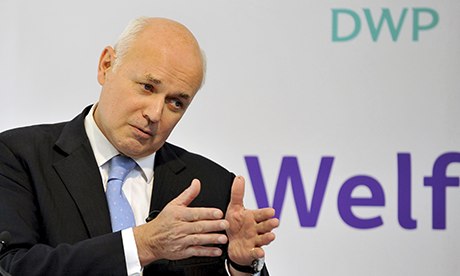
Iain Duncan Smith
Work and pensions secretary Iain Duncan Smith is understood to prefer the plan to improve the existing universal credit system. Photograph: Ian Nicholson/PA

Ministers attempting to put the troubled universal credit welfare reform programme back on track have been presented with a radical plan to restart the scheme and write off £119m of work over the past three years.
The proposals would create a much more web-based system, reducing the need for jobcentre staff, but putting the whole scheme back to "phase one".

The plan is detailed in more than 150 pages of leaked documents that present two options for rescuing the huge project to merge six major benefits and tax credits into one payment. The other plan would attempt to improve the existing system and build on the investment already made. Both plans were drawn up by civil servants at the direction of Department for Work and Pensions ministers.

The documents include a risk assessment of each option, which criticises both plans and warns that a maximum of 25,000 people – just 0.2% of all benefit recipients – will be transferred on to the programme by the next general election, whichever route is taken.

The risk assessment warns that the plan to start again, the "design and build" web-based scheme, is "unproven ... at this scale". It says the plan to fix three years of work on universal credit is still "not achievable within the preferred timescales", describing it as unrealistic.

The scheme has suffered management and computer problems since work began in 2010, causing Iain Duncan Smith, the work and pensions secretary, at the start of the year to push back the timetable for rollout. Labour says the scheme is in "total chaos".

Sources working on the programme say Cabinet Office minister Francis Maude, who is responsible for the government's digital team, is in favour of the fresh web plan. Duncan Smith and his newly appointed project director, Harold Shiplee, are understood to back fixing what has been created over the past three years.

The risk document says that the option to fix the current system is "not endorsed" by the Cabinet Office, which could have "an adverse impact on delivery timescales" in getting government approvals. A source close to Maude insisted there was no division with Duncan Smith, saying they were "working closely and strongly together". A decision is expected by the middle of next month.

Duncan Smith has repeatedly maintained that universal credit will be delivered on time and on budget but, according to sources close to the project, senior civil servants have raised concerns in the past few weeks that the 2017 deadline for getting millions of people on to the programme is now unrealistic because IT systems are not working as expected and design flaws are too numerous.

Last month a damning National Audit Office (NAO) report catalogued failures of leadership and project management and identified £34m in wasted expenditure. The NAO said the project had been beset by poor governance, but ministers said they had already initiated a "reset" and had called in Shiplee, the Olympic project manager, to regain control.

The risk assessment, dated 11 October, says the plan for a faster, more web-based system would involve writing off £119m of previous work, and cost the DWP £96m to develop. However, it warns ministers that they will have no idea if the web-based system will work until the summer of 2014 "when it is live for 100 claimants".

Fixing the existing system would cost £226m, the report says, and the completed design would still be vulnerable to security flaws. While this option offers a chance for reputational recovery, a smaller write-off cost of £21m and less disruption, the report warns it may ultimately not prove value for money. Asked about the findings of the risk report, the DWP said its plans remained on track and would ultimately save the country £38bn.

The shadow work and pensions secretary, Rachel Reeves, said the leaks showed that the "only options on the table involve millions more being committed with no certainty of when or whether this project will ever be properly rolled out".

She added: "At a time when budgets are being cut across government, this is scandalous mismanagement of taxpayers' money. And instead of getting a grip, the government are in complete disarray over what to do about it."

Ministers may order both plans to be pursued at the same time and wait to see what happens after six months.

On Monday universal credit trials were extended to London, with new claimants in Hammersmith shifted on to the programme. Hammersmith is the fifth area to pilot the benefit, which was initially intended to cover the UK by this month.

Though no official figures have been released, there are understood to be several thousand claimants involved in the trials. The department said it was will expand them to Rugby, Inverness, Harrogate, Bath and Shotton by spring 2014.

A DWP spokesman said: "Our work on the development of universal credit is ongoing and, as we said back in July, we will be announcing the next stage of rollout later this year. Our plans for delivery, which will ultimately bring a £38bn benefit to society, remain on track."

Guardian

Survey highlights needs of older workers


Employers are being urged to be more sympathetic to requests for flexible working and annual leave from older members of staff.

With two in five women over the age of 50 also the mothers of school-age children, the Trades Union Congress (TUC) is urging employers to be more sympathetic to requests for flexible working and annual leave from older members of staff – especially during the school holidays.

The TUC survey of older workers – conducted as part of its Age Immaterial campaign which looks at the often ignored needs of the over 50s at work – found that almost three in five (59.4 per cent) have to combine caring responsibilities with their jobs.

While almost half of those with caring responsibilities (48.6 per cent) are looking after elderly parents, almost two in five (38.6 per cent) have children of school age. A fifth of the respondents (20 per cent) are looking after their grandchildren and working.

With much of the government’s and employers’ focus on the childcare needs of parents with pre-school children, the TUC says that employers need to understand that parents’ caring responsibilities do not end the minute their child starts school.

Rather than assume that it is only be staff in their twenties and thirties who need to work flexibly around their childcare needs, employers must also understand that many of their older employees are also juggling work and family commitments. This can become increasingly complicated during the school holidays – especially for single parents – says the TUC.

In addition, there is little support for the parents of teenage children, who often struggle to find appropriate after-school and school holiday care, says the TUC. For many parents, including those who live in rural areas with limited public transport, who work long hours, do unpredictable shifts, or who have disabled children, this can be especially problematic.

Recent research from the Daycare Trust suggests that the average cost of an after-school club is now £49.67 per week across Britain. This would mean a parent with two children in an after-school club for 15 hours per week having an annual bill of nearly £4,000 during term time. Given the rise in living costs and the ongoing squeeze on wages, the cost of after-school care is likely to prevent many parents from working full-time, says the TUC.

The TUC is calling on employers to recognise the needs of older parents – and parents with older children – when considering requests for flexible working or annual leave during the school holidays. It would also like to see a greater commitment from the government to address the patchy provision and spiralling costs of after-school and school holiday care.

TUC General Secretary Frances O’Grady commented: “While most schoolchildren look forward to the holidays and a break from school, the three half-term and the annual Christmas, Easter and summer holidays can be a worrying time for working parents.

“With wages undergoing the sharpest squeeze in a hundred years, the cost of holiday clubs – particularly for families with more than one child – can be beyond the means of many working parents. And while parents might be happy to leave their 14 or 15 year olds home alone for the odd day during this half-term, they will be much more reluctant to do so for their younger children.

“It’s not just younger employees who have childcare responsibilities, and good employers should be aware of the stresses facing working mums and dads of all ages as they fret about what to do with their older children during the holidays, and should be sympathetic to their requests for leave.”

Working Families Chief Executive Sarah Jackson said: “Childcare and flexible working hours are not just concerns for new mothers, and certainly not just for young women. We welcome the TUC’s findings that almost 40 per cent of older workers have dependent children of school age.

“Good employers will recognise the business benefits of retaining the experience and expertise of older men and women and will offer flexibility to allow parents to fill the childcare gaps. But we’d also like to see much more available, affordable childcare in school holidays, including for children with disabilities.”

Source 

Week of Action to Stop Workfare and Sanctions: 2nd – 8th December


Join the week of action to end sanctions and workfare

In January this year, 110,000 people had their benefits stopped – ‘sanctioned’ – in a social security system that now leaves people with nothing for up to three years.

The government has not revealed how many thousands of people have been sanctioned since then, but it looks clear that more than a million people will have faced sanctions - and the hunger, pressure on families and stress they cause - by the end of the year.

Workfare, which forces people to work without pay and pushes those in work out of their jobs, is still the government’s ‘flagship’ solution for the unemployed. Osborne’s latest workfare proposal is more than twice the length of a maximum community service sentence.


But people’s action is pushing back their plans:
  • Wetherspoons, Argos, Shoezone, The Red Cross, and Superdrug have all dropped out since the start of the year. Homebase has scaled back significantly and Homes for Haringey has started paying people.
  • Despite a court ruling, the government is still refusing to publish the list of organisations exploiting people on workfare. It argued “disclosure [of names] would have been likely to have led to the collapse of the MWA [Mandatory Work Activity] scheme”!
  • The government’s plan to send people leaving the Work Programme from June this year on an automatic six month workfare placement could not be rolled out.
  • The government has had to double the amount of money it pays to workfare contractors like Seetec to find Mandatory Work Activity placements because they say it’s got so difficult since organisations started pulling out.
 This is your actions making a real difference.


The chances are you probably know someone who has faced the hardship and stress of sanctions – which means you’ll know that these devastating decisions are handed out for the pettiest of reasons.

It’s time to take action, and to push back against sanctions as we have against workfare. Whether you’re on your own or in a group, take part in the week of action
And let us know what you plan so we can help spread the word!

Boycott Workfare

Nihilism isn’t cool, trendy or the path to Nirvana: it’s a lazy abstention from all that matters.

Reblogged from kittysjones:

1209102_539900659412800_1664499134_n
nihilismˈ
noun
1.
the rejection of all political, religious and moral principles, often in the belief that life is meaningless. “Insistence that man is a futile being”
synonyms: negativity, cynicism, pessimism; rejection, repudiation, renunciation, denial, abnegation; disbelief, non-belief, unbelief, scepticism, lack of conviction, absence of moral values, agnosticism, atheism, non-theism.
NO PRINCIPLES.
The road to nowhere, dissolution.
In short, it’s the absence of belief in anything meaningful, positive, celebratory or decent. No acknowledgement of our remarkable potential as human beings. No faith in anything – its grubby, and leaves you groundless, rootless, and in a no-place, with no escape.
Russell Brand is a “trendy” nihilist.
However, this is not simply another article about Brand, but rather, I want to use this as an opportunity for discussing critical thinking. Brand is as good a case as any to use to explore this and propaganda techniques.
My friend, Charles Britton, commented on an article I wrote about the Russell Brand interview with Jeremy Paxman, and it’s a brilliant comment, because it shows a step-by-step process of critical thinking and analysis that exposes something that many seem to have have missed: an absence. A void. Brand used a lot of words that say nothing at all. Here is the comment:
“When I saw the argument between Russell Brand and Paxman, there were things he said that were clever, and which I liked and there seemed to be a real passion.
Apart from the not voting, I thought, I couldn’t agree with that.
And apart from the revolution idea because a) they are bloody, b) you don’t know who’ll you’ll end up with in charge (you may even lose the vote), and c) we do have the vote.
If there were enough of a groundswell of anger about how we are being treated to spark a revolution, then it would show in how people voted (and how we campaigned). We’d vote out the bastards without needing a revolution!
(I’m fairly certain that if people can’t be bothered voting, they won’t be bringing on a full-blown revolution any time soon either. Anyone out there got one booked? Please do pencil me in.)
I still liked some other things he said. Apart from the implication that the parties are all the same. That’s the kind of thing you hear from most of the ”cutting-edge” (aggressive and politically ignorant) stand-ups on TV panel shows and celebs guesting on Question Time.

Sadly, this blanket cynicism 
tends to win-over the politically illiterate of the crowd.
Eventually I realised that there wasn’t really anything much in his statements apart from a certain  confident, [apparently] eloquent style.
I’m left confused by this, wondering why his Newsnight interview was so “sensational”!
scroll2
I have also pondered why Brand has such undeserved attention at the moment, and why some seem to think he had something to say, I clearly missed something, so I studied his interview with Paxman carefully.
One thing that really struck me is that Brand completely failed to recognise and acknowledge that it wasn’t the same under the last government. We didn’t have austerity, there were not thousands of sick and disabled people dying, and there was no substantial increase of absolute poverty and wealth inequalities under the Labour government, because of their policies, but these things are happening now. Labour  created human rights and equality policies, and the Tories are steadily unravelling those. Only the wealthy and the indifferent nihilists can afford indifference regarding the fundamental contrasts of Labour and Conservative governments.
Brand’s self-serving claim that “they are all the same” only echoes what many of the most disruptive, aggressive and very divisive anarchists, militant greens, narxists and trotskyites have been using to misinform anyone who will listen. But a look at the differences in policies shows clearly that there are fundamental differences between the Conservatives and Labour. (For example, See here: Political Parties – NOT all as bad as each other).
So why would Brand or anyone else, for that matter, offer such a dangerous idea up – that voting is futile – especially when the consequence is likely to be further divisions amongst those on the left, whilst the right-wing supporters, who ALWAYS vote, will simply ensure we have another Tory government in office in 2015? How will that help the situation Brand outlined and criticised? And why is it ever okay to advocate no action? How about encouraging people to take some responsibility for how things are, and to work together to change things for the better?
I’ve written elsewhere about Brand’s narcissism and a fundamental lack of concern for others. As empathy, emotional sustenance and support, solidarity, loyalty, and a sense of belonging all become relics of a fast receding past due to the policies of the Tory-led Government, which act upon citizens as if they were objects, rather than serving them, as human subjects, the mass victims of anomic trauma put up as primitive, last resort narcissistic defences. These, in turn, only exacerbate the very traumatic conditions, social dislocations, and experiences that necessitated their deployment in the first place. But our ability to organise, self-assemble, and act in co-operation and unison is in jeopardy, as is our future as a society, yet Brand advocated no action.

He also used propaganda techniques in his interview with Paxman that signpost people to a variety of typified meanings, without actually meaningfully exploring any of them, using superficial Buzzwords (and phrases,) and Glittering Generalities.
The narrative isn’t coherent and meaningful, has no real depth, but what Brand does very well is implies – “signposts” you – via common stock phrases, creating the impression he understands and sees the world as you do. He creates a faux sense of rapport by doing so.
But if you look elsewhere, the clues about Brand are there, in his books, articles and  other interviews. It soon becomes clear that he does not connect with people, he doesn’t seem to relate. He generally seems to others as a means to his own ends, and tends to exploit them. Those that that have a joke at the expense of others have little empathy, and tend to be unsurprisingly exploitative and cruel. That’s all Brand does, and even in the interview with Paxman, when he was asked something he couldn’t answer, he resorted to talking the piss out of Paxman.
It’s worth bearing in mind that when someone speaks or writes, they are trying to convince you of something. Ask yourself what it is that they want you to believe, then analyse their basic proposition carefully. Examine what they are saying, look for consistency, coherence, reasoning and logic, and look for the evidence to support the proposition. Analyse what he actually said – there is NO proposition there at all, he used a lot of words to say nothing – it really is a cul-de-sac.
Buzzwords and phrases are a propaganda technique to shape people’s perception, and persuade them that you “know” about their lives, situation and that you have insight. Management jargon is an example – the familiarity of the words and phrases lulls you and fools you into feeling some important recognition has been made.
Here are some of the buzzwords and phrases Brand used to get your attention, gain your credibility, admiration, create a false sense of rapport; people, power, hierarchical, paradigm, serves a few people, humanity, alternate, alternate political systems, destroy the planet, economic disparity, needs of the people, treachery, deceit, political class, disenfranchised, disillusioned, despondent, underclass, represented, social conditions, undeserved underclass, impact, but that’s all just semantics really, political or corporate elites, serve the population, currently, public dissatisfaction
Glittering Generalities is a propaganda technique, arises very often in politics and political propaganda. Glittering generalities are words that have different positive meaning for individual subjects, but are linked to highly valued concepts. When these words are used, they demand approval without thinking, simply because such an important concept is involved.
Brand made use of these Glittering Generalities; socialist, egalitarian, massive redistribution of wealth, heavy taxation of corporations, massive responsibility for energy companies, environment, profit is a filthy word, global utopian system, genuine option (amongst several others).
The whole dialogue is a propaganda vehicle that aims to deliver one message: there’s no point voting. Go back to sleep.
There are darker fifth column ideologies of nihilism and anarchism which have continued to gain popularity among some of the left wing. Such anti-values of hopelessness and rejection of organised government are a toxic brew for a nation that desperately needs to rekindle respect for humanity, human rights, equality, and shared societal values of compassion, hope and community. Nihilism attacks the very worth of humanity itself – because it’s based on the view that “nothing really matters, nothing has worth or meaning”.
There is a link with nihilism, and the egocentricity of psychopathy. First of all, psychopaths may be regarded as moral nihilists. Secondly, psychopaths like an apathetic, disengaged society, where citizens lack conviction, and there’s an absence of moral values. Psychopaths regard the rest of us as defective, and seek relentlessly to remake the world in their own image, to proselytize their viewpoint and  to “teach” their “defective” empathic fellows to think like them.
Unfortunately, they can. A psychopath can never learn to think like an empathic person. But people with a normal capacity for empathy can turn off that capacity and think like psychopaths. Language is a powerful thing, and normal human beings need linguistic cues to switch to “psychopathy mode”.
The ancient Greeks and the Founders of our country understood the devastating destructiveness of the language of demonising hate, particularly to democracies. They called the charismatic psychopaths who excelled at its practice “demagogues.” More recently, neuroscience has provided evidence that such demonising and hate radically alters the way the human brain processes information, making subjects immune to reason, increasingly intolerant, and very easily manipulated.
Divide and conquer is the Tory way.
By now, I am sure the link between nihilism, psychopathy and conservative ideology will be apparent to most reading this. Research has found significant correlations between key antisocial personality traits and bedrock conservative views. Specifically, the research claims to find elements of narcissism, psychopathy and Machiavellianism in conservative subjects. The conservative ideological justification for the destruction of the social unit, promotion of competitive individualism and “survival of the fittest” principles, the shrinking of the State and deliberate destruction of public belief in government overall is psychopathic.
By focusing on individualism as the primary method of improving the economy and society, conservatism is an inherently misanthropic ideology; as all motives are seen through pure self-interest, cynicism in human nature becomes the norm. If people exist to simply get what they can for themselves, the motivation for sociability and co-operation decreases. We become insular, fragmented.
The characteristic of the psychopathic value system is its somewhat Manichean world view  - idealised me  versus demonised him, idealised us  versus demonised them, reflecting the echo-other world view of the pathological narcissist or psychopath. The Tories deliberately create anxiety about others, divide social groups, reduce social cohesion, and create folk devils to bear the brunt of the blame for consequences of Tory policies. By no coincidence at all, those folk devils also bear the brunt of inhumane Tory policies, too. The Labour government didn’t get everything right for everyone, but Labour have never persecuted social groups like the Tories have, or wilfully destroyed state support for the most vulnerable citizens.
If we don’t vote, then that leaves the Tory supporters, who will simply vote the Tory authoritarians back into Office, and guess what? That doesn’t affect Brand at all. Well, except the standard £107, 000 that all millionaires get under this Government, each, per year, in the form of a tax break.
We can politically engage, campaign, lobby politicians, and take some responsibility, rather than shrugging, disengaging, and ensuring that nothing will change. Authoritarian governments require a passive, disengaged public to emerge and to maintain their power. We have a duty to challenge and to push back – to demand positive changes and shape a society that supports those that cannot support themselves, that’s the mark of a civilised society. We simply have to fight our way back to decency. We have to reclaim the progress we once made in an evolved human rights orientated culture. The Tories have undone many decades of hard work and struggle to establish those rights. We have to act, and we must vote. Vote Labour.
scroll2
This is also worth reading: “They are not all the same. ‘They’re all the same’ is what reactionaries love to hear. It leaves the status quo serenely untroubled, it cedes the floor to the easy answers of Ukip and the Daily Mail. No, if you want to be a nuisance to the people whom you most detest in public life, vote. And vote Labour.”   Robert Webb - http://www.newstatesman.com/politics/2013/10/robert-webb-re-joins-labour-protest-russell-brand
226786_150917841725939_960158327_n                 Thanks to Robert Livingstone for his brilliant artwork


Back to work schemes legally flawed: video & transcript on decision and repayment aims

Reblogged from Kate Belgrave:

Video from outside the Supreme Court where five justices found that government “back to work” schemes were legally flawed.


Have put a full transcript of Tessa Gregory’s speech below as it appears in the video – in it, she details plans to pursue repayments for sanctions.

“We’re delighted that the Supreme Court has unanimously dismissed the government’s appeal and confirmed that the regulations under which most of the back to work schemes were initially created were unlawful. The court upheld the findings that Iain Duncan Smith acted beyond the powers given to him by parliament by failing to provide any detail about various schemes in the regulations and in any event, the required notice provisions have not been complied with.

Shortly after lodging his appeal, Iain Duncan Smith rushed emergency legislation through parliament which retrospectively amended the law. This effectively overturned the court of appeal’s judgement and shamefully rendered much of its own appeal proceedings academic.

Indeed the Supreme Court was moved to note that the government has rather unattractively taken up court time and public money seeking to establish something that it had already sought a rememdy for in parliament.

We have already issued judicial review proceedings challenging the validity of that retrospective legislation which following today, we will seek to extradite.

It is also though important to note that the judgement has real practical implications.

In addressing one of our arguments, the court found for the first time that the government has a duty as a matter of fairness to provide from the outset enough information for jobseekers about a given scheme to enable them to make informed and meaningful representations.

A failure to provide that informtion is likely to make it unlawful for the DWP to require people to participate on a given scheme, or to dock their benefits if they fail to do so. The court found that on the facts of this case, the secretary of state did not provide our clients with adequate information. For Jamie Wilson, who was stripped of his benefits for six months, that means that notwithstanding the restrospective legislation, we will now seek repayment of his benefits on that basis. We know that like Jamie and Cait, hundreds and thousands of other jobseekers have not been and continue not to be provided with information about the dizzying array of schemes. Following today’s judgement, any such jobseekers can object to sanctions that have been imposed and seek repayment of their benefits. It is staggering that Iain Duncan Smith has found himself in this position even after fast-tracking emergency restrospective legislation through parliament specifically designed to prevent repayment of benefits.

We intend to work with advice organsations to ensure that following this ruling, affected individuals have the right information and assistance. This case has expsoed an utterly shambolic system, where individuals are routinely being stripped of their subsistence level benefits after receiving inadequte and inaccurate information. Iain Duncan Smith has sought to brand our clients as job snobs. In reality, all they have been seeking is a system that is fair and transparent.”

Keep up campaign to end workfare after Supreme Court rules scheme unlawful – unions


Job Centre cropped

Campaigners have welcomed a Supreme Court ruling that the government’s back-to-work scheme was legally flawed.

Work and Pensions Secretary Iain Duncan Smith failed in a bid to overturn an earlier ruling that the regulations underpinning the programmes, making jobseekers work unpaid in certain circumstances, were not valid.

Cait Reilly, from Birmingham, challenged a requirement under the scheme that she should work for free at a Poundland store to receive jobseeker’s allowance.

She had to give up voluntary work at a local museum in November 2011 to stack shelves and clean floors at the store after being told she would lose her allowance if she failed to carry out the work placement.

HGV driver Jamie Wilson, from Nottingham, who is a qualified mechanic, was also involved in the legal action after he objected to doing unpaid work cleaning furniture and lost his jobseeker’s allowance for six months as a result.

Cait Reilly said: “I am really pleased with today’s judgment, which I hope will serve to improve the current system and assist jobseekers who have been unfairly stripped of their benefits.”

Despite criticism from groups such as the Right to Work campaign that the schemes constituted “slave labour”, the Supreme Court ruled that they did not constitute forced or compulsory work.

TUC general secretary Frances O’Grady said:“The government say they want to make work pay. But this kind of scheme is work with no pay, and employers can use it to replace paid staff with free labour.

“Sacking paid staff and replacing them with unpaid conscripts is the opposite of making work pay.

“Instead we need policies that create real jobs such as a jobs guarantee for the long-term unemployed and young people.

“Ministers must stop treating hardworking people who lose their jobs through no fault of their own as if they are all potential benefit cheats.”

Lawyers said unemployed people who had lost their jobseeker’s allowance for not complying with the schemes – dubbed “workfare” by campaigners – should be able to reclaim the money.

The PCS welcomed the decision by the three judges, but said it is disappointing they ruled the government’s workfare schemes do not constitute “forced or compulsory labour” under the European Convention on Human Rights.

PCS general secretary Mark Serwotka said: “While ministers disgracefully changed the law to over-ride the original court ruling, this decision confirms their schemes were unlawful but shows we need to keep up the pressure to end workfare.

“Jobcentre staff do not go to work to be in conflict with the people they are there to help, and we believe workfare schemes are exploitative and counter-productive and should be scrapped.”

The schemes are seen as a key element of the Coalition’s plans to get people back into work, with unemployment at 7.7% in the three months to July.

DWP issues ‘urgent bulletin’ about bedroom tax tribunal decisions

The Department for Work and Pensions has issued an ‘urgent bulletin’ calling on councils to notify it about any tribunal decisions relating to the bedroom tax.

In a sign the DWP is growing increasingly concerned about tribunals upholding tenant appeals, the department has today issued a request for information. It says this is needed as the DWP may appeal against decisions even if councils have chosen not to.

The document said: ‘The DWP needs to get a clearer picture of the number of first tier tribunal decisions where the removal of the spare room subsidy is the main issue.

‘Local authorities are therefore asked to notify DWP of all first-tier tribunal decisions relating to this subject regardless of whether the decision is overturned or whether you intend to appeal adverse decisions.’

Where a tribunal has upheld a tenant’s appeal against a bedroom tax decision, the DWP is asking councils if they plan to appeal the decision or not.

Under the bedroom tax, social tenants of working age have their benefit deducted if they are deemed to have spare bedrooms. The DWP has purposely not defined a bedroom and said it is up to landlords to ‘describe the property in line with the actual rent charged.’ This has led councils to award benefit using information provided by housing associations.

However, a series of tribunal rulings, including four in Fife, Scotland, found councils have incorrectly applied the bedroom tax using information from landlords.

Tribunals have taken matters such as room size and use into account to decide rooms have incorrectly been classed as bedrooms. The rulings do not set a legal precedent, but if an appeal goes to the upper tribunal it does.

Source

Up to the Job?: BBC File on 4 examines the Work Programme

8pm Guy Fawkes night Radio 4

The Work Programme is the Government's flagship scheme designed to help the long term unemployed off benefits and into lasting jobs. But how well is it working - both for those at whom it is aimed and for the private companies who are paid to deliver it?

Official figures paint a patchy picture and some companies have already been sanctioned for not meeting targets. Their record has been particularly poor for claimants whose illness or disability makes it hard to find a job.

Despite this, the Chancellor recently announced an addition to the scheme - called Help to Work - which places new demands on those the Work Programme has failed to move into employment.

But, with the economy still struggling in many areas, is it asking too much? Gerry Northam investigates.

bbc