Forget second hand furniture – the British Heart Foundation is the place to go if you want to understand the reality of workfare. I popped along to my local store this afternoon in the hope of speaking with someone about their experience of workfare. The policy director of the BHF had announced that every store had people on work placements from the government’s various schemes and so this seemed like a good place to start. Speaking with the manager, she looked around the room and counted those on Mandatory Work Activity, ‘1,2,3,4,5,6,7,8 today’ she informed me, adding ‘we do have pure volunteers as well’. I certainly had come to the right place to witness workfare at work. Three men were at the back of the room hammering at a wardrobe, a young woman was answering the phone and arranging for donations to be collected by the van, another woman was sticking price tags on sofas – all of these people were here because, as one of them put it, ‘there is no choice’, if they refused they would lose their benefits.
Before I could even ask a question, the young woman at the desk hearing why I was there, said quietly and emphatically ‘it’s not nice here, it’s not nice here’. She went on to tell me that she had a qualification in retail and so ‘it’s not benefiting me at all’. She wanted to work with animals but had been told by her job centre advisor that they would not help her in pursing this interest, instead she’s found herself stuck here for a month. I mentioned to her that Boycott Workfare were protesting against BHF’s involvement in workfare this weekend and she became very excited ‘come here and protest when we’re here! That would be so fun!’
I went over to the three men who were fixing a broken wardrobe. ‘It’s a punishment’ one of the men told me as he hammered a nail into the wardrobe ‘it’s nothing to do with work experience, if you miss a day your benefits are stopped, it’s about stopping people from claiming benefits…Yes, I really appreciate this work experience, the 13 years of work I’ve done managing clubs in London really wasn’t enough’ he says good naturedly. ‘It’s a punishment because you are in the same boat as a probation person’, he turns to the man who is hammering the wardrobe with him who is there on probation ‘no offence’ he says. ‘I’m unemployed and he’s a criminal’.
I speak with a black woman who tells me workfare makes her feel ‘mad…it’s absolutely slave labour – absolutely – it’s the 21st century. They took me out of slavery and put me back in slavery.’
Charities are the new face of workfare with politicians stressing the words ‘community benefit’ in order to make workfare seem more acceptable and friendly as they attempt to expand it on an incredible scale. But as is clear from the people I spoke with whoever workfare is for, it is a punitive, degrading, and exploitative practice.
This Saturday join Boycott Workfare’s UK-wide day of action against charity involvement in workfare.
The London action will be meeting at 11.30am outside Nat West which is opposite Camden town station and will take a tour taking in the charities involved in workfare on the high street.
Source
Thursday, September 6, 2012
Thursday, August 30, 2012
Austerity by way of the Colonies: Workfare in the UK
The taxi took an alternate route to the airport that day, the day before the Queen’s Jubilee parade, to avoid the very early morning rehearsals of military personnel, horses, and others involved in orchestrating the impending celebrations. Arriving at my destination 22 hours later, in a time zone 13 hours behind GMT, I went to the Guardian website and saw the headline “Unemployed Bussed in to Steward River Pageant”. Had the jetlag affected my cognitive capacities, or had the government actually forced the unemployed poor to sleep under bridges and to work, for no pay, for the celebration of the 50th year of the Queen’s sovereign reign? This seemed more feudal than Dickensian. The ferocity of Tory austerity measures had forced citizen into the role of humble subject in the most abject, if not derisible manner imaginable.
As I de-planed at Heathrow some time later, attempting to ignore the ever more perverse HSBC ads that line the jet bridge (the ‘where you see global destruction, we see a new market’ variety now being replaced by ever more absurd and delirious capitalist fantasies such as ‘one day we will all fly organic’) an article in the FT was brought into my view: the High Court had ruled that the workfare scheme was not in violation of the Article 4 rights of Ms. Reilly and Mr. Wilson.
Ms. Reilly and Mr. Wilson had sought judicial review of the Jobseeker’s Allowance (Employment and Enterprise) Regulations 2011, and more specifically, the SBWA (Sector-based Work Academies) and CAP (Community Action Programme) programmes, alleging that these two workfare schemes were ultra vires on a number of grounds, and that in addition, the schemes violated their Article 4 rights under the ECHR.
How is it that compulsory, unpaid labour in order to receive an unemployment benefit does not constitute a violation of Article 4 of the European Convention on Human Rights? Mr. Justice Foskett of the High Court found the following with regard to the Article 4 claim:
“For my part, I do not see any material distinction in principle between Van der Mussele in terms of the matters considered in that case by the Court to render the requirement on the applicant lawful and the schemes or programmes under challenge in the present case: each can be seen as a step towards obtaining eventual employment for the person concerned. But whether that assessment is correct or not, it does have to be said that the sbwa scheme, and indeed the CAP, are a very long way removed from the kind of colonial exploitation of labour that led to the formulation of Article 4. The Convention is, of course, a living instrument, capable of development to meet modern conditions, and views may reasonably differ about the merits of a scheme that requires individuals to ‘work for their benefits’ as a means of assisting them back into the workplace. However, characterising such a scheme as involving or being analogous to ‘slavery’ or ‘forced labour’ seems to me to be a long way from contemporary thinking.” (para 174)
It is interesting, as Rahul Rao notes in a recent blogpost on the Olympic narrative of Great Britain’s historical achievements, to see where and when colonialism is remembered and where it is forgotten. Legal judgments are of course, an enterprising genre for those interested in texts about national identity. This fairly complex judgment is compelling for a number of reasons, but here I want to note how the brief reference to colonialism reveals a moment in which the colonial is made to stand in as a referent against which contemporary British policies and in this case, workfare schemes, are measured. The judgment also reveals a bewildering attachment to a vision of the British state in which the private and public spheres are distinct; so separate in fact, that compulsory labour at the behest of the State, for the benefit of the private sector seems to cast this labour outside of what is currently cognisable by the judge as forced or compulsory labour under Article 4 of the European Convention on Human Rights. Let’s break it down a bit.
Van der Mussele involved a trainee barrister who alleged that compulsory pro bono work violated his Article 4 right. (Yes, the word chutzpah came to my mind too, but putting aside criticisms about the rather wide range of uses to which the ECHR has been put, it is a very interesting read.) The Ordres des avocats in Belgium had rules whereby trainee lawyers would be assigned cases to represent indigent litigants on a pro bono basis. Sometimes, the cases would continue after the pupillage had ended, which was the situation in this instance. The European Court of Human Rights found that no violation of Mr. Van Der Mussele’s Article 4 right had occurred. The Court laid out 2 conditions that must be satisfied in order for an Article 4 claim to be satisfied: 1). The labour must be “performed by the person against his or her will, but either the obligation to carry it out must be ‘unjust’ or ‘oppressive’ or its performance must constitute an ‘unavoidable hardship’, in other words be ‘needlessly distressing’ or ‘somewhat harassing’” (Van der Mussele, para 37). In this case, the Court held that neither of these conditions had been satisfied.
Significantly however, they did find that Mr. Van der Mussele’s consent to perform pro bono work at an earlier stage, upon entering his pupillage three years prior, did not mean that he had consented to each and every assignment of pro bono work subsequent to that (para 36). More broadly, the issue of consent is central to, although not determinative of the claim of forced or compulsory labour. Interestingly, the 29th Report of The House of Lords Select Committee on the Merits of Statutory Instruments considered the workfare Regulations. As noted by Mr. Justice Foskett, the Committee wrote the following in relation to the Explanatory Memorandum provided by the DWP:
“The [Explanatory Memorandum] states that participation in certain elements, for example the Service Academies, is to be by mutual consent, but this does not appear to be borne out by the legislation. DWP explain that ‘this aspect of support and conditionality for customers is not reflected directly in these Regulations because it applies before a Jobseeker’s Allowance recipient is referred to any of the initiatives covered by the Scheme’ (Q7). It is not clear what provision there is to prevent a harsher system being implemented administratively at a later date.”
In this case, the CAP scheme, aimed at the long-term unemployed, is mandatory. The SBWA scheme is voluntary, however, Ms. Reilly was told by her Job Centre Plus Advisor that working at Poundland was mandatory. The sanction in both instances is a loss of benefits.
Putting the questions of voluntariness and consent aside, let’s look at the two reasons for Mr. Justice Foskett’s conclusion that Ms. Reilly’s Article 4 right had not been violated. Unlike Mr. Van der Mussele, it really stretches any reasonable and credible understanding of the nature of her unpaid labour at Poundland to find that this was aiding her in finding employment. Ms. Reilly, a graduate in geology, had made it quite clear that her aspirations lie in working in the Museum sector. Furthermore, and it may seem quite obvious to many people, but there are compelling and persuasive arguments that workfare schemes do not actually assist in getting people back into paid work. The Court seems to have missed an opportunity to evaluate the validity of the workfare schemes as to whether they actually do fulfil this legislative objective.
And to the second basis of the Court’s conclusion: of course a workfare scheme is not the same as slavery. Of course workfare is not the same as indentured labour, or multiple other forms of forced labour that millions endured during colonial rule all over the globe. But how curious it is to import into contemporary human rights jurisprudence colonial slavery as the standard against which any claims to forced or compulsory labour are measured. Engaging in what one might call a peculiar sort of relativism, it becomes impossible to imagine conditions under which a claimant might be successful in an Article 4 claim against the State.
Let’s engage in some speculation. It seems as though there might be two forms of bifurcation at play here, one is the spectre of the racial and its association with ideas of enslavement and free labour. Is unfree, forced or compulsory labour something that can only, in a colonial or imperial imaginary, be associated with black bodies, or alternately, the body of the trafficked woman forced into prostitution? Modern day anti-slavery campaigners focus for the most part on the situation of women (and children) who are trafficked into prostitution or domestic slavery. Successful Article 4 claims have been brought by a Togolese woman who was forced to work for no pay for several years in a household; and a Russian woman forced into prostitution in Cyprus. The latter category, constituted by a particular liberal vision of the powerless victim par excellence, (see Juliette Hua’s excellent work on this topic) also involves a particular kind of racialization of Central and Eastern Europe women. In a colonial, progressivist understanding of history, white indentured labour to the Americas is far in the past, and slavery and conditions of forced labour, and perhaps, simply being in a state of unfreedom is an unfortunate affliction that marks the lives of the ‘global’ poor; but apparently, not the unemployed and poor in the U.K.
The second dichotomy at play reflects a refusal to account for the nexus between public and private spheres. The government has not only dramatically pushed New Labour’s privatisation of basic social welfare provision and education agenda along way forward, but through workfare schemes, provides the private sector with free labour, which despite the radical difference in political configuration, seems somewhat similar in form and effect to an imperial authority forcing people to work for the benefit of private industry.
To add another interesting wrinkle to this tale of exploitation under austerity is the fact that some of the beneficiaries of the workfare scheme are charities, private organisations that are, in what appears as a throwback to the 18th and 19th centuries, increasingly providing social welfare services that are no longer provided for by the state. At the same time, charitable status is benefitting various organisations, such as fee paying independent schools, in ways that are problematic to say the least. The Upper Tribunal decision in AG v The Charities Commission for England and Wales, and the Independent Schools Council of October 2011, which held that fee paying independent schools can have charitable status even though students who cannot afford the fees are clearly precluded from benefitting from all that these schools offer, led to a redefinition of what constitutes a ‘public benefit’ in relation to fee paying charities. In a move that seems to run counter to an increasing reliance on charities to provide social welfare and to run programmes such as the workfare schemes, the Tories have attempted to cap tax relief on charitable donations by rich people, leading W.G. Runciman to conclude, quite simply, that charity law is a mess.
The claims by both Mr. Wilson and Ms. Reilly bring before the court the justness of a workfare scheme that forces thousands of benefit recipients to work for free on penalty of losing their benefits. With housing and disability benefits, legal aid, and a range of other social welfare provisions having been savaged by a government that has also cut thousands of public sector jobs, a sound analysis of the legality of the workfare schemes requires a contextualised analysis of contemporary conditions, not those of the early 20th or late 19th centuries, even though for those benefit recipients who slept under the bridge on the eve of the jubilee celebrations, one might be forgiven for thinking they had somehow slipped far into a past era.
Brenna Bhandar is Lecturer in Law, Queen Mary, University of London.

Sunday, August 26, 2012
Dad committed suicide after housing benefit cut…
A desperate man who lined up three kitchen knives before stabbing himself twice in the heart, blamed cuts in housing benefit.
Unemployed Richard Sanderson took his own life after writing three suicide notes which were laid out neatly on a bed in a meticulously planned act.
In one to his wife he wrote: “Don’t come into the bathroom, this time I will most certainly be deceased”.
Mr Sanderson, who said he could not face the thought of his family being homeless, stabbed himself twice in the heart with a kitchen knife on May 29 at home in Augustus Road, Southfields, after years of being unable to find work finally took its toll, an inquest heard.
The 44-year-old former helicopter pilot wrote three suicide notes – two for his wife, Petra, and one for the police – after carefully planning the suicide over several days.
This followed a failed attempt less than a year earlier.
Coroner: Man ordered by Job Centre to give up training course
After returning a verdict of suicide at Westminster Coroner’s Court on Tuesday, August 23, Dr Fiona Wilcox said: “What I find particularly tragic in this case is this act appears to be pursued by a man who was not suffering from an illness and appears to have made a considered act in response to his inability to find employment.
“The fact his housing benefit was about to be cut and the family would be at risk of having nowhere to live, and being ordered to give up his training course because of the Job Centre’s rules, would appear to be especially poignant and tragic.”
In February, Merton Council estimated up to 3,000 residents would be made poorer by the coalition Government’s policy of cutting housing benefits, which will decrease by between £5 and £400 a week from November, depending on the size of the property.
“80,000 Londoners at risk of eviction”
Annys Darkwa, who runs St Helier-based Vision Housing and helps find homes in Merton for ex-offenders, said tragic cases like this would become more frequent in the coming months because housing benefit cuts would hit the most vulnerable the hardest.
Mrs Darkwa said: “We are going to see this happen more and more as we expect 80,000 people across London to be evicted due to housing benefit cuts.
“It is especially concerning in Merton where mental health provision has disappeared. What’s going to happen to people who think they’re all alone and commit suicide because they think there’s no one to help them?”
Mr Sanderson, who was also a window cleaner, met his wife while travelling in South Africa in 1995 before the pair eventually settled in Wimbledon in 2007 to find better work prospects in London.
Widow: Council cut our housing benefit by £30 a week
Mrs Sanderson got a job but was made redundant in 2009, while Mr Sanderson constantly struggled to find work and was unable to complete training as an electrician because the job centre would not continue to pay his benefit because his training stopped him from being available for job interviews.
He tried to commit suicide the first time in June 2010 by crushing up 150 tranquiliser pills which he swallowed with a glass of whisky.
He was found at home unconscious but still alive by his wife.
Mrs Sanderson, who did not attend the inquest because she thought it would be too upsetting, gave a statement to police in which she explained the first suicide bid was done so she and their nine-year-old son could benefit from a life insurance policy payout worth 2.5m South African Rand (about £210,000), which she soon cancelled after the suicide attempt.
A psychological report by Dr Joanne Turner, who examined Mr Sanderson at St George’s Hospital, said he did not exhibit any signs of mental illness or depression and claimed to be “embarrassed” by his suicide bid.
But in her statement, Mrs Sanderson revealed: “In March or April [2011] we received a letter from [Wandsworth] Council which said our housing benefit would decrease by £30 a week, forcing us to move but leaving us with nowhere to go.”
“Despite this, I hadn’t noticed any major change in Richard’s mood. I don’t know why he killed himself. We had planned to go to Wimbledon Common the next day.”
Wednesday, August 22, 2012
UK coalition’s real agenda : Behaviour change to suit policy: House of Lords [reblogged]
Silver tongued programme for the slave mentality

In all cases brought before the court, evidence is the key.
Blinded as we are to the insidious moves made by successive governments in finance, as they shift the countries revenue collection from income tax to service tax, and Value Added tax (VAT), they must also do something about the way in which we the masses, understand what is happening without understanding what is happening.
I know frustrating is it not, but of course that is the nature of the game called politics.
In 2011 a meeting was had in which a dark doctrine from an equally dark cult was discussed and rubber stamped for the full term of this three party coalition, I mean, when you have Tony Blair back as the Olympic legacy don,[1] and Nick Clegg, the occult arm to this coven of deceivers, claim, he was ready to enter talks for a possible coalition with the Old New Labour under Ed Miliband at the next general election.[2] Blighty we have a problem?
The Science and Technology Select Committee met to give life to a policy of Behaviour Change, for the population and the civil service, and through education direct to the children. If we take Lord Adonis as an example, former director of the Institute for Government[3] that have big plans for allowing Academies to become boarding schools, we can’t go wrong. Such an agenda has even more sinister harmonics when we consider the Olympic push to pick your children off the street, taken to what they call ‘a place of safety’, to be returned once the parents have satisfied corporate psychiatrist’s and corporate social workers they are indeed as insane as they are.[4] Academies are to be used as such places of safety which will open the doors to child removal in order the Academy can demand a huge tariff charge off the taxpayer to board the child until the psychiatrist’s release the child.
The expanding use of psychiatry in the corporate system takes on a whole new meaning when we consider the elite of this craft are lobbying to legalise paedophilia, begging the question what kind of mind does one have to be, to be classified as normal to a psychiatrist?[5]
Using the Olympics to make that behavioral change with the aim of forming a fitter nation, specifically with the children, it appears this coalition government backed by the House of Lords, are implementing the same programme as that under Hitler and the Third Reich and his gymnasium programme. They called it Eugenics in order they could form their idea of the Aryan master race by changing the behaviour of the entire population to mimic the traits of the master race. With a population on its knees after the war reparations, a position we are heading to suffer with the current batch of blithering financial experts Inc, holding the fort, begs another question; to what end is this readiness for war moving?…Erm…war.
Externalising the hierarchy and its methods appears to be the time-frame we experience today, with the elites presenting what was a secret control mechanism, into the open in order they can gain statutory consent for that control mechanism, without giving the population the real facts until the consent is gained. This is how the dictatorship is to be formed through consent. In the conclusion document at the bottom of this report, it would appear they have all the consent they require through various licensing and school statute demands, already in the bag, as they decide to hell with the need for consenting taxpayers to the whims and willies of the Institute for Government, they will intervene and change policy without the taxpayers even being aware of the fact.
To position the populations in the trance like state, required in order they do not fully grasp the contract on offer, a contract pushed with menace, is to first educate them below the level of comprehension apportioned to the world of the solicitor, the lawyer, both dealing almost entirely in statutory rules of commerce while claiming them to be law, and we fall for it.
In that context the game is rigged from the start and the reason for the use of behavioral strategies to allow the deception to operate uninterrupted. They have achieved this in these times by programming adults back to the school mentality, whereby they obey instruction without question, speak to any head teacher, and teachers today, and witness the childlike attitude coming back at you, the same in the civil service, specifically the Jobcentres, more so in their sub contractor operations carrying out the work programme mind job, which have the feel of a pre-school mentality.
Openly today proved in the document from the House of Lords, we can see how the corridors of real power play the masses like sheep… because the people act like sheep.
As with a court of law let us get to the evidence, the introduction to the document states :
“The Government welcomes this timely exploration by the House of Lords Science and Technology Select Committee into the use of behaviour change interventions to achieve policy goals.”
The Coalition’s Programme for Government rejects “the assumption that central government can only change people’s behaviour through rules and regulations” and promises that “our government will be a much smarter one, shunning the bureaucratic levers of the past and finding intelligent ways to encourage support and enable people to make better choices for themselves.”
Shunning the bureaucratic levers of the past, means further shunning our constitutional civil system, the use of the term ‘smarter one’ and intelligent, has to coincide with the rise and huge expansion of intelligence agencies. Better choices for themselves has to coincide with the deceptive nature of statute rules, deceptive in the first instance in that they present themselves as law. A statute is never law, it is a contract containing the rule that enforcement of its agreed terms can be enforced ‘as if the power of law’, and contracts have to be consensual.
Under the heading of Government Activities they state :
“Behaviour change theories can help us to understand why individuals behave the way they do. They can also help policy makers frame choices for individuals in order to ‘nudge’ them into behaving differently and regulating their own activities.”
They then cite particular organisations and publications the coalition through various government departments have taken into consideration in forming their strategy for behavioral change :
“Drawing on a range of academic literature including seminal publications such as Robert Cialdhini’s Influence: The Psychology of Persuasion, Richard Thaler and Cass Sunstein’s Nudge, and David Halpern’s Social Capital and Cabinet Office, Department of Education and the Government Economic and Social Research Team MINDSPACE: a joint collaboration between the Cabinet Office and the Institute for Government.” [3]
Clearly presented in the introduction is the evidence that not only is the coalition government operating behavioural modification programmes against the cash stricken population, so to is the House of Lords, and indeed the corporate Crown. That they intend to expand such modification until ‘their’ policy aims are met. The question at this juncture would be to determine whether the policy of the Cabinet is in any way the same policy as that the people want?
In a simple answer the word NO stands tall as it is clear the cabinet’s aims are the aims of the corporate realm, a realm in which ‘the people’ have no input or recourse, as such evidence comes to the fore that the political class and the judiciary are not upholding the constitutional realm.
In Promoting and co ordinating government activities, they state :
“The new Government wants to increase the amount of joint working between Departments when designing, implementing and evaluating behaviour change interventions. A closely related theme in the Coalition Programme for Government Agreement – that of changing the culture within Whitehall to move away from a reliance on conventional regulatory and legislative approaches – means that we can expect a richer mix of interventions being used to achieve our policy goals.”
In effect they want to ensure every department in Whitehall operates as the think tanks determine, how this stands with Cameron’s pledge to remove quangos and such is beyond this investigation.
Under the title Engaging beyond Government, leveraging other sectors sector more effectively, they state :
“The involvement of private and Voluntary, Community and Social Enterprise sector organisations will be crucial for us as we apply behavioural insights to achieving our policy goals. A core idea of the Big Society is that we encourage ‘people to help people’ rather than assuming that the state and conventional public services are the answer.”
The crucial point here is the fact all such charitable trusts and volunteer services are forcing signatures to statutory contracts, so their help as they call it is no such thing, it is nothing other than capitalising on peoples desperation and trapping them within yet another statute contract.[6][7]
“We will be building on efforts to strengthen charitable giving; we hope charitable organisations become an increasingly important partner of Government – helping us develop a mix of conventional approaches and “nudges” that encourage citizens to give more of their resource (time and money) to good causes. We will also be building on work undertaken by departments such as DECC, which successfully engaged with utility companies in the design of its Community Energy Saving Programme (CESP). Utility companies will be central to the roll out of the Green Deal, helping install energy efficient devices in homes.”
The push for charity merging with government has to be taken in context with the fact charities pay zero tax, are unaccountable, and today are becoming limited entities and thus with limited liability, raising another question… where is democracy?
On page 9 of the document they cite a case study involving the HMRC and debt collection, they state :
“HMRC is carrying out a rapid transformation of its entire debt collection approach. As part of this work they have re-written their tax collection letters, to experiment with different messages to see which prove most successful in terms of people. The key changes they have made to the letters are to include a range of triggers designed to influence the behaviour of the recipient and to spell out the choices the taxpayer could make upon receipt of the letter. Early results indicate that these letters have been very successful typically generating a response rate of around 50% and in some instances the response rate has been as high as 85%.”
“An example used was to state in the first line of a letter is ‘9 out 10 UK citizens pay their self assessment tax on time funding the public services from which we all benefit” This letter was intended to indicate to those who had not paid that they were in the minority and therefore not displaying normative behaviour. It was used in the first campaign which has been evaluated and which successfully cleared 86% of the debt portfolio compared to 57% cleared in the previous year. However, although HMRC believes the letters have made a material difference to the success of our collection strategies, they are not able to isolate their impact because we have made a number of other changes simultaneously.”
In the transcript of the meeting they move to question and answers :
Q12 Lord May of Oxford: What is the role and the intended remit of the Cabinet Office’s behavioural Insight Team? What’s it designed to do? In what ways will it make government make best use of behavioural change theory?
Dr David Halpern : (right) In some sense, it comes from the coalition agreement. It’s a way of expressing its objection to assumptions that the Government can only change people’s behaviour through rules and regulations and trying to move to : “Our Government will be a smarter one, shunning the bureaucratic levers of the past and finding intelligent ways to encourage, support, and enable people to make better choices for themselves”. In some ways, it’s a tool to make that a reality.
Such a polite way of stating that the cabinet behavioral insight team will act as the enforcer to ensure their own policies become the policies of the elected government, while presenting it as guidance in order the elected politician’s make better choices for themselves. This could be taken to mean ‘yes’ to all evertything the say means bigger salary? (page 20-21)
Also worth noting is the fact it was Lord Sainsbury that requested of Dr David Halpern[8] he draw up the plan for the Institute of Government,[3] so he would say that wouldn’t he?
Q18 Lord Warner : I just wanted to get a feel from all four of you. Do you see your role as reactive——you wait for the departments to come to you——or do you busy yourself, poking your noses into the departments, if I may put it that way, when you know there is a topic that is floating around there that you think it ought to be involved with?
Dr David Halpern : Maybe I should have said that the team has a steering group. Obviously, it expresses some views about topics we should go into. That steering group includes Sir Gus O’Donnell, the Cabinet Secretary, Steve Hilton from Number 10, Polly Mackenzie from the Lib Dem side, and Robert Devereux, who is head of profession for policy-making. So it is a very strong group.(page 24)
Q22 Baroness Perry of Southwark : Don’t you think that regulation should at the very least be based on evidence? You mentioned, for example, the tobacco regulation of putting the cigarettes down under the counter or whatever. The evidence where this has been tried is that it makes absolutely no difference at all. Why regulate something that all the evidence shows isn’t going to make any difference whatsoever in people’s behaviour? The amount of educational initiatives on sex education for teenagers has not reduced the number of teenage pregnancies and so on. Shouldn’t regulation, regulatory intervention, at least be based on the evidence of its effectiveness?
Dr David Halpern : Well, absolutely. I’m afraid I’m going to agree with you all the way on this in as far as all policy, frankly, should be based on evidence——if possible——and especially these kinds of issues. On the very specific examples you’ve mentioned, my own reading of that literature would be the former on cigarettes; you can make a reasonable case that reducing the prominence of cigarettes is likely to have some, albeit very modest, effects, on the basis of at least some meta-analytic studies. (page 27)
Q35 The Chairman: So are you saying between you that this will be easy to take forward or continue to be taken forward when the Behavioural Insight Team has gone? In a sense they will have embedded it into government?
Dr Rachel McCloy: I think the Behavioural Insight Team gives this a great impetus. I think once you get a network going it’s dependent upon the people who are involved and the enthusiasm there. There will be challenges to it, but I don’t think it’s either wholly dependent on myself being here or the Behavioural Insight Team being here. I think it’s becoming more of the language of government or part of that. (page 35)
The aim of the sinister network is to make the language of the political world to be the script they are pushing at any given time, how they are to achieve this system is glimpsed in the following exchange :
Q40 Lord Crickhowell: I’m sorry I wasn’t at the start; I was at a funeral. I’m just slightly amused by the most recent exchange. Pardon me for coming in. I’m reading Jonathan Powell’s book on Machiavellian government, which I suggest you all go away and read quickly. He has a passionate piece about how you’re all absolutely marvellous at stopping things happening or saying why they shouldn’t happen, but extremely poor about using creative ideas and getting things to happen. He has a very interesting section on it. Do you think that’s unfair?
Richard Bartholomew: It’s certainly not my experience that civil servants are primarily motivated to stop things happening. I think there’s tremendous energy and passion amongst my younger colleagues, and hopefully me too, in terms of new initiatives and different ways of doing things. (page 37)
The whole agenda at this point is about replacing current civil posts with their new breed youngster, and exact replica of the Third Reich.
Document
Session conclusion
From a second report from the committee, and their conclusions to the idea of behavioural change, we are further enlightened as to the mentality of the committee itself.
They have determined that the consent of the people is no longer an issue when determining when the government (Institute of Government) can intervene in the policies of our nation to counteract the peoples behaviour towards thwarting any aspect of their agenda, in order they get the right behaviour to implement their agenda :
Ethical acceptability and “public permission”
2.16. Some witnesses suggested that the ethical acceptability of an intervention was related to its level of public acceptance, or popularity, or even the degree to which its use was based on “public permission”.24 We are not convinced by this link. For example, levels of public acceptance for interventions might improve after their introduction, as happened for example with the ban on smoking in public places.25 Moreover, the very fact that the degree to which the public accepts, or welcomes, an intervention can change over time suggests that this is likely to be determined by assumptions about the impact of the intervention which had perhaps initially been based on incomplete information. Consequently, it may be ethically acceptable for governments to introduce a measure even though it is unpopular if there is strong evidence that it will be effective and beneficial. For example, the ban on smoking in public places was not ethically unacceptable despite the fact that it initially had only modest levels of public acceptance.
2.17. It is important to note, however, that a measure which does not have public support is, in general, less likely to succeed. Professor Mike Kelly, Director of Clinical Excellence at National Institute of Health and Clinical Excellence (NICE) drew our attention, for example, to the adverse impact of using pricing as the primary mechanism of control of alcohol in Scandinavia,26 and Ms Milton appeared to agree when she observed that “the trouble with nannying is that it can be hectoring, and produce the opposite effect”.27
Distinction between individuals and business
2.18. The discussion so far has focused on interventions which affect individuals. It was suggested to us that the arguments for the ethical acceptability of an intervention are different if it applies to businesses rather than individuals. Professor Thomas Baldwin, Professor of Philosophy, University of York, summed this up as follows :
“… it is individual persons whose status as rational agents is a fundamental value of liberal society; but commercial organisations are not rational agents of this kind … So they do not merit the kind of liberal freedom from interference which applies to individual persons, and there is, therefore, no principled objection to regulating them in restrictive ways. What they can nonetheless demand is that they be regulated only in ways which are effective, well-motivated, and fair; and they can argue that if the ends sought by regulation can be achieved by voluntary codes, then this approach should be tried first. So here too there is an intervention ladder which starts from voluntary codes and ends up with restrictive formal regulations. But in this case the relevant considerations are primarily pragmatic rather than principled.”28
We agree with Professor Baldwin insofar as he points out that different considerations should apply to interventions which affect individuals directly than those which affect commercial organisations directly. The latter are more likely to be pragmatic, rather than ethical, considerations.
Conclusion
2.19.Though governments must consider the acceptability of any behaviour change intervention, there is no set of rules against which to determine whether or not an intervention is acceptable. Rather, ethical acceptability depends to a large extent on an intervention’s proportionality. Proportionality can be determined by looking at the scale of the problem the intervention is designed to solve and the evidence that it will be effective in doing so. This should be weighed against ethical considerations including intrusiveness, restriction of freedom and transparency. We do not believe that levels of public acceptance or “public permission” are a necessary pre- condition of an ethically acceptable intervention, but given the potential impact of low levels of public acceptance on the effectiveness of an intervention, this must be relevant to any policy decision.
2.20. The idea of the Government intervening to change people’s behaviour will often be controversial, and so it is important that ministers are always able to explain the evidence-base of any proposed behaviour change intervention, and why it is a necessary and proportionate means of addressing a well-defined problem. (page 14-15)
Document
So it would appear evidence according to the House of Lords is only that they provide via some crap think tank which Cameron pledged to throw out of our system…
Notes
[1] Clegg looks for coalition with Labour
[2] Tony Blair back as Olympic Legacy don
[3] The Institute for Government
[4] Operation Staysafe
[5] Psychiatrists and Professors are Lobbying to Normalise and Decriminalise Paedophilia
[6] Barnardos Cashing in on Slave Labour Under the Work Programmes
[7] In Profile : The Trussell Trust
[8] Dr David Halpern
Further Study
Froebel Education Method and the Third Reich
Froebel in the technocratic age twisting the minds of the children
BAE Systems, LEGO, and the Froebel Education Method
Boy to Girl Synthetic Chemistry, the Hermaphrodite Mind
Psychiatry and its Views on Education
T@vi$t0ck 2012 : The Constitution Unit
Source
Thursday, August 16, 2012
Daily Mail's attack on mentally ill actress
 The Daily Mail has published ‘cruel, unnecessary attack’ on actress diagnosed with a mental illness - Emily Lloyd
One of our supporters today alerted us to a particularly nasty article in the Daily Mail, about the actress Emily Lloyd.
Her crime? Daring to be seen in public without full make-up and a perfectly matched outfit. The piece disapprovingly describes her as ‘dishevelled and downcast’, notes her ‘mismatched outfit’ and claims that ‘the last two decades have been less than kind to the Bafta winning actress’ who was ‘once a radiant and glamorous woman’.
The fact that this thinly veiled attack is dressed up as faux concern, makes it even harder to stomach.
The paper goes on the explain that Emily has struggled with various mental health problems over the years including schizophrenia, Tourette's syndrome, obsessive compulsive disorder and attention deficit disorder.
Rethink Mental Illness CEO, Paul Jenkins said: “This is a cruel, unnecessary attack. We can’t speculate on the current state of Emily’s mental health, but if she isn’t very well at the moment, this is the last thing she needs. To ridicule someone in this way, who is known to have a history of serious mental illness is breathtakingly insensitive.
Brilliantly, readers of the online version of the story have been overwhelmingly supportive of Emily in the comments section. One of our supporters got in touch with us to say a lot of the critical comments have been deleted and that aspects of the article have been changed since the original piece was published. A sign perhaps that the Mail realise they have overstepped the mark.
Source
Source
Wednesday, August 15, 2012
Workfare & Sanctions: Using Benefits to Blackmail
Gillian Wilkes, from the West Midlands, was recently made redundant after working all her life. She describes her shock at the Job Centre’s treatment of claimants, and explains the reasons for her refusal to participate in one of the government’s workfare programmes.
Following redundancy I had to claim Jobseeker’s Allowance. I read the rules and regulations to ensure I didn't fall foul of any stipulations and dutifully carried out my job search.
However, at my fourth signing on appointment I was told by the advisor that because I had not applied for two jobs within the last fortnight, my search was not adequate and that my benefit would be stopped. I pointed out that I had completed the required six 'tasks' on the agreement, which included contacting two companies to see if there were any job vacancies available. The regulations did not stipulate that applying for 2 jobs was a condition of receiving benefit. The advisor didn't agree with me and informed me that my job search would be sent to the 'Decision Makers' to see if the doubt was justified. In the meantime, my benefits would be stopped immediately for two weeks.
I was horrified as my disabled husband and I had no other income (his claim is linked to mine). Those two weeks without money were the most humiliating of my life. We had to ask for food hand-outs from friends and family, couldn't pay any bills and had to scrounge tins of food for our dogs and cat. After both of us working for 45 years (I'm 60 and my husband is 63) and paying a lifetime of tax and contributions, we were being punished because I hadn't applied for two jobs.
That was in May and, to date, I have still not been notified of a decision by the Decision Makers. I appealed against the sanction and heard nothing. When I contacted the appeals department, I was told that my case would not be heard until around September.
‘Granny Groundworker’
Then, after signing on for just ten weeks, my advisor said she was referring me to the Mandatory Work Activity (MWA) programme. She handed me a letter without any explanation of what it was about. I asked her for some details and she mumbled something about skills.
A week later I received a text message from a company called Groundwork West Midlands telling me I had been referred to them. I checked them out on the internet and discovered they were an environmental company that trains young people in ‘groundwork’. I then started to worry what this was all about. Am I to be trained as ‘Granny Groundworker’, I wondered.
I then received a letter from this company, thanking me for attending an engagement meeting or telephone interview (I had been offered neither), and informing me that I was to start my MWA programme on the Monday coming. It said I must participate for 30 hours a week for four weeks at ‘Acorns’. The letter stated if I did not have good reason for turning up then, for my first offence, I would lose my benefit for 13 weeks, and for my second offence I would lose it for 26 weeks.
What am I now? A criminal it seems! I was simply told that I must dress smartly in black trousers and white shirt. There were no details about the work or the company so I contacted them to request some information.
Acorns turned out to be a charity shop. Now, I don't wish to sound like I am above charity shop work, as I know charity shop workers do a wonderful job, but what skills am I going to learn that will help me find the sort of job I am seeking? I do not need discipline or time-keeping lessons. I have worked as an Administrator, Secretary and Finance Officer for the past 45 years but now I am just being used for free labour.
Adding ten hours a week travelling time amounts to a 40 hour week but I would still have had to sign on, attend interviews and complete a job search every day. That means I would have had to complete my job searches in the evening. I would have thought it was illegal to expect people to work day and evening.
The Department for Work and Pensions contradicts itself as this programme stops people from doing the very thing they need to be doing: looking for paid and fulfilling work.
I have paid enough tax and contributions in my lifetime to cover the cost of my benefit so I find it insulting that after just a few weeks of claiming, I am expected to work for every penny. The programme is a total waste of taxpayer's money, which would be better spent on skills courses for the young unemployed, not placing the older, experienced generation on these money wasting programmes.
Money owed
I have now read other people's accounts and experiences on the internet regarding this MWA and believe advisors pick on claimants that have been sanctioned before or have challenged them over other issues. I personally believe it is very wrong they can use a claimant's benefit to blackmail them. Why should someone's welfare be in the hands of some judgemental advisor who is anxious to show her superiors that she is fulfilling her quota? There doesn't seem to be any way of complaining about this or challenging the referral without going to the very people who have placed you on the programme in the first place.
The DWP claim the sanctioning of benefits has stopped on ‘workfare’ programmes but it is clearly continuing. The greedy employers who exploit the unemployed should try living themselves without income for 26 weeks. They would soon back out of this scheme.
I have refused to attend this program and have now received a letter warning me that my benefit may be sanctioned. Fortunately, my husband is now entitled to receive Pension Credit so I can sign off JSA.
I will fight for a refund of my sanctioned benefit from May. After all, I feel it is money I am owed and will sue for it in court if necessary. I hope others will do the same.
And I will continue to campaign against the injustices of this MWA program, both for the benefit of those who do not have the means to fight back and for taxpayers in general, who are not aware of how their contributions are being used.
Thank you for taking the time and trouble to read this.
Corporate Watch
Monday, August 13, 2012
Daily Mail deletes 'Arbeit Macht Frei' advice to unemployed graduates
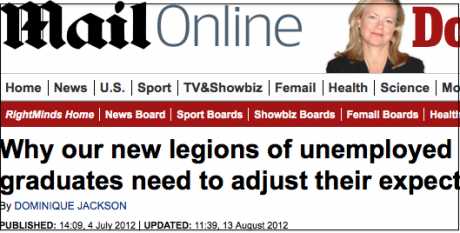
The Right Minds article that included an offensive paragraph
The Daily Mail has been embarrassed into deleting an offensive paragraph from an online contribution to its website.
A piece headlined Why our new legions of unemployed graduates need to adjust their expectations, by Dominique Jackson, contained this extraordinary paragraph:
"The German slogan 'Arbeit Macht Frei' is somewhat tainted by its connection with Nazi concentration camps, but its essential message, 'work sets you free' still has something serious to commend it.
There is dignity to be gained from any job, no matter how menial, and for young people at the start of their careers, there are valuable lessons to be learned from any form of employment, whether that is on the factory floor, on a supermarket till or in the contemporary hard labour camp of a merchant bank or law office."
This grotesque lapse in taste was removed from the article once its presence was revealed on the Twittersphere.
There was no mention of the deletion despite the fact that three (of the 29) commenters on the article - which was posted on 4 July - pointed out that it was entirely inappropriate.
One of them, gloworm, glos, wrote: "Somewhat tainted? By the deaths of considerably more than a million men, women and children? I understand the point you are making, but to write off a phrase like 'Arbeit Macht Frei' as somewhat tainted demonstrates such a complete lack of feeling for context that... Christ, words fail me."
Yet the editor of Mail online's Right Minds comment section didn't feel it necessary take it down at the time.
Tom Chivers, in a Daily Telegraph blog today, wrote:
"Somewhat tainted, yes, Dominique. I mean, admittedly reductio ad Hitlerum is a logical fallacy, but nonetheless I think there might be lower-hanging fruit to reach for when it comes to inspiring slogans."
And the New Statesman's Alex Hern, in noting that the Mail was practising its usual "editing by Twitter" recorded that the Jackson piece had "mysteriously been updated" (at 11.39am) within minutes of the story going viral. Updated means deleted, of course.
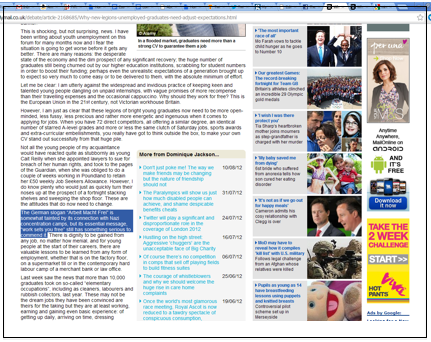
Index on Censorship's news editor, Padraig Reidy, managed to get a screenshot of the undeleted paragraph before the Mail censored itself, as the twitpic above shows.
Tuesday, July 31, 2012
Sick and disabled being pushed off benefits at any costs
As Panorama showed, the pressure on medical assessors to declare sickness benefits claimants fit for work is immense
 |
Employment minister Chris Grayling told the BBC 'there are no targets anywhere in the system'.
|
Viewers of last night's Panorama programme, Disabled or Faking it?, may have been shocked by the story of Stephen Hill, the man who died of a heart attack 39 days after he was declared fit to work by a government contractor and subsequently denied sickness benefits by the Department for Work and Pensions (DWP). But for those of us who have been voicing serious concerns about the government's changes to employment support allowance (ESA), the story was met with both exasperation and frustrating familiarity.
To receive ESA, the new incapacity benefit, the vast majority of claimants have to pass a working capability assessment (WCA) – a short medical test carried out by government contractor Atos Healthcare. The WCA is so consistently failing to recognise those who are in dire need of support that it is hard to understand why society is not in uproar. The cost to the government alone is staggering. Appeals against incorrect WCA decisions are costing £50m a year, with tribunals having to sit on Saturdays and increase staff by 30% to deal with the backlog. Appeals find in favour of the claimant in at least 30% of cases, according to the government's own statistics – although Neil Bateman, a welfare adviser featured on Panorama, believes this rises to a staggering 80-90% if the appellant seeks the help of an experienced adviser.
With such high costs to the taxpayer to manage the assessment and appeal process plus the health implications to those British citizens left abandoned by the government when they are most in need of help, the coalition must find a commonsense approach to the ESA.
Firstly, it needs to be open about the allegation that the government and/or Atos have been set targets to minimise the number of people that can be found incapable of work. The DWP and Atos Healthcare both gave firm rebuttals to this allegation by both Panorama and Dispatches, which also aired a programme last night looking into the same issue of sickness benefit. The employment minister, Chris Grayling, told the BBC that "there are no targets anywhere in the system", although the government refused to allow the broadcaster to see the full contract it holds with Atos.
Moreover, with Atos's government contract valued at £100m a year, it is reasonable to expect it to have some financial accountability for the high rate of successful appeals. However, Dispatches revealed this isn't the case. As one Atos trainer states: "The thing for us is, even if you made the wrong decision … you never go to the tribunal. So, sort of, you won't be blamed."
The medical test in its current form isn't fit for purpose, and the government's contract with Atos Healthcare isn't providing the value for money that taxpayers deserve. It is reasonable that the government suspends its relentless reassessment of 11,000 sickness benefits claimants every week until practical changes can be made to the medical test that protect the genuinely sick and disabled.
Yet, in a worrying development, professor Malcolm Harrington, shown criticising the WCA in last night's Panorama programme, was removed from his post yesterday as an independent adviser to the government on the WCA. He insists he hasn't been sacked, but the move will add to concerns by leading charities and 44,000 GPs that the government has little interest in listening to critics of the WCA. Perhaps the greatest concern raised by the two programmes is how committed the government is to making changes to a system that Grayling believes is providing "tough love". In research released last week by the Institute for Employment Studies, carried out on behalf of the DWP, 25% of ESA claimants that had been found fit to work are neither back in employment nor receiving benefits – a statistic the DWP seems unconcerned by.
Guardian
Record numbers of anti-depressants prescribed in 2011. Politicians to blame
Record numbers of anti-depressants (46,000,000) were prescribed in 2011. Politicians are to blame.


The current economic model we live under does not work. Insolvencies have grown by nearly 600% since the first day Tony Blair entered Number 10 Downing Street. More than 600,000 are set to bankrupt under the Tories, and that by no means excuses the million who went bankrupt under New Labour. In addition, the majority of jobs created since 1979 were part-time hours. This economic model provides low wages, short hours and unsustainable consumer debt levels. For those in full time hours, they work too long. Instead of switching to family friendly weeks of 35 hours for those who wish to avail of them, we in the UK have the third longest working week in Europe at more than 42 hours per full-time worker. On top of that we have an ailing transport network that means many parents spend as much time commuting to work as they actually do in it. All of this puts pressure on healthy eating, healthy family life and healthy finances. It causes stress and depression.
That is why the graph above, I am very sad to say, comes as no surprise to me whatsoever. In England, doctors prescribed more than 46,000,000 courses of anti-depressants last year. This is a 50%+ increase in just 5 years on the levels of anti-depressants prescribed in 2006. This record number of anti-depressants prescribed should signal a warning to all of our political leaders that the work life balance needs to be tackled and that we need a more sustainable economic model. Some may also argue, correctly in my view, that it highlights the urgency of investing, not cutting, more money in alternative treatments. In Olympics week if politicians are serious about creating a genuine Olympics Legacy (they are not), they should consider free gym membership for any person diagnosed with mental health problems. Exercise is no panacea but many with mental health problems will testify that it helped them achieve greater control over their mental health difficulties. A sad day, that requires us all of reflect upon the type of society we wish to live in.
Friday, July 20, 2012
Double suicide after ATOS ‘fit for work’ test

The death of a young woman who killed herself after being found “fit for work” is the latest proof of the catastrophic consequences of the government’s cuts to disability benefits and services, say campaigners.
The mother of the young woman – from London – also killed herself, just 24 hours after hearing of her daughter’s death earlier this month.
Paula, a disabled activist from south London and a friend of the young woman, took part in a protest and lobby of parliament this week that had been organised by the grassroots campaign group Disabled People Against Cuts (DPAC).
News provided by John Pring at www.disabilitynewsservice.com
Tuesday, July 17, 2012
Wednesday, July 4, 2012
Birmingham dad dies after being ruled ‘fit for work’

Article by -Anuji Varma, Birmingham Mail
A BIRMINGHAM dad died from a serious heart condition – weeks after Government assessors stopped his benefits and ruled he was fit for work.
Paul Turner, 52, from Erdington, was ordered to find a job in February following a medical review with doctors.
But he died on April 2 from ischaemic heart disease – caused, his family claim, by the stress of losing his benefits.
The dad-of-one was medically retired from his job as a stores manager for West Midlands Travel in 2000 after he suffered a heart attack. He later had to undergo a double bypass because of the condition.
Mr Turner, who also had angina, was claiming around £400 per month incapacity benefit until he was called in for a review at the Midlands Disability Benefits Centre in Five Ways in January.
Three weeks later he received a letter stating he was not entitled to the new Employment and Support Allowance, the controversial new payment that has replaced Incapacity Benefit.
On April 2 Mr Turner flew to France for a short family holiday with his wife and teenage son. Later that evening he suffered heart failure and died.
His death certificate recorded the cause as ischaemic heart disease, a condition which also cost the lives of his father and grandfather.
Mr Turner’s widow was too upset to speak about the case, but she is continuing his appeal to prove he was unfit for work.
But his devastated mum Sheila, 76, said: “We believe the claim he was fit to work brought on his death. He was very upset and worried that he would fail any medical given to him by a potential employer.
“He also thought the officials believed he was a fraud who should not have been claiming this benefit in the first place.
“But Paul was a very proud man. He was entitled to claim more through the system, but he didn’t.”
During the medical assessment Mr Turner’s family claim he did not undergo any physical tests, which could have picked up problems with his heart.
Mum-of-three Sheila added: “The observations of the healthcare professional were based on dialogue as the only two tests performed involved Paul either sitting in a chair or kneeling on a chair.
“They just asked questions about how long he could sit for, and looked at his back and hips.
“When Paul was told of the decision he was distraught. He didn’t know how he would explain the 12-year gap of not working to any employers. And he was worried about what people would think.”
Last night, a Department for Work and Pensions spokesman said: “Our sympathy goes out to Mr Turner’s family during what is obviously a very difficult time.
‘‘The work capability assessment is just that – an assessment of what, if any, work a person could undertake.
‘‘Jobcentre Plus decision makers look at all available information, including any medical evidence, to support their claim.”
Source
Cruel welfare system is steadily crushing lives – where is the anger?
This cruel welfare system is steadily crushing lives – where is the anger?
No one seems to be concerned that hugely profitable private firms are forcing thousands into borderline destitution
John Harris
guardian.co.uk, Tuesday 3 July 2012 08.30 BST

The former chair of A4e, Emma Harrison, 'who last year paid herself a dividend of £8.6m'. Photograph: Christopher Thomond for the Guardian
If you want a sobering flavour of where Britain is heading, set aside banking, the Leveson inquiry, our relationship with Europe and whatever else – and consider a Guardian story by Patrick Butler that appeared last week. It was about food banks, the charitable set-ups that supply emergency parcels to people who have fallen between society's cracks. FareShare, a charity that sits at the heart of all this, says it is experiencing "ridiculous growth" in demand, and expects that trend to continue for at least five years; over the last 12 months, it claims to have sent out 8.6m meals.
Spend any time around a food bank – and I have, in Inverness and Liverpool – and it quickly becomes clear that their core constituency is based around two groups of people: refugees who have either recently arrived in the UK or opted to go underground; and people who have suddenly had their benefits stopped.
Thanks to the increasingly cruel regime that now applies to benefits – which, we now know, David Cameron wants to make yet crueller – the latter seem to be increasing in number by the week, pushed into their predicament by a system that can summarily ruin lives, but offer only the most sluggish remedies by way of appeal. By and large, they remain invisible, but their fate is starting to intrude on the news media: last week, a man set himself alight outside a Birmingham jobcentre, reportedly thanks to a "dispute over benefit payments", an episode that occurred just as the Guardian was revealing rising concerns about suicides among people faced with so-called benefits "sanctions". For an intimate picture of the misery and anxiety that lies behind all this, have a look at this film by my colleague John Domokos, partly centred on a family reduced to fretting over their last dregs of electricity, and apparently surviving on a diet founded on budget baked beans. The benefits system refuses to understand that one of them is a carer, whose obligations to his ill wife mean that he cannot always make his appointments at the jobcentre.
Which brings us to revelations that appeared over the weekend, and the latest news about the government's increasingly brutal welfare-to-work drive. Thanks to research by Corporate Watch and an article in the Observer, we know that the private companies involved in the Observer, we know that the private companies involved in the government's Work Programme have been pushing for unbelievable numbers of people to have their benefits cut, aiming at figures that even the ever-more stringent Jobcentre Plus regime has refused to sign off. Meanwhile, there's a clear sense that in the context of a flatlining economy, the Work Programme's targets – indeed, its entire logic – are proving impossible: the scheme's core presumptions were based on economic growth of over 2%, and a revived job market. Given their non-appearance, the companies involved look they're getting desperate, and in the absence of any convincing carrot, frantically reaching for the stick.
In the context of the firms' returns, all this leaves an impossibly nasty taste. The best example is the welfare-to-work outfit A4e. This year, it has been blitzed with all those allegations of fraud; I've also reported on allegations of a "champagne culture", company events held in upscale foreign locations, and the dizzying lifestyle led by its former chair and public face, Emma Harrison, who last year paid herself a dividend of £8.6m. And what apparently lies at the heart of all this opulence, and the activities of a firm that claims to be "social purpose company" with "one sole aim, to improve people's lives around the world"? Over six months, 10,000 requests were made for its "customers" to have their benefits cut, of which only 3,000 were granted by Jobcentre Plus. Similar statistics for other companies abound: Working Links referred nearly 12,000 cases for sanctions, Serco managed just over 9,000, and G4s came in at 7,780. Such is the upshot of the stock warning that appears on most of the correspondence sent to Work Programme participants: "If you do not attend this appointment, your benefits could be affected." And how.
This is yet another one of those stories that come with a head-spinning sense of how much Britain has changed, under this government and its predecessor. Rewind 15 years, and imagine the spectacle of hugely profitable private firms pushing for thousands of people to be propelled into borderline destitution: the result would have been acres of coverage, and molten anger. And now? Even backbench Lib Dems are predictably silent, and Labour restricts its criticisms of a system it invented to technocratic hand-wringing, focused not on any kind of moral outrage, but whether everything's working, and how much it all might cost ("Chaos at DWP is stalling the government's reforms … the welfare bill is going through the roof" was the response to Cameron's welfare proposals of Liam Byrne, a man for whom the adjective "blank" might have been invented). Even the trade unions are bizarrely quiet. The reality is something to which mainstream politics cannot admit, and which bumps up against a cross-party accent on welfare being the last resort of malingerers: that people are living in fear and going hungry, and a cold state machine seems to have been designed to put them there.
Now, incidentally, we hear word that that plenty of police officers are of the opinion that last year's riots could easily be repeated. One hesitates, of course, to be alarmist. But as more and more people feel the cruelties of a policy that makes no sense – that people must be kicked into work, even if jobs don't exist – has anyone considered that the two things might be connected?
Guardian
Saturday, June 30, 2012
Subscribe to:
Posts (Atom)