Thursday, February 28, 2013

Cameron on disability: masking sinister intent?

paralympians

Even when David Cameron is saying something positive, we need to look for the hidden meaning, it seems.

This week, in Comedy Prime Minister’s Questions, Mr Cameron fielded a query from Liberal Democrat Greg Mulholland about last year’s Paralympic Games. Mr Mulholland said: “We were all hugely inspired by the wonderful Paralympic Games in London last year – not only a triumph for sport but also a triumph for perceptions of disability.

“Will the Prime Minister welcome the ‘Generation Inspired’ report which is going to be presented to Downing Street today, as a great opportunity to use the legacy of this to improve the lives of young disabled people?”

On the face of it, this might seem very bright and noble – reminding us all of our paralympians’ achievements and making a commitment to keep trying to help them, so that their aspirations will not outstrip the support they receive.

But let’s all remember that this question was being put in the same week that Channel 4′s Dispatches programme aired a documentary about the disappointment that awaited our paralympians after the Games – the loss of interest, the loss of help and, crucially, the loss of benefits.

It seems that they are capable of work, you see.

Look at Mr Cameron’s response in this context.

“I thought that the Paralympic Games were an absolute triumph for Britain – the way they were put on, and also the way that the auditoria, the stadia were full for almost every single event.” On the face of it, very supportive.

But then he said: “I thought it was a great testament to the generosity of people in this country and their enthusiasm for paralympic sport, but I think the most important thing is the change in perception about what disabled people are capable of, and I think that is a real gift and something we should encourage.”

A “change in perception about what disabled people are capable of”? This is very worrying indeed. He’s saying that the performances of athletes are comparable to the abilities of other people with disabilities – many of whom struggle simply to get out of bed in the morning and get dressed!

Would he have grouped his late son together with paralympians in the same way?

It is completely unrealistic to compare the two – akin to equating a marathon runner with a 50-year-old woman with a tendency to overweight, who survives on junk food and runs a supermarket checkout all day (with apologies to any such ladies who may exist).

He thinks that’s a “real gift”? There can be only one reason for that – it’s a gift because it supports his government’s policy of clearing disabled people – real, honest, disabled people who deserve state benefits to help them survive – off the benefit books.

If the wider public perception of disabled people is that they can compete and win in Olympic sports, then that’s half Cameron’s work done for him. No wonder he said it was “something we should encourage”!
Perhaps you thought the Paralympics were excellent – and they were. Maybe you thought they struck a blow for recognition of disabled people – and they did.

But not all disabled people are the same. I’m no marathon runner – and I consider myself to be relatively fit.
But I’m not superfit. Neither are the majority of disabled people even remotely able to achieve the feats of our Paralympians.

Cameron should be ashamed of himself for trying to group them all together in this way.

At the very least, Conservatives across the UK should be ashamed of him.

Vox Political

Wednesday, February 27, 2013

There is an alternative and the British Chambers of Commerce spell it out

Today the Prime Minister, David Cameron, adopted the strategy of economic madness. Whilst his Business Secretary, Vince Cable, has described the loss of the triple A status as being largely 'symbolic', Mr Cameron once again nailed his colours to its mast. It is a bit like crashing a car into at a tree and then declaring that it indicates they were travelling in the right direction. Mr Cameron continues with the line that there is no alternative. This is wrong, blind, foolish, obstinate and rather arrogant. It rejects advice from those economists who call for a change in direction.

The economy is in a bad shape. It is insufficient to point to the odd 'green shoots', the odd indication that things might turn out all right in the end. The coalition is missing its targets by a wide margin, and with the current strategy, austerity is set to last at least until 2017 and beyond. A decade of austerity will leave the economy considerably weakened, the poor poorer.

Nor is this a party political issue. Groups across the political spectrum, and of no political colour, have called for a strategy for growth.  Today, in light of the absence of growth, the British Chambers of Commerce has called for immediate action to stimulate growth. This would be a major change of direction. Growth should be the objective, and not simply cutting the deficit.

The Director General of the BCC said today:

"The Chancellor should seize the opportunity in next month's Budget to be radical, and introduce measures that creat“e an environment of enterprise, stimulate export growth, kick-start infrastructure projects and create a structure of business finance which supports growing companies. Above all, these measures should create confidence. Our own research shows that firms across Britain believe they can drive growth this year, but they can’t do it alone. The government must be bold and do all it can to boost confidence so that businesses can create jobs, wealth and ultimately long-term growth.”

The government strategy is counter productive as blind austerity reduces revenue it becomes more difficult to cut the deficit. It is bad economics and bad for the country. There is an alternative.


Song of Life

So councillor you say disabled children should be put down as they cost too much?

A CORNWALL councillor has apologised but refused to resign after telling a disability charity that all disabled children “should be put down”.

Collin Brewer, independent councillor Wadebridge East, made the comments to Disability Cornwall at County Hall when the group had an information stand at an event to allow councillors to meet equalities organisations and understand some of the issues they face.

At the event, which took place in October 2011, Mr Brewer approached the stand and was told how the group helps parents of children with special educational needs.

He responded by saying: “Disabled children cost the council too much money and should be put down.”

Disability Cornwall advice services manager Theresa Court said: “I was absolutely horrified anyone would make such a depraved comment, let alone a Cornwall councillor and at a public event.

“As far as I was concerned I had a duty to make a formal complaint against Councillor Brewer to seek appropriate justice.”

An investigation was launched and the independent standards committee ruled that Mr Brewer should write a letter of apology to the organisation.

His letter read: “I am writing to offer my whole hearted apology for the offence these remarks have clearly caused. While I meant no offence by my remarks to you I can see, in retrospect, that they were ill judged and insensitive and should not have been made at all.”

Chair of Disability Cornwall Steve Paget, MBE added: “It is of great concern to us that anyone with such beliefs, let alone to vocalise them, could be a representative and elected member of our local authority. For such a serious issue and multiple breach of code of conduct, bringing the council into disrepute, we did expect no less than this councillor’s resignation.”

When the West Briton contacted Mr Brewer about whether he would resign he initially claimed that he could not recall the incident.

However when prompted he said that he was not aware that there had been calls for his resignation and indicated that he would not stand down.

He said: “I had come to their stall after a long council meeting and I was probably a little bit het up as we had had some difficult debates.

“I could see that they were trying to sell me something so I said something to them which I thought would provoke a reaction. But they turned their backs on me and I walked away – I thought that was the end of the matter until the complaint.

“I used to be a salesman and I said it to provoke them into a discussion – I expected them to parry it and talk to me.

“I didn’t mean any offence and didn’t want to upset anyone.”

Should Councillor Collin Brewer resign? Vote in our poll now.
96 % say yes so far

Read more: http://www.thisiscornwall.co.uk/Cornwall-councillor-refuses-resign-saying/story-18257973-detail/story.html#ixzz2M7iOp1QN
Follow us: @thisiscornwall on Twitter | thisiscornwall on Facebook

Activists are “intimidating charities” into quitting work scheme, says DWP

Iain Duncan Smith speaks at Glasgow Welfare to Work conference
iF YOU EXPLOIT US
‘If the unemployed do not take part they can have their benefits reduced for up to three years.
‘They can have it all stopped, not just reduced.

‘following a rule change in December, sick and disabled benefit claimants could also be made to work unpaid or face having their benefits cut off’ 
‘It is worse.
‘There is a time limit to the MWA for able-bodied jobseekers.
‘There is NO time limit for disabled people – they can be on slavefare for life. And if their disability means they cannot do the slavefare placement they are sanctioned.’
http://discussion.guardian.co.uk/comment-permalink/21605353
GUARDIAN: ‘Sick and disabled braced for enforced work-for-benefits programme’ ~ BTC SAYS: PLEASE USE OUR REGULATIONS 29 & 35 CAMPAIGN MATERIALS! Posted on December 3, 2012
No PasarĂ¡n! Our struggle continues apace ……

The Department for Work and Pensions has blamed a band of activists for intimidating high-street charities into quitting a major government employment programme.

On Monday night Sue Ryder became the third charity this month to leave the DWP’s mandatory work activity (MWA) scheme, which makes jobseekers work at least 30 hours a week unpaid doing activities which benefit the community such as recycling, park maintenance and in retail shops and warehouses for the third sector.

If the unemployed do not take part they can have their benefits reduced for up to three years.

Early this month the animal charity PDSA and deafblind charity Sense also withdrew from the scheme, citing disquiet over the controversial use of so-called “forced volunteers” in their stores.

Their departures follow four other charities late last year – the British Heart Foundation, Cancer Research, Age UK and Scope – leading to fears that the entire scheme could soon become unviable if not enough month-long placements can be found.

The care and hospice provider Sue Ryder said that around 1,000 of its volunteers came from government schemes but it was withdrawing “with a heavy heart” to protect staff from an online campaign of harassment.

In a statement the charity said: “Recent online lobbying using strong and emotive language and making misleading claims about our volunteering practices has presented a risk to our critical work. Equally we need to protect our service users, their families, our supporters and Sue Ryder staff and volunteers from any further distress.

“Therefore, we have taken the decision to withdraw from the DWP’s mandatory back-to-work schemes. We do this with a heavy heart as our volunteers, including those on placements, regularly tell us how much they have benefited from their time with us and we are immensely grateful to them for their time and dedication.”

The DWP said it was “deeply regrettable that a small number of people have targeted charities and subjected them to intimidation and abuse in an effort to disrupt the operation of this scheme.” It added that it was grateful for the support of remaining charities “in helping unemployed people … move closer to employment”.

The campaigning group Boycott Workfare, which has branded MWA and other work-for-your-benefit schemes “slave labour”, vehemently denied any intimidation and said comments left on Sue Ryder’s Facebook page were public and showed the strength of opposition to programmes under which, following a rule change in December, sick and disabled benefit claimants could also be made to work unpaid or face having their benefits cut off.

A spokesperson for Boycott Workfare said: “The fact that so many charities have withdrawn and are now refusing to take part is testament to the strength of public opposition, and will make it more difficult for the coalition to introduce further schemes. Workfare is wobbling. If we keep pushing it will fall.”

An official evaluation of MWA in December found that organisations paid to set up the work experience placements were struggling to meet demand after the withdrawal of charities.

The 158-page DWP report backed activists’ claims that charities and community organisations were relying on unpaid jobseekers to staff their operations.

The report found:
“The majority of the hosts describe getting involved in MWA to provide staff for their organisations, which in many cases relied on unpaid staff to operate. Indeed several described coming to rely on MWA to provide a steady supply of staff.”
Kirsty McHugh, chief executive of the employment industry body ERSA, said she did not believe MWA was coming under strain.

“It is a real shame when any organisation withdraws from a scheme. However, we have no evidence that work placements are proving harder to find.

“Work experience is a really important step to helping people to gain the confidence and skills to enter employment and we are pleased that so many charities and employers continue to recognise this.”


Powered by Guardian.co.ukThis article titled “Activists are intimidating charities into quitting work scheme, says DWP” was written by Shiv Malik, for guardian.co.uk on Wednesday 27th February 2013 15.44 Europe/London

OPEN LETTER TO ANY MP WHO CARES ABOUT THIS COUNTRY [Socially Housed]

I’m writing to you today as just an ordinary member of the public who works extremely hard & who has lived in Social Housing for 25 years. In that time I have paid almost twice over the value of the property in rent & I have never shirked my responsibility, with regards to keeping my home in good order.

I am not a Scrounger or Skiver as some of you who should know better have labelled me (purely because I live in Social Housing & I had a period of full benefits in 2011 after a redundancy, of 3 months).

I am not a Lying thief, I do not “cheat a system” to enable me to work, BUT I do get £20 a week towards the cost of my rent (which is170pw) purely due to lack of income & decreased work (due to ill health I work part-time as I have many hospital appointments / procedures – BUT I DO NOT CLAIM DISABILITY BENEFITS –I WORK).

I didn’t ask to be ill, I didn’t ask to be looking after 3 children by myself, after a marriage broke down after 12 years, I didn’t ask for food costs & petrol to increase or heating to cost so much I can’t afford it – I could go on….

I have in fact been gainfully employed full time in numerous positions for numerous companies ever since I left school at 18yrs old (I went on to study but left to work, as I knew that’s what I wanted to do) and during all that time I paid my taxes and NI like everyone else.

What angers me is that ever since the Banking Crisis you in Government have been looking for someone to blame for the mess, but instead of directing your attention at the ones who caused the problems, IE the Bankers and the Get-Rich Quick City-Boys and profit hungry Buy to let landlords you turned your attentions to the ones least able to defend themselves. The Sick, The Disabled, those on JSA, Incapacity Benefit, and DLA.

You have Systematically Cynically and callously forced through Parliament changes to every avenue of Welfare you can think of while turning a blind eye to Corporate Corruption, Tax Dodging, Tax Evasion and any other nefarious trick the Rich Elite could think of to keep your hands off their wealth.

One way, a particularly narrow minded ill thought out way of making some cuts was achieved by employing Lord Freud to conjure up the Under-Occupancy Charge, aka The Infamous Bedroom Tax. Lord Freud and many others in Parliament have massive homes, sometimes two homes that are never fully occupied, yet you didn’t go after him or them or their rich influential friends who own mansions but who no doubt donate massively to the party Coffers.

No. You deliberately choose to target the poorest in society, those who can’t afford to pay their rent because they are out of work due to illness or lack of opportunities, or those who do work but who’s wages are too low and so they need help through Housing Benefits.

You didn’t stop beforehand to consider that there just aren’t enough smaller properties to downsize to even if people were willing to move. You didn’t stop to consider what any of this would do to families or communities. You don’t care or think about the disabled person needing a room of their own while their partner and carer sleeps in the next room out of necessity and not choice. You don’t care about the Mother/Father who only gets to see their kids of a weekend or holidays and who need somewhere for them to sleep, or the Mother/Father whose son/daughter is away fighting an immoral war, or the son/daughter away studying at University etc. You don’t even bat an eyelid at the prospect of thousands of people getting evicted because they can’t pay the immoral charge levied on them.

All you lot care about is reducing the Housing Benefit Bill.

Oh you wrap it up all in a neat package and sell it to the media that it’s because there are so many other families living in overcrowded conditions while there is someone two doors away with a spare bedroom. What you don’t explain to the media is it’s virtually always been that way. More so since in the 80’s it was decided to allow so much Social Housing stock to be sold off without a thought for the babies being born in those decades & their future need/want to work hard & have a stable home of their own, from which to ground themselves. What you also don’t tell is where the money went from those sales because it certainly hasn’t go into building more Social housing, You know, the sort where we pay the rent & it gets recycled through the economy – NOT the sort you are investing our taxes in – Buy to Lets for rich landlords, those who get the actual benefits you are harping on about & poke the profits away in non-tax-paying countries (where, let’s be honest a vast majority of these property magnates live)…

All you will have achieved financially with this is to ruin the lives of thousands of people. Your heartless actions will make sick people sicker as they worry where the money is coming from. They will have to choose to eat or heat or pay other bills, or if they don’t pay the charge they face the prospect of eventually get evicted. What will that solve?

Personally, I am now in arrears – for the first time EVER – I have 2 adult children living with me, the sort who want to work hard (They get this ethic from their mum – NOT YOU) & the sort who will NEVER have a home of their own now – (THAT MY FRIEND YOU CAN TAKE CREDIT FOR).

I ask you – as a Normal, hard-working, proud woman.. Re-think what you are doing… It’s not just me & my daughters – We will survive I WONT LET THEM DOWN, I will work myself to death if I have to, to ensure they are safe & housed… BUT it’s the others, the sick, the disabled – The honest people who are suffering – Bedroom Tax is a farce… No one chooses to under occupy – There are No smaller properties, The Government has seen to this with the stopping of Social housing building….

It used to be “An Englishman’s home was his castle” Now it feels like “An Englishman’s home can be his cold, coffin”.

Shame on you if you don’t act NOW


Isn’t it time to leave the politics of austerity behind?

Austerity has failed the UK. The Moody’s downgrade is evidence of that.

Austerity is proving to be bad politics: Italy’s election is proving that.

Labour’s lead of 12% without, as yet,  offering any significant policy alternative to the Coalition is also proof of that.

And yet austerity lives on. Sunny Hundal may taunt those in Labour who are wedded to austerity, but that won’t end their commitment to the policy of bankrupting this country in the interests of a few.

When will we see a commitment from a major political party to the policies we need? I argued some time ago that this would revolve around closing the tax gap, creating an industrial strategy and reforming pensions to release money for real long term investment. Nothing has changed since then, except the need for action.

When will a new politics based on the need for positive action rather than the fear that drives negative reaction be offered to the people of the UK, and elsewhere? So far there’s not enough of a hint of it.

Tax Research UK

Surge in food banks shows welfare system is in crisis

Over 35,000 people in the UK were fed by the food bank network last month alone. We need a new social settlement that will meet the challenges of 21st Century Britain.


The rising cost of living and an absence of real wage growth, combined with the Government’s relentless austerity drive, are forcing hundreds of thousands of people onto the breadline. Nowhere is this more evident than the recent surge in food banks – their use has grown to the point that Defra are now launching an enquiry.

When quizzed on the matter late last year, Prime Minister David Cameron thought it appropriate to praise the volunteers responsible and make reference to his now largely discredited idea of a “Big Society”. Ed Milliband’s response, to criticise the Coalition Government’s record to date and their unbending austerity agenda, did not suggest a strong desire to engage with this growing crisis either.

Make no mistake – this is a crisis. Not just a crisis of poverty, or of recession, but a crisis of the welfare system altogether. The figures are startling:
  • The largest foodbank charity, the Trussell Trust, reports that there are now over 300 food banks operating in the UK, up from 28 in 2009. In 2011-12 food banks fed 128,687 people nationwide, in 2012-13 the charity anticipates this number to rise to over 230,000.


    (graph from The Trussell Trust’s UK Foodbank report 2012)
We now face the very real danger that food banks will become a fixed feature of the UK’s increasingly fragile welfare system. As Olivier de Schutter, UN special rapport on the right to food, puts it:
“Food banks are the safety net of safety nets. It is only when government fails that food banks have to step in”.
Do we want to live in a society where poverty and hunger are entrenched? Do we want a system like that in the US, where 37 million people on low-incomes rely on emergency food assistance each year?

nef has already begun to develop a new economics vision of a welfare system that is able to meet the challenges of the 21st Century. At a time of prolonged recession, 70 years on from the Beveridge report, we must now decide what kind of social settlement we want for future generations.

Jacob Mohun
Barry Amiel & Norman Melburn Trust Fellow

Source

Support Growing For Benefit Justice Summit On 9th March


Support for the Benefit Justice Summit on Saturday 9th March to coordinate resistance to the vicious ConDem benefits cuts is gaining momentum.

The numbers of people signing up to support the Facebook campaign against the hated bedroom tax doubled to more than 11,ooo.

Hands Off Our Homes in Leeds have been organising local meetings across the city where impressive numbers of tenants have resolved to fight evictions.

More than 160 residents and workers expressed their rage at benefit cuts that are forcing more than 750 families out of their homes at a meeting in Camden. There have been large protests in Portsmouth and Croydon against benefit cuts with more to come in other towns.

More local campaigns have pledged support for the statement launching the summit initiated by Defend Council Housing, Disabled People Against Cuts, Right To Work, Unite and PCS.

Recent backers for the Summit include Medway Against the Cuts and Barnet Alliance For Public Services.

These campaigns are starting to have an impact. Despite a concerted media campaign to justify the Tories vicious benefit cuts, - a ComRes poll for ITV News showed more support for increased spending rather than cuts to welfare ( 43% to 27%).

Campaign for Benefit Justice Summit
Saturday 9th March
11am at ULU, Malet St London WC1E 7HY
Cut Rents, Not Benefits – Can’t Pay , Won’t Pay – Can’t Move , Won’t Move
Register For The Summit
Download Leaflet for the Summit

Email Campaign For Benefit Justice – benefitjustice@gmail.com
You can follow the Campaign For Benefit Justice on:
Facebook   www.facebook.com/benefitjustice
Twitter @benefitjustice

Right to Work

ATOS assessor found blind woman fit for work after “wiggling his fingers” in front of her eyes

(It’s not satire – it’s ATOS!)

Yet more proof of the unprofessionalism of the so-called medical experts at ATOS – the company paid huge amounts of taxpayers’ money by the government to carry out tests on behalf of the Department for Work and Pensions which are supposed to decide whether sick or disabled people are eligible to receive support.

A blind woman was found fit for work by an ATOS assessor after he wiggled his fingers in front of her eyes to test her sight.

The woman finally ‘won’ her case against ATOS – but not after a hard fight. You can read about it here in an article from the Manchester Evening News:


What is it with this government and its obsession with paying out vast amounts of taxpayers’ money to bunches of cowboys to run public services?

ATOS, G4S, A4e, CAPITA – seems to me there’s a common theme here.

Must be a case of birds of a feather.

Or is it more a case of thick as thieves?

Pride's Purge

DWP bullying of mentally ill and vulnerable has to stop

A plea from Lynn Blackmore:

“Please would people kindly sign this petition which ends 20th March.  I have tried very hard to get this to 10,000 signatures but there seems to be apathy when it comes to signing it. I feel if this we’re for a basket of pretty kittens the signatures would have been there in a week like the badger petition, yet human beings who suffer mental ill health don’t seem to count as much in the publics eye!  My son who suffers from schizophrenia, has been in a psychiatric hospital now for 31 months, yet he’s being hassled by ESA, WCA, DWP, asking him if he’s fit for work!  This is crazy, and the bullying of the mentally ill and vulnerable has to stop! All I can do as a distraught and worn out mum now, is beg you to PLEASE sign this so I at least get this to 10,000 signatures, because the Government then HAS TO AT LEAST ACKNOWLEDGE THIS PETITION!”

Here’s a link to Lynn’s petition. With PIP (Personal Independence Payments) seemingly overlooking mental illness it is vital people act. Time is running out for this petition. There are 23 days to get just over 800 people to sign, how hard can that be folks?

imagesClick here to sign

Member of ‘Fit For Work Coalition’ Brought in to Scrutinise Atos

paul-litchfield

The DWP have brought in a member of the ‘Fit For Work Coalition’ and the neo-liberal think tank the World Economic Forum, to carry out a review of the brutal assessments for sickness and disability benefits.

Dr Paul Litchfield will replace Professor Malcolm Harrington who was sidelined after being mildly critical of the Work Capability Assessment (WCA), the relentless health and disability tests which have driven some claimants to suicide.

As well as his membership of the sinister sounding World Economic Forum’s Global Agenda Council – who promote more capitalism to deal with the problems created by capitalism – Litchfield is Chief Medical Officer at BT.  He is also a member of the aptly named Fit For Work Coalition which: “brings together healthcare professionals, policy makers, employers, and patients to improve the productivity of Britain’s workforce, by empowering and supporting people, including those with long-term conditions, to remain in or return to work and be economically active.”

Litchfield has long been working behind the scenes with both the current and the last government in a bid to dismantle the welfare state.  Way back in 2006 he was a member of the Mental Health Technical Group who were involved in proposals to ‘transform’ the old Personal Capability Assessment (PCA) – the previous assessment regime for Incapacity Benefit.

He then went on to sit on the Technical and Consultative Working Group involved in the creation of the Work Capability Assessment, along with Angela Graham of Atos Origin and Sue Godby of Unum.
He will now prepare a review on the shambolic Work Capability Assessment which is seeing more seriously unwell or disabled people than ever successfully appealing Fit for Work decisions.

Litchfield has already given an early indication of his true role at the DWP , which appears to be that of a glorified spin doctor.  He claims in a statement on the DWP website that:  “Any assessment not only has to be fair but must be perceived as being fair.”

He’s not there to change the assessments, but to change people’s minds about the assessments.

Boycott Workfare: Just two people can have a big impact


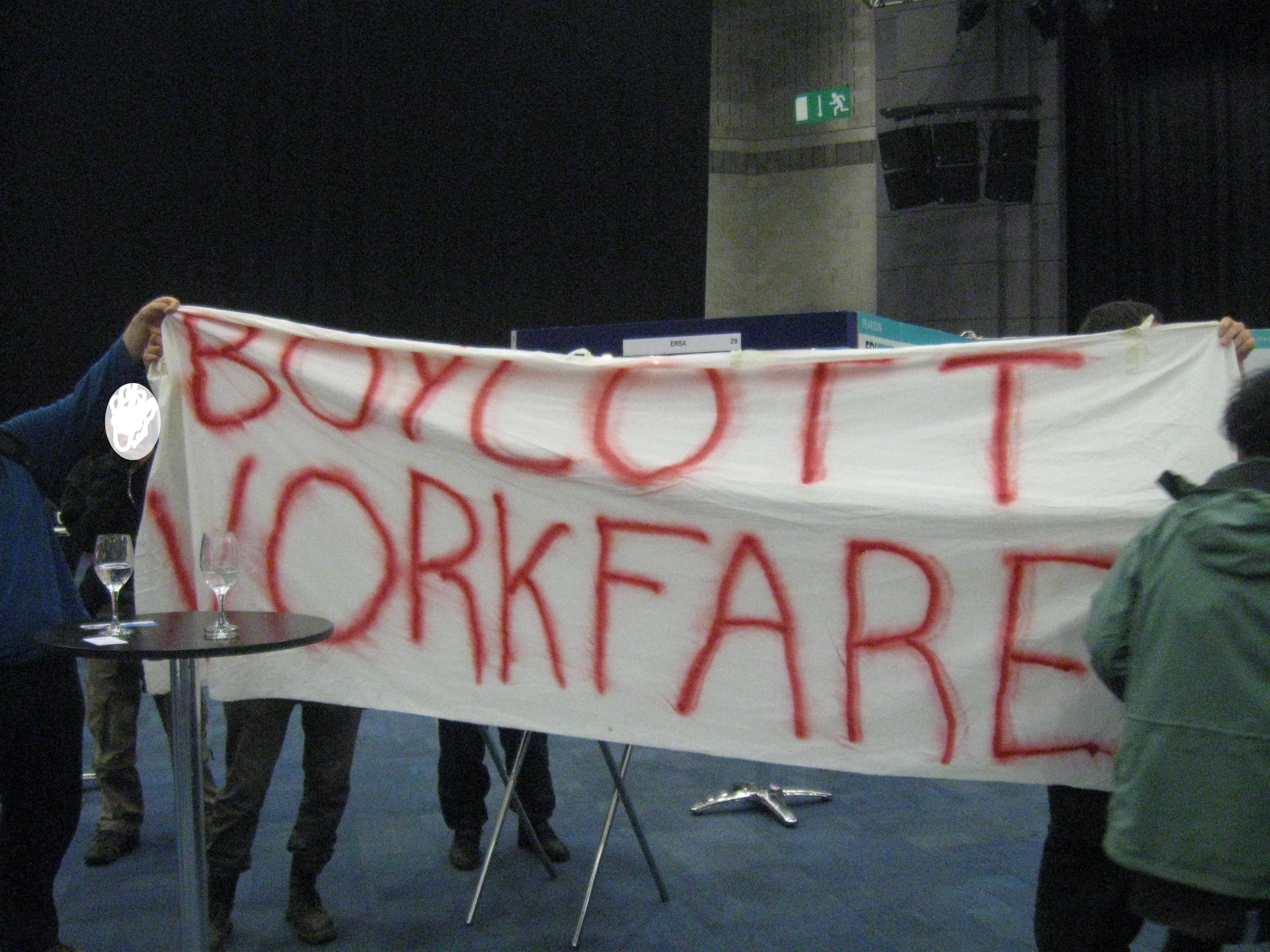
ON Tuesday, A boycott Workfare delegation paid a short but vocal visit to the Welfare to Work workfare industry convention. More on this soon!
Atos have forced thousands of sick and disabled people onto Jobseekers Allowance or into the “work related activities group”. These people now face workfare.

The Week of Action Against Workfare is coming up on 18-24 March and you may be wondering what you can do in your town or city. There’ll be lots more online action during the week, but if you want to take to the streets, this report of a two-person action in Newcastle shows you don’t need loads of people to have an impact!


If you’re tempted, head over to the Facebook event where loads of people have posted to find people in their area. Get in touch and order some leaflets, and let us know what you plan so we can help let others know about it!

So here’s what happened when two campaigners took to the streets in Newcastle to highlight that people on sickness and disability benefits can now be forced to do workfare.

Despite snow at home, Newcastle was rather more sheltered, which wrapped up or not, I was grateful for since I would be sitting down outside for a few hours. We’d picked ‘Grey’s Monument which is appropriately a monument to Charles, Earl Grey, the great 19th century political reformer and champion of civil liberties and which also acts as Newcastle’s answer to Speaker’s Corner. There were plenty of people about, and our placard with it’s bright blue disability logo got heads turning, even before my husband decided to start shouting slogans. David, who isn’t built like Brian Blessed for nothing, bawling in his best street-hawker’s manner, “Mandatory Workfare for disabled people starts today- Scrap it now!” got a fair few heads turning.

We had warned the police in advance that we would be there so there was no bother with officialdom – one bobby kept an eye on us for a bit, but meandered off once he realised we didn’t intend to set fire to any civic monuments.

The public were by and large very interested given there were just two of us and our cry of “Workfare is slavery” earned us the heartfelt response, “Damn right!” from a passer-by. Several people came up to to find out more about the protest, commiserate with the general attitude towards disabled people, or congratulate us for getting involved.

Most folk we spoke to seemed to know at least something about the iniquities of ATOS and the Work Capability Assessments and to be genuinely horrified at the possibility of sick and disabled people being mandated to Workfare or sanctioned for non-compliance, even though this ‘non- compliance’ might actually be due to an inability to do the work ‘offered’ by the DWP.

We wheeled out some of the more worrying statistics that exist even before disabled people have been mandated onto work schemes; the fact that 32 deaths a week in the Work Related Activity Group suggests that some very sick people who should clearly be in the Support Group of ESA could be potentially be forced into unpaid labour which could have fatal consequences and the fact that incurring a sanction would leave a disabled person with only £28 per week to live on.

Predictably we had the odd one or two who were largely sympathetic but excused the Government’s actions on the grounds that they were forced to it by the need to weed out fraud but in general, the folk we spoke to were extremely supportive and interested, those who were already aware of the ATOS assessments or even of proposed disability workfare listened avidly and we really felt that we got noticed by people who might otherwise barely have registered such a change.

At one point a rather belligerent chap on a mobility scooter threatened to get us moved on because we were telling lies about the DWP who had assured him that HIS disabled wife would not be made to work. I was more worried by the freelance photographer who wanted to take a picture of us to sell to the Daily Mail. I refrained from pointing out that the Mail don’t want pictures of real disabled people spoiling the myth of 75% scroungers and declined the offer of that sort of publicity as politely as possible!

We had a couple of coffee breaks in the indoor shopping centre to thaw out but got a good couple of hours in between our start at 11 and finish at 2pm. All in all, it was very relaxed and enjoyable and Newcastle’s usual spirit of goodwill and desire to chat to anyone and everyone, made us feel that the word really WOULD be passed on that Workfare Isn’t Working!

What will you do in the Week of Action Against Workfare?


Food Poverty: UN Special Rapporteur Finds Austerity, Food Banks And Working Poor In UK ‘Extremely Worrying’

Banks must not be allowed to become a permanent fixture in the UK and Europe, or used by governments to “clear their conscience” and neglect their duty to protect the country’s poorest people, a top UN official has warned.

The emergency food banks are now accepted by governments as the norm, which they “absolutely should not be”, the UN’s Special Rapporteur on the Right to Food Olivier de Schutter told HuffPost UK.

It is the UK’s government’s duty to protect the poorest in society and part of their duty under human rights law, de Schutter said.

On Monday night, the UN representative spoke about starvation in developed nations, at a talk organised by the charity Just Fair, alongside food bank charity chair Chris Mould of the Trussell Trust.

UN Protocol means he cannot comment on specific UK government policies.

But it is the working poor in Britain that most concern him, the fact that 62% of children in poverty are living in families where at least one of the parents has a job is “very striking” he told HuffPost UK before his speech.

“That is very worrying. It is really unacceptable. It shows wages are too low, people have to work part-time and not by choice, or that minimum wage legislation is not adequate. But it is worrying to see that in a country like the UK.”

The horse meat scandal here too has not escaped his attention. “It is one more reason for us to be discontent with the mainstream food system. People have seen what it looks like and they don’t like it.
“So governments must do more to promote alternatives, small farmers, small food systems. And it is not necessarily cheaper to eat these processed foods.”

Last year, De Schutter published a damning UN report into Canada, and the failure of one of the world’s richest nations to protect its poorest citizens.

The country relies heavily on foodbanks, an emergency food system which is growing in Britain, feeding 260,000 people last year.

De Schutter said food banks were “becoming a fundamental feature of our social protection system and they absolutely should not.

“I admire them, but this is not a substitute for social policy which provides people with the right welfare support.

“It is not OK for governments to clear their conscience by these food banks taking over when it should be their responsibility. It should not become a permanent feature. And yet food banks are increasing, very strikingly so in the last five years.”

Mould, of the Trussell Trust, told the talk on Monday night he envisaged every town in Britain would soon have a food bank.

“But it should be the same as every town having an ambulance service. It’s for emergencies. If you need a food bank all the time, you need to be signposted to something more permanent that can help.”

In the first week of February 2013 alone, Trussell Trust foodbanks gave emergency food to 5,150 people in crisis across the UK.

In the same week, Downing Street, during PMQs, stated that foodbanks are there for people who ‘feel they need a bit of extra food’ and that benefits were set at a level that means people should not go hungry.
FOOD BANKS IN BRITAIN
    • Trussell Trust foodbanks have fed over 260,000 people since April 2012.
    • Trussell Trust foodbanks fed 128,697 in the entire 2011-12 financial year.
    • The Trussell Trust is opening 3 new foodbanks every week.
    • At the beginning of December 2011 The Trussell Trust had launched 149 foodbanks nationwide, we now have 292 launched nationwide: almost doubling the number of foodbanks in the last year.
    • Trussell Trust foodbanks will give emergency food to over 15,000 over two weeks of Christmas.
    • During that period in 2011, the trust fed 8,500 people.

The inequality in countries like Canada and the UK is almost more shocking that starvation elsewhere, De Schutter said.

He told HuffPost UK: “Rich countries have more of a duty towards their poor. They can meet their duty to the poor, and therefore they should not excuse their job in meeting it, because of austerity.

“We are on our way to a having a permanent underclass, people living in poor neighbourhoods that have no opportunities to choose different ways to feed themselves, fewer role models to follow and poverty transferred through generations.”

De Schutter said the UN’s human rights representatives were concerned that governments were using austerity as an excuse not to tackle inequality and the problems faced by the poorest in society.

“It is a concern for human rights committee at the UN that governments now have an austerity programme that do not take into account the needs of the poor,” he told HuffPost UK.

“And when you have a highly unequal society you have a large group of people with an interest in things not changing. It makes robust social policies more difficult to adopt.”

De Schutter acknowledges that starvation is not what occurs in developed nations, like it does in the Sahara or south Asia, but “it means people too poor to choose diets that are healthy for them. They develop diseases, they have health problems.

“The impact on healthcare in the next 15/20 years will be gigantic.”

In the run up to the event Just Fair Patron and Shadow Equalities Minister, Kate Green MP, stated that, “the coalition government says ‘we’re all in this together’.

“But children should not be ‘in this’ at all. Nor should desperate families hit by benefit cuts or unemployment, or those in working households who earn too little to make ends meet. That is why I believe it is time for us to debate the introduction of a legal duty on the UK government to ensure an adequate standard of living for all.

Jonny Butterworth, director of Just Fair, said “It is unacceptable that the seventh richest country in the world cannot ensure a basic threshold of decency for all of its people.

He urged de Schutter to make a similar mission to the UK as he had to Canada, saying the UK “could benefit greatly from a full country visit.”

De Schutter told HuffPost UK has been invited to do an official mission to look at food poverty in the UK, by the government, but has declined due to other commitments. But he praised the government for being “willing to look in the mirror.”

A DWP spokeswoman told HuffPost UK: “We welcome the contribution of voluntary organisations for the work they do with local communities. That is why Jobcentre Plus – for the first time – is now referring people to their services.

“Universal Credit will be gradually rolled out over four years from October 2013 and will directly lift hundreds of thousands of people out of poverty as well as encourage many to move into work with the knowledge they are better off in work than on benefits.”

“Despite paying out £171bn in tax credits over the last decade alone, the previous Government failed to meet their target to halve child poverty by 2010 and far too many children were left behind.

“This Government remains committed to eradicating child poverty, but we want to take a new approach by tackling the root causes including worklessness, educational failure and family breakdown.”
 
Jessica ElgotHuffington Post

“I will not participate in a government under which police are beating people”

Sam Cage and Tsvetelia Tsolova
Huff Post

“I will not participate in a government under which police are beating people,” Prime Minister Boiko Borisov said as he announced his resignation on Wednesday.
SOFIA, Feb 20 (Reuters) – Bulgaria’s government resigned on Wednesday after violent nationwide protests against high power prices, joining a long list of European administrations felled by austerity during Europe’s debt crisis.

Prime Minister Boiko Borisov, a former bodyguard who swept to power in 2009 on pledges to root out corruption and raise living standards in the European Union’s poorest member, now faces a tough task to prop up eroding support ahead of a probable early election.

Wage and pension freezes and tax hikes have bitten deep in a country where living standards are less than half the EU average and tens of thousands of Bulgarians have rallied in protests that have turned violent, chanting “Mafia” and “Resign”.

On Tuesday, 11 people were hospitalised – including one man bleeding heavily from the head – and 11 arrested after protesters threw flares at police, who fought demonstrators with shields and truncheons.

“I will not participate in a government under which police are beating people,” Borisov, who began his career guarding the Black Sea state’s communist dictator Todor Zhivkov, said as he announced his resignation on Wednesday.

Parliament is expected to accept the resignation later in the day.

The spark for the protests was high electricity bills, after the government raised prices by 13 percent last July. But it quickly spilled over into wider frustration with Borisov’s domineering manner and unpredictable decision making.

The prime minister made sacrifices in an attempt to cling on, sacking his finance minister, cutting power prices and risking a diplomatic row with the Czech Republic by punishing foreign-owned companies, a move that conflicted with EU norms on protection of investors and due process.

Borisov’s rightist GERB party is the dominant faction in parliament but will not take part in talks to form a new government, Interior Minister Tsvetan Tsvetanov said, indicating that an election planned for July will now be held early.

“He made my day,” student Borislav Hadzhiev, 21, in central Sofia said, commenting on Borisov’s resignation. “The truth is that we’re living in an extremely poor country.”


IRE

GERB’s popularity has held up well and it still leads, just, in the polls, largely because budget cutbacks have been relatively mild compared with those in many other European countries. Salaries and pensions were frozen rather than cut.

But the last opinion poll, taken before protests grew last weekend already showed the opposition Socialists were nearly tied with the ruling party and analysts said the protests had boosted the Socialists’ chances.

Unemployment in the country of 7.3 million is far from the highs hit in the decade after the end of communism but remains at 11.9 percent and average salaries are stuck at around 800 levs ($550) a month.

Millions have emigrated in search of a better life, leaving swathes of the country depopulated and little hope for those who remain.

The measures announced this week has also put the country on a collision course with the EU and financial investors without easing the tension at home.

Czech Prime Minister Petr Necas demanded an explanation from Bulgaria and accused it of “politicising” the power sector by threatening to revoke the electricity distribution licence of central Europe’s largest listed company CEZ, 70 percent of which is owned by the Czech state.

There have also been fines for another Czech company, Energo-Pro and Austria’s EVN.

The precedent is unlikely to encourage other foreign investors, who already have to navigate complicated bureaucracy and widespread corruption and organised crime if they want to take advantage of Bulgaria’s 16-percent flat tax rate.

“The resignation is the only responsible move,” said Kantcho Stoychev, an analyst with pollster Gallup International. “It also gives Borisov some legitimacy to stay in political life in the future, despite the violent police actions last night.”


#call_to_action h4 {padding:0px 15px;}

Grahame Morris MP challenges growth of Food Bank Britain


Easington MP Grahame Morris visited a ‘pop-up’ food bank outside the Houses of Parliament, to draw attention to growing poverty and the reliance on food parcels in the UK.

Grahame Morris MP visited the Unite food bank at a time when reliance on food support is rocketing. The number of people supported by food banks has grown from 2,800 in 2005-06 to over 128,000 in 2011-12, while Britain’s largest network of food banks, the Trussell Trust, predicts that they will need to support in excess of 260,000 people over the next year.

The Department for the Environment announced yesterday (Monday 25th February) that it was going to examine why there has been a surge in the demand for food support.

People turn to food banks in times of desperation – usually because of an unexpected bill, or the miscalculation of welfare cuts, but more and more because of shrinking wages and rising living costs.

Mr Morris warned that further benefit cuts, due to impact from April 2013 on people both in and out of work, will force ever greater numbers to rely on emergency food support.

The pop-up food bank has appeared as the Welfare Benefits Uprating Bill is being debated by the House of Lords. This Bill seeks to place a real terms cut on all benefits, by capping annual rises to a below inflation 1 per cent. Some 60 per cent of those households affected by this cap will be in work.

The influential Institute for Fiscal Studies predicts that as many as seven million working households will be hit by the uprating cap, by an average of £165 per year. These factors are set to significantly increase food and fuel poverty, leaving growing numbers of people reliant on food banks.

Speaking at the event Grahame Morris, MP said:

“The work carried out by food banks – like The Trussell Trust – in giving vital supplies to people both in and out of work is invaluable. They provide a lifeline to people in dire need.

“However, it is appalling that this level of support is needed in 21st century Britain and at the same time this government is set to give huge tax breaks to millionaires from April.

“Growing poverty is now a real issue in this country, so where is the sense in the government making ordinary people poorer and scared for their futures, which is what their cuts hatchet does. People need a government that is on their side during this terrible recession, not a government for the super rich.”

Len McCluskey, Unite general secretary, added:

“It is shameful that that under Cameron’s watch the world’s seventh richest nation has become so reliant on food banks.

“The Prime Minister snuck in to a food bank in his own constituency, perhaps because he is ashamed that over 260,000 people are expected to use food banks this year, as a result of his shambolic handling of the economy and brutal welfare cuts.

“That is why we are calling on the government to put an urgent hold on the welfare cuts, due to kick in from April. It is grossly unfair and will hit the most vulnerable the hardest, particularly – children, people with disabilities and lone parents.”

Grahame Morris MP

Health Committee to investigate Government’s NHS privatisation plans [Grahame Morris MP


I am delighted that the Health Select Committee, of which I am a member, is to launch an investiation into the Government’s back-door privatisation of our National Health Service. I have campaigned long and hard for this to take place, and as a result the Committee will hold a special session on Tuesday 19th March. It will be looking specifically at what is known as Statutory Instrument 257 under Section 75 of the Health & Social Care Act.

This hugely controversial new regulation, due to come into force on the 1st April, would impose compulsory competitive markets in the health service, and bring the NHS under the full scope of EU competition laws. The trouble is that this is no ‘April Fool’, it is for real.It mirrors exactly what has happened to the Post Office, and if allowed to go ahead will destroy the National Health Service as we know it. It will be virtually impossible to reverse these so called reforms if they are allowed to go ahead.

The regulations directly contradict promises made by former Health Secretary Andrew Lansley to Clinical Commissioning Groups that they would not be forced to put services out to tender.

Current Health Secretary, Jeremy Hunt is also breaking promises made to MPs when legislation on the NHS was voted through last year. Under his plans, GPs would have to open up every part of local health services to private companies, whether or not it’s what they or local people want. It would speed up the break up of the NHS, giving profit-hungry companies new rights to muscle in. let us not forget that it was Jeremy Hunt, who as Culture Secretary was happy to do deals in secret with Rupert Murdoch. Now he is doing the same with the NHS.

However, due to the magnitude of these changes, the rightful place for them to be debated is in the House of Commons Chamber. I will be pressing for a full parliamentary debate on this issue, as we need a Government guarantee that health services will not be privatised against the wishes of the public and commissioners.

There has been a lack of critical thinking or analysis from the mainstream media, who have failed in their public service duty. The Government would have been able to pass the biggest change to the NHS since its foundation unopposed,  if it were not for a well organised public campaign against these regulations.

I am delighted that social media campaigners, ’38Degrees’ whose campaign against the privatisation of our forests was so successful is also working hard to halt the privatisation of our NHS through the back door. Please sign their petition and urge your MP to sign my Early Day Motion demanding that our NHS be kept out of the hands of the privateers

Sign the petition against Jeremy Hunt’s new NHS privatisation plan here:
https://secure.38degrees.org.uk/nhs-section75

Grahame Morris MP

Universal Credit risks exposing people to Russian Gangsters

This April, the new system for paying benefits, Universal Credit, will go live for people in Tameside, Oldham, Wigan & Warrington. The rest of the country will be moved onto it by October. This is the flagship policy of Ian Duncan Smith’s Department for Work and Pensions. Many people like me will be involved in this trial, guinea pigs in a much criticised system.

Having worked in IT for 18 years as a Systems Architect, Analyst and Manager I have been involved in many projects like this; although none so large and complex. To understand how complex this project is we need to, first of all deal with what Universal Credit is and what it’s replacing. The majority of people seem to be under the impression that this is the replacement for Job Seekers Allowance; it’s not.

Universal Credit is intended to replace ALL Government issued benefits, including:

• Housing Benefit
• Income Support (IS)
• Jobseekers’ Allowance (JSA)
• Employment and Support Allowance (ESA)
• Child Tax Credit and Working Tax Credit Budgeting loans and crisis loans.

So, in effect, it will affect a much larger pool of people than previously expected, i.e. every person in the country who earns less than £60,000. A large number of these people have no idea that they will be included. That is a convergence of systems from the DWP, HMRC & Local Councils. Each of these systems has to somehow talk to each other, which when one remembers that back in the ’90′s when they started planning to link the then Inland Revenue with the then DSS they found that the DSS had somewhere in the region of 3 million more NI numbers than the IR. I cannot begin to describe just how complex this project is so I won’t try. Perhaps that’s for another article. So let’s focus else.

In order to provide access to this system the Government has come up with the “Identity Assurance Scheme”. In the past you would’ve turned up at the Job Centre along with your Passport and Utility Bills and that would be taken as proof of ID. You could be asked to provide these again at some point but generally these were considered safe. With a purely online system, and after April this will be 100% online, the Government have decided to use third party systems to authenticate and identify you. Several providers have been awarded contracts including The Post Office, Experian, Verizon and Paypal.

The difference between online authentication and physical authentication are fairly obvious. To produce fake documents that will stand scrutiny requires a certain level of sophistication. We’ve all heard about Identity Theft and may even know somebody who’s been affected but in order to receive someone’s benefits one needs to produce the correct documentation and convince someone in person that you are that person. These documents don’t come cheap. In order to impersonate someone online all that is required is to hack their email account. This invariably gives access to their Paypal, Facebook, Twitter, eBay, LinkedIn etc. Pretty much they’re entire digital life.

Most ordinary people don’t fully understand the principals of secure passwords or two factor authentication. They will generally have one password for everything, one they’ll consider secure. But that is far from the biggest flaw in this system; the biggest risk to them is that online fraudsters, especially from China and Russia, will see this as the biggest opportunity in the history of internet fraud. This same system will eventually be used for issuing driving licenses and passports. So we have a system that will use various companies who never meet you to issue passports and driving licences and manage benefits, pensions and taxation. Far too good an opportunity to resist.

So what can be done to make this more secure? Well perhaps they could provide people with special software to protect their computers but therein lies the problem and it’s the problem with this entire approach to “Digital by Default”. The majority of people on benefits can’t afford a broadband connection. They will have to go to libraries or friends and relatives houses, places where they will have no control over the computer they’re using. They won’t know if they’re neighbour’s PC has a virus on it that causes every website visited along with every key typed to be transmitted to an organised crime syndicate in Russia or China.

They would most likely be having to check their email while they’re there and perhaps log into Facebook. Of course then they’ll go about their business as usual having no idea that someone is accessing their benefit records and changing the bank account details, hacking into their Facebook account to send messages to their friends which contain links that will cause their friends to be hacked too. It’s quite possible that until they next visit the cash machine, they might not even know what’s happened to them. They will have been digitally burgled, their email account taken over, no way of getting back their Facebook account, their bank account emptied, their benefits being sent to China or Russia and their identity stolen.

One of the biggest issues is going to be demand on the libraries who’ve managed to survive the Spending Review. They will have queues of people wanting to use their computers to access the internet, people who have no internet, indeed people who don’t own a computer at all and possibly never have. They won’t know how to use a computer much less have a quick look around the back for a key logging device. It’s quite likely more local gangs will realise very quickly the opportunity that these places present. In one week they could very quickly gain access to hundreds of bank accounts. In essence we could be looking at a new organised crime network of American Prohibition proportions especially when you consider that according to ONS figures 20% of households in the UK do not have internet access and that rises to 36% for households where one of the occupants is over 65.

Many of these households have never needed nor wanted internet access, particularly the over 50′s. Now they are going to have to learn how to use the internet, acquire an email address and learn how to navigate a website. They won’t know what’s suspicious and what isn’t.

I know from the experience of own Mother when she was tricked into paying £29.95 for the free Adobe Reader. She searched Google, the first link that came up was a scam but she knew no better. She paid her money and got sent a link to Adobe’s website. Of course as soon as she told me what she’d done we managed to stop the payment and get the card stopped but had she not done so, her credit card would’ve been used to the credit limit and she would’ve been liable.

So what we have is a flawed system that has been ill thought through which will put the most vulnerable people in our society at risk of fraud and destitution without the support required to ensure that these people are protected. There aren’t enough facilities available for them to use to access it and they don’t have the money to provide their own. The DWP most certainly doesn’t have the trained staff available to help them and considering the budgeting choices councils have to make, they don’t either.

Source; Joe Halewood

‘Ill advised cuts can risk a downward spiral,’ EU Commissioner warns

Governments must avoid policies that axe spending in the name of competitiveness and short-term savings, “but in reality jeopardise future competitiveness and longer-term prosperity”  EU Commissioner for Employment, Social Affairs and Inclusion LĂ¡szlĂ³ Andor has said in a speech to the Institute for Public Policy Research (IPPR) today.
IPPR

In his keynote speech at the IPPR’s Revitalizing Social Europe event, Mr Andor warned that “polices that axe spending in the name of competitiveness may jeopardise … future prosperity”.

“Ill advised cuts can aggravate [deficit reduction] and risk a downward spiral,” he said.

“For instance, putting public workers out of work may reduce public spending on wages, but it will increase public spending on welfare benefits as well as resulting in a loss of tax revenue.”

The Commissioner also said a rise in social welfare spending at start of crisis held up UK living standards compared to those of Ireland and Greece, and he added that social investment was crucial to ensuring that a stronger, more cohesive and more competitive EU emerged from present crisis.

“It means treading a fine line between reducing spending to improve the public finances and jeopardising the future.”

Mr Andor also defended the EU’s Working Time Directive, which has been subject to much criticism from the Right in Britain of late.

“[The Directive] is a much discussed piece of legislation which I inherited as part of my portfolio, along with the Posting of Workers Directive, that was also controversial in some quarters,” he told the audience.

“A few weeks ago, I saw a set of short BBC interviews of individuals who were responding to questions regarding the consequences if Britain were not a member state of the European Union.

“Among them was a doctor who was very concerned at the effect of long working hours on his capacity to perform his work properly. He was worried that he might make serious errors of judgment affecting his patients through being overworked and lacking sleep.

“Another interviewee was a haulage-company operator. He was worried about unfair competition from other hauliers from other Member States who did not have to comply with the same rules.

“We must work to ensure that employment and social cohesion are given substance in EU policy — on a par with financial consolidation and economic growth.

“The recovery must bring jobs and opportunities for people, not just profits for companies and banks.”

Mr Andor’s full speech can be read here.

Left Foot Forward

Daily Mail mocking sick and disabled people

When did sick and disabled people become 'fair game' for mockery in the UK?

Over the last few years the way certain elements of the media have portrayed these sections of the population as ‘scroungers’ and ‘benefit cheats’ has been depressing, but today the Daily Mail reached a new low. In this article dramatic claims were made about the numbers of new claimants for Disability Living Allowance, describing a rush to claim the benefit before new more stringent rules are introduced.

The figures cited in this article require expert checking. They may or may not be accurate. If they aren’t accurate, it will not be the first time that the Daily Mail, in alliance with the Department for Work and Pensions, has been accused of misusing statistics in relation to disability benefits. Here is an example from 2011 when the Disability Benefits Consortium, made up of 30 disability charities, wrote to the Minister for Disabled People, saying:
‘We don't need to remind the department of its Equality Act obligations to not generate stigma, persecution or harassment of disabled people requiring support from the welfare system. However, some disabled people consider the articles which appeared as a direct result of DWP campaign information to have had these effects.’
  Even the House of Commons Select Committee on Work and Pensions has had occasion to write to the Department and express concern over the way it has released statistics to newspapers, particularly the Daily Mail and Express, and allowed them to be used in ways that are deeply damaging. Read that letter here.
But in today’s Daily Mail article, perhaps what was particularly offensive was the cartoon. A man sits on a sofa with one shoe and sock off, whilst a woman, presumably his wife says, ‘Yes it’s a bad blister, but a bit of Disability Living Allowance should make it better’

Now for anyone who has not experienced serious illness or disability, it may be difficult to understand just how offensive, hurtful, and potentially harmful this cartoon could be.

Disability Living Allowance is awarded to people who cannot, to a greater or lesser degree, perform everyday activities without support. They may have difficulty getting dressed or bathing, or making a meal. They may have varying degrees of difficulty with mobility, meaning they can’t be involved in society without support. They will probably be experiencing unpleasant symptoms or pain on a regular basis. To suggest that DLA is available for something as trivial as a blister, even as a ‘joke’ in this context, is irresponsible.

Disabled people increasingly face suspicion and hostility from people who think they are having a cushy life on benefits. Cartoons like this only fuel that attitude, and make life harder for people whose lives are already a daily struggle.

Somebody with legal qualifications can decide whether this cartoon breaches any law, but anybody with a sense of decency can see that it is cheap and nasty.

© Bernadette Meaden has written about political, religious and social issues for some years, and is strongly influenced by Christian Socialism, liberation theology and the Catholic Worker movement. She is an Ekklesia associate and regular contributor.

Ekklesia