Homeless people and people with mental health problems will be victims of further cuts. There's no safety net for the vulnerable
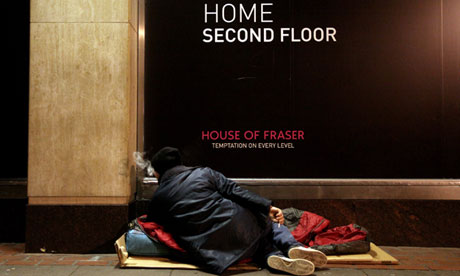
'Most homeless people want to work because
employment is an important step towards getting back on track.' Photograph: Oli
Scarff/Getty Images
Could I live on just £45 a week? This is the question I asked myself last
week as I listened to George Osborne's announcement that he will increase the
use of benefit sanctions when the help-to-work scheme comes into effect.
According to our survey of relevant services, 31% of homeless people claiming
jobseeker's allowance had been the subject of sanctions compared with a national
average of just 3%. Most homeless people want to work because employment is an
important step towards getting back on track, but complex problems make the
journey to finding a job hard. Individuals require extra support to get
there.
The challenges that many homeless people face are simply not suited to the current one-size-fits-all system. Of our survey respondents, one-third reported that clients with mental health problems were sanctioned and nearly half of them reported that clients with substance misuse issues were also penalised. Is it realistic to expect these people to meet the same conditions for claiming benefits as everyone else?
The welfare system should ensure there is a safety net for the most vulnerable and the excluded in our communities. In reality, the inflexibility of sanctions is allowing such individuals to slip through the net to the margins of society where their problems are likely to worsen.
The conditions that claimants are expected to meet to claim benefits must reflect their individual circumstances and be realistically achievable. The evaluations that the Department for Work and Pensions conducts recognise that individuals facing the greatest barriers to work need more support. This should be reflected in greater flexibility in the benefit system.
This is only possible if Jobcentre Plus staff are given specialised training
in working with clients who have complex issues and can then tailor support to
suit the individual.
Our research also revealed a lot of confusion about the sanctions regime and the appeals process, which is considered to be long and complicated. There are too many examples of individuals being unfairly sanctioned, because of administrative error, for example, and falling into real financial difficulty while their appeal is processed. There must be greater communication from the department to avoid harming those who are often the most in need.
Sanctions are designed to give incentives to individuals to find work. While the threat of having benefits stopped or reduced may lead to positive behavioural change in some, it clearly does not work for those who face the most severe barriers to employment.
The knock-on effects of sanctions can be significant. They can lead people into increased debt and rent arrears, food poverty, crime and worsening physical and mental health. Instead of moving closer to work, sanctions are leading to many homeless people moving further away from getting a job.
Benefit sanctions simply do not work for many of the most disadvantaged
members of society. They could be making the process of simply surviving more
difficult and further reducing the likelihood of finding a job. This makes no
sense for individuals or society. Better support is needed, not stricter
conditions.
Rick Henderson is chief executive of Homeless Link
• Want your say? Email housingnetwork@theguardian.com
Guardian
When we interviewed one
individual for our research into the impact of sanctions
on homeless people £45 was the amount he was left with after his benefits
were docked. Sadly, his is not an isolated case.
The challenges that many homeless people face are simply not suited to the current one-size-fits-all system. Of our survey respondents, one-third reported that clients with mental health problems were sanctioned and nearly half of them reported that clients with substance misuse issues were also penalised. Is it realistic to expect these people to meet the same conditions for claiming benefits as everyone else?
The welfare system should ensure there is a safety net for the most vulnerable and the excluded in our communities. In reality, the inflexibility of sanctions is allowing such individuals to slip through the net to the margins of society where their problems are likely to worsen.
What needs to
change?
The conditions that claimants are expected to meet to claim benefits must reflect their individual circumstances and be realistically achievable. The evaluations that the Department for Work and Pensions conducts recognise that individuals facing the greatest barriers to work need more support. This should be reflected in greater flexibility in the benefit system.
Our research also revealed a lot of confusion about the sanctions regime and the appeals process, which is considered to be long and complicated. There are too many examples of individuals being unfairly sanctioned, because of administrative error, for example, and falling into real financial difficulty while their appeal is processed. There must be greater communication from the department to avoid harming those who are often the most in need.
Sanctions are designed to give incentives to individuals to find work. While the threat of having benefits stopped or reduced may lead to positive behavioural change in some, it clearly does not work for those who face the most severe barriers to employment.
The knock-on effects of sanctions can be significant. They can lead people into increased debt and rent arrears, food poverty, crime and worsening physical and mental health. Instead of moving closer to work, sanctions are leading to many homeless people moving further away from getting a job.
George
Osborne, in his speech to the
Conservative conference, recognised that individuals with problems such as
mental health, drug addiction and illiteracy need more support. However, another
mandatory regime and strict conditions could disproportionately hit thousands of
people and further exacerbate the issues that led them to the streets in the
first place.
Rick Henderson is chief executive of Homeless Link
• Want your say? Email housingnetwork@theguardian.com
Guardian
