With an election not far away, it doesn't matter if policies work – only that they come down hard on malingerers and migrants
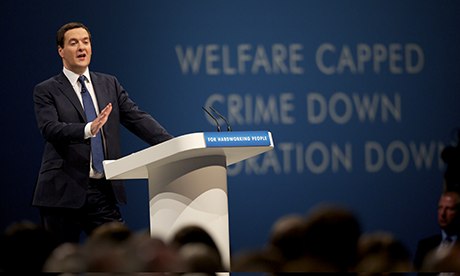
George Osborne speaks at the Conservative
party conference. Behind him is the slogan: 'Welfare capped, crime down,
immigration down.' Photograph: Christopher Thomond
With 18 months until the
next election, welcome to the latest phase of Conservative politics.
Modernisation now looks like a brief nightmare from which a relieved party has
awoken, and most elements of the Tory agenda seem to have been signed off by
their campaigning guru Lynton Crosby. As
a very insightful piece
in the current issue of the New Statesman puts it: "No 10 aides boast that
campaign strategy and policymaking are now inseparable." In other words: plans
are afoot that will have a profound effect on millions of lives, but they have
almost no basis in what we once called "evidence-based policy", and everything
to do with desperate electioneering. The result is a meandering popularism that
ignores questions about where the country might end up and fixates on the most
cynical of political games.
Private landlords will now have to run checks on their tenants (thanks to the Lib Dems, something to be trialled in a single area pre-2015, though the Home Office insists this move boils down to the policy being rolled out on a "phased basis"). Getting a bank account will involve being cross-referenced with a list of "known immigration offenders"; temporary migrants will be charged a "levy" for use of the NHS; powers to collect fingerprints and search for passports will be extended. "Most people will say it can't be fair for people who have no right to be here in the UK to continue to exist as everybody else does," May said last week, and that was that: to use the argot of the last Tory campaign Crosby masterminded, she's thinking what they're thinking, which is all that matters.
And, of course, the policies won't work. The urban demi-monde of landlordism, illicit employment and lives lived in the most precarious circumstances will balloon. Moreover, as the Immigration Law Practitioners' Association has pointed out, a "hostile environment" for one part of the population will entail a pretty trying time for everyone else, and routine identity checks for the whole adult population. Mindful of what might be called the British liberal inheritance, even Nigel Farage gets that: "This legislation would lead to a society where scrutiny in daily life would threaten individual freedoms and liberties," he says.
As the Tories' approach to
so-called welfare hardens to the point of institutionalised cruelty, another
election-oriented wheeze is about to arrive. In April anyone who is long-term
unemployed will have to fall in with the
regime the government has called "Help to Work" and, under pain of having
their benefits stopped, be forced to either spend 35 hours a week in their local
jobcentre, do indefinite unpaid community work, or agree to "compulsory
training". The "sanctions" system which is already pushing people into
borderline destitution is sure to become even more arbitrary and punitive.
In political terms, whether
any of this will actually work is scarcely relevant. After all, the existing
work programme doesn't
work: thanks to the National Audit Office, we now know you've got a better
chance of finding a job if you go nowhere near it. The bedroom tax doesn't work:
the entirely imaginary prospect of three- and four-bedroom houses being freed up
was always going to bump up against the complete lack of one- and two-bedroom
social housing. After another
punishing report from the National Audit Office, it is looking increasingly
like the grand project that is universal credit will be a disaster. But for now,
it doesn't matter: more than ever, politics is about the manipulation of
appearances rather than any concrete outcomes, and, in the collective
Conservative mind, as long as the party is coming down hard on an imagined army
of immigrants and malingerers, all is well.
Amid the bathos and farce
of British politics, that might sound alarmist. But if nasty populism meanders
on and on, you run the risk of arriving at a society that will feel hateful and
soulless even to the millions of people who were said to be willing its creation
(including, I would imagine, plenty of Tories). If you want a sense of where we
might be going, consider the fact that the Red Cross is to get
involved in food aid in Britain for the first time since 1945, and imagine
the most likely results of these latest government moves: even more desperate
people, existing on society's margins, and living from hand to mouth –
untouchables, in all but name, there to be kicked around for other people's
political advantage.
And then came Iain Duncan Smith's new opposite number, Rachel Reeves. "Nobody should be under any illusions that they are going to be able to live a life on benefits under a Labour government," she said. "If you can work you should be working, and under our compulsory jobs guarantee if you refuse that job you forgo your benefits, and that is really important … It is not an either/or question. We would be tougher… If they don't take it [the offer of a job] they will forfeit their benefit."
In 1984, Orwell coined a
term for this kind of political expression. He called it duckspeak: a
bland but pernicious honk, these days the sound of intelligent people stooping
to conquer, trying not to think about where all their meandering populism might
take us.
