A leaked report
shows 97% of people undergoing its assessment are 'expected' to recover within
two years
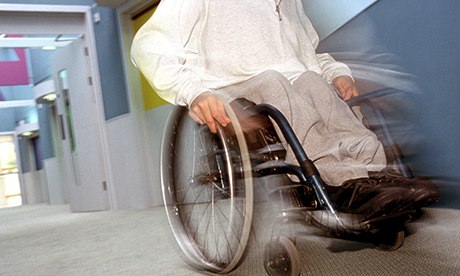
Leaked data suggests the Department for
Work and Pensions is holding Atos to extremely tight tolerances. Photograph:
Janine Wiedel Photolibrary/Alamy
Ask Atos, the company
responsible for executing the work capability assessment (WCA), or the
Department for Work and Pensions, which defines how the WCA is conducted, and
they will tell you that they have no targets for the number of people who pass.
Yet a new report from the Centre for Welfare Reform, How
Norms Become Targets, uses a leaked set of Atos data to suggest that the DWP
is holding Atos to extremely tight tolerances on its results.
Combining any
data-gathering system with pressure to meet expectations will drive staff to
converge on the "official" numbers; norms will become de facto targets, and no
manager wants to be forced to justify their region's figures. Unfortunately
pressure to meet expectations is exactly
the process described to the Guardian by Atos whistleblower Dr Greg Wood,
who went public after being repeatedly asked to change assessments, including at
least one case that conflicted with his professional medical opinion.
This suggests an
explanation for some of the stranger Atos rulings, where people with lifelong or
degenerative disabilities have been told their
conditions are expected to improve in six months. Any assessor struggling to
keep down their average for longer-term prognoses has to be tempted to assign a
shorter prognosis instead. Someone with a long-term disability should
theoretically face an assessment once every three years, but if they are
consistently assigned to the six-months prognosis group, they will potentially
face not one but six assessments in that period.
Similar problems exist for
points awarded during the assessment. The "descriptors", if matched, are worth
six, nine or 15 points, and many disabled people will match multiple
descriptors. It takes 15 points to qualify for the ESA, yet the report suggests
national averages of 2.1 points for physical issues and 3.6 points for mental
issues. The only way to maintain such low averages is by scoring several people
at zero points for each one who passes. Are cases of people who score zero
points when they clearly should pass simply evidence that the assessor saw too
many seriously ill and disabled people that week? There is already
an outcry over the state of the work capability assessment, with roughly one
in six of all assessments successfully appealed against, at a cost to the
Tribunals Service, and the taxpayer, of more than £75m per year. If that failure
rate is not caused by poor quality work at the healthcare professional level but
is a consequence of the Atos management system, which in turn is driven by the
contractual requirements placed on it by DWP, then shouldn't that outcry be
louder still?
theguardian.com
