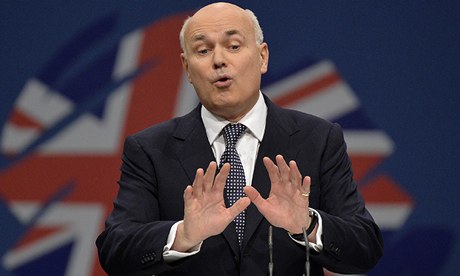
Iain Duncan Smith conceded that he will
miss his own deadline for moving all claimants to universal credit by 2017.
Photograph: Toby Melville/Reuters
It has been another noisy
week for the quiet man. Iain Duncan
Smith decided that the chancellor's statement on the economy made Thursday a
good day to bury bad news. With a shabbiness entirely in keeping with the work
and pension secretary's low character, he sneaked out the admission
that he would fail to hit the 2017 deadline for the introduction of his
universal credit when no one was looking.
The truth that he had
wasted more money than an army of benefit fraudsters on a grandiose IT system
had been dragged out of him like a confession from a hardened criminal. The
Department for Work and Pensions admitted
to writing off £34m in September. The public accounts committee upped the
losses to £140m
in November. The spectacularly well-informed tech journalists on
Computer Weekly were gloomier still: the taxpayer may have to lose
most, if not all, of the £303m Duncan Smith had spent, they
reported.
The day before the
universal credit fiasco, Kent county council linked Duncan Smith's welfare "reforms" to the
growing
misery in the county. Thousands were dependent on food banks, its officers
said. In a throwaway line that tells you all you need to know about Britain, the
council added that 1,357 children had come to the banks, not so much to ask for
"more" as for any food at all. Hunger was up, crime was up and homelessness was
up. The only thing falling was household incomes. And this in Kent, "the garden
of England" and one of the most prosperous counties in the land.
Paul Carter, Kent's
Conservative leader, promptly
suppressed his officers' findings. We need a new word to describe such
underhand tactics – "Duncian" or "IDioSyncratic" perhaps; a neologism that
acknowledges all the deceits that Duncan Smith has weaved from the moment when
he claimed on
his CV that he had studied at Perugia University, rather than an Italian
language school, to his manipulation
of statistics today.
But in a week that has
tested the stoicism of the most unshockable Duncan Smith watchers, it was
Tuesday's news that shook me most. The authorities increased from nine to 13 the
number of people facing charges over an alleged fraud on the taxpayer at A4E.
The parasitic company grew at public expense, most notably with contracts to run
Duncan Smith's Work Programme. The trial is pending, but we already know that
A4E gave its former chairman, a Cameron crony called Emma Harrison, a £1.3m
dividend after the fraud scandal broke in 2012, and that the prime
minister's former families' adviser had pocketed an £8.6m
dividend the year before.
"Are you still giving public money to A4E?"
"Yes, we are."
If you think of believing
the right's claims that it is cutting welfare to help the taxpayer, then think
of A4E and of the hundreds of millions thrown away on the universal credit and
think again. Inevitably, the Work Programme to find jobs for the unemployed is
another joke, and a cruel one at that. One of the standard tunes of the Tory
party and press is that sick and disabled people, who receive the employment
support allowance because they say they can't work, are liars. Duncan Smith
therefore sends them to dubious medicals. The doctors declare them healthy.
Duncan Smith cuts their benefits from £106 per
week to between £56 and £71. He then puts them on the Work Programme. His
own department's figures show that just 4% find jobs afterwards. Nothing has
changed for the remaining 96%, except that Duncan Smith has pushed them deeper
into poverty.
I ask not only because his incompetence and mendacity would disqualify him from any reputable firm, but because the removal of Duncan Smith from the leadership of the Conservative party is the opening chapter of the myth of David Cameron's moderation.
The modernisers say that
Duncan Smith's time in charge, from 2001 to 2003, was the catastrophe that at
last made the party realise that it had to return to the centre ground. The
Tories' poll ratings collapsed. Duncan Smith's friends turned against him. "I
can't think of a good thing to say about Iain," one prominent Tory of
the time told Tim Bale, an excellent historian of the modern Conservative
party. "He's not very bright. He's not very loyal either."
After his disastrous "the quiet man is here
to stay and he's turning up the volume" speech to the 2003 Tory conference,
Michael Gove wrote in the Times that everyone knew the Tories had to be
more than a rightwing rump. Yet Duncan Smith could not control himself. He had
given a "bitterly vicious" performance that would appeal to no one outside the
Tory tribe.
The Conservative party revolted. It threw out Duncan Smith and put Michael Howard in his place as caretaker. He promoted the young stars Cameron and George Osborne, who led the Tories back to the centre ground and back to government for the first time since 1997.
The trouble is, the Tory right never wanted to move to the centre and it has grown in power since 2010, as has the UK Independence party. Both admire Duncan Smith's "bitterly vicious" policies and would go wild if Cameron succeeded in firing him, as Osborne tried to do last year. In other words, Cameron's failure to take his party with him means that the wabbling fool is unassailable.
The children begging at food banks and the sick men and women that the coalition tells to work in jobs that do not exist deserve an answer to a hard question. The Conservative party did not consider Duncan Smith fit to be its leader in 2003, when it was in opposition and had no power. Why, then, does it give him the power to ruin their lives when it is in office in 2013?
Guardian
