We have iPads and broadband – but also oversubscribed foodbanks. Our economy is no longer zooming along unchallenged in the fast lane, but a clapped-out motor
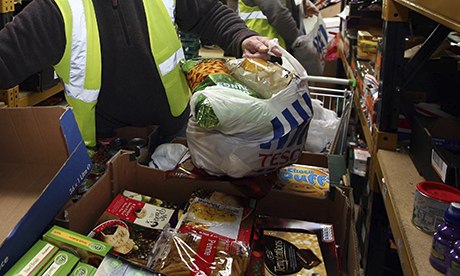
A foodbank in the Black Country.
Photograph: David Jones/PA
Elite economic debate
boils down to this: a man in a tie stands at a dispatch box and reads out some
numbers for the years ahead, along with a few micro-measures he'll take to
improve those projections. His opposite number scoffs at the forecasts and
promises his tweaks would be far superior. For a few hours, perhaps even a
couple of days, afterwards, commentators discuss What It All Means. Last
Thursday's autumn
statement from George Osborne was merely the latest enactment of this
twice-yearly ritual, and I bet you've already forgotten it.
Compare his forecasts and
fossicking with our fundamental problems. Start with last week's Pisa
educational yardsticks, which show British teenagers trailing their
Vietnamese counterparts at science, and behind the Macanese at maths. Or look at
this year's World Economic Forum
(WEF) competitiveness survey of 148 countries, which ranks British roads below
Chile's, and our ground-transport system worse than that of Barbados.
Whether Blair or Brown or
Cameron, successive prime ministers and their chancellors pretend that progress
is largely a matter of trims and tweaks – of capping business rates and funding
the A14 to Felixstowe. Yet those Treasury supplementary tables and fan charts
are no match for the mass of inconvenient facts provided by the Organisation for Economic Co-operation and
Development, the WEF or simply by going for a wander. Sift through the
evidence and a different picture emerges: Britain's economy is no longer zooming
along unchallenged in the fast lane, but an increasingly clapped-out motor
regularly overtaken by Asian Tigers such as South Korea and Taiwan.
Let me put it more broadly, Britain is a rich country accruing many of the stereotypical bad habits of a developing country.
I began thinking about
this last week, while reporting on graphene,
the wonder material discovered by Manchester scientists and held up by cabinet
ministers as part of our new high-tech future. Graphene is also the point at
which Treasury dreaminess is harshly interrupted by the reality of our national
de-development.
How can any nation that
came up with the BBC and the NHS be considered in the same breath as India or
China? Let me refer you to one of the first lines of The Great
Indian Novel by Shashi Tharoor, in which a wise old man warns International Monetary Fund
officials and foreign dignatories: "India is not, as people keep calling it, an
underdeveloped country, but rather, in the context of its history and cultural
heritage, a highly developed one in an advanced state of decay."
Even banana republics have cash: it just ends up in the hands of a very few people – ask the bank managers of Switzerland or the hotel concierges of Paris. In Britain, we have become used to having our resources skimmed off by a small cadre of the international elite, who often don't feel obliged to leave much behind for our tax officials. An Africa specialist could look at the City and recognise in it a 21st-century version of a resource curse: something generating oodles of money for a tiny group of people, often foreign, yet whose demands distort the rest of the economy. Sure, Britain has iPads and broadband – but it also has oversubscribed foodbanks. And the concept of the working poor that has dominated political debate since the crash is also something straight out of development textbooks.
Nobel laureate Amartya
Sen defined development as "the removal of various types of unfreedoms that
leave people with little choice and little opportunity of exercising their
reasoned agency". Yet when it comes to social mobility, Britain now has the
worst record of all advanced countries – and will soon be overtaken by the newly
rich countries of east Asia.
This isn't a sub-Rhodesian moan about Britain going to the dogs. But as my colleague Larry Elliott said in his most recent book, Going South, the sooner we puncture our own complacency at having created a rich economy for the few, and think of ourselves as in dire need of a proper economic development plan, the better.
Otherwise, we're well set
to corner the world market in pig
semen. The United Kingdom of spoink.
