Reblogged from Scriptonite Daily:
One of the purported achievements of the Coalition government’s disastrous
economic policy of austerity, has been the unemployment figures. Pundits say
that at
7.8% (2.51m)
they are nothing to shout about but not the disastrous rates seen in states such
as Greece (
26.9%)
or Spain (
26.3%). In
reality, the unemployment rate is more than double this in many areas, while
those in employment are facing ever worsening conditions to retain their
non-jobs.
Messing with the Figures
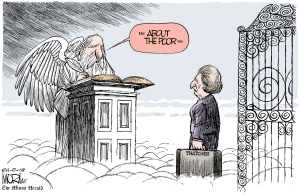
We have the Thatcher government to thank for the majority of the statistical
trickery which currently renders the government released unemployment figures
redundant. Prior to 1979, the unemployment rate was anyone registered as
unemployed, this was converted to a percentage of the total workforce and that
was the published unemployment rate. Then some changes came in:
- Redefining
Unemployment: originally defined as those ‘registered’ unemployed, changed
to only count ‘claimants’ – this obviously reduced the number greatly as many
unemployed people do not, for various reasons, claim benefits.
- Cutting Benefit
Entitlements: By making changes to the benefit system (who is eligible and
not) the government can magic away unemployment numbers by simply removing
eligibility for benefits. If the person cannot claim, they are not classed as
unemployed.
- Training Schemes
& Work Programmes: the conservative government of the 80’s began to
double count those in training & work programmes. First, they excluded them
from the unemployed figures, then they added them to the total workforce figures
– this means that simply by recruiting people into a work programme, the
government has reduced the unemployment figures. Prior to Thatcher, these
schemes were not counted as employment.
The Thatcher government was able to show a drop in unemployment of
550,000 in July 1986,
and
668,000 in 1989
by transferring those unemployed into work programmes. They also kept an
average
90,000
unemployed under 18 year olds off the books by making them ineligible to claim
benefits.
Sadly, none of these changes have since been reversed, giving the UK public a
much skewed view of unemployment and underemployment. If we look at the
research prepared by other bodies without such downright deceitful exemptions,
we reveal a more realistic picture of the economic woe being meted out across
the country.
The Real Unemployment Rate
A study put together by Sheffield University last year set out to establish
the real level of unemployment in the UK, given that there has been little
change in the published unemployment statistic, we can suppose they still hold
relatively true. The
study
found:
- For Britain as a whole in April 2012, the new figures point to more than 3.4
million unemployed. This compares to just 1.5 million on the claimant count and
2.5 million according to the Labour Force Survey – the government’s two official
measures of unemployment. The difference is attributable to extensive hidden
unemployment.
- An estimated 900,000 unemployed have been diverted onto incapacity benefits.
These are men and women with health problems who claim incapacity benefits
instead of unemployment benefits. They do not represent fraudulent claims.
- Hidden unemployment is disproportionately concentrated in the weakest local
economies, where claimant unemployment is already highest. The effect has been
to mask the true scale of labour market disparities between the best and worst
parts of the country.
- In the worst affected districts, the real rate of unemployment is often
around 15 per cent. Knowsley in Merseyside tops the list with a real rate of
unemployment estimated at 16.8 per cent.
- The older industrial areas of the Midlands, the North, Scotland and Wales
mostly have the highest rates of unemployment. In large parts of the south of
England the rate is still only 3-4 per cent.
- Comparisons with similar data for earlier years shows that Britain was still
a long way off full employment before the 2008/9 recession. Full employment is
now still further away and the real rate of unemployment is higher than at any
time since 1997.
- The report casts serious doubt on the likely impact of the Coalition
government’s reforms, notably the Work Programme and Universal Credit, which are
founded on the assumption that unemployment can be brought down by encouraging
the unemployed to find work. The evidence points to large and continuing
shortfalls in job opportunities away from the most prosperous parts of southern
England.
One of the more worrying points in the survey is the widening gap between
‘claimant
count’ and unemployed (p5), as ever increasing numbers of people fund
themselves without a job or eligibility to claim social security. For this
expanding pool of people, exploitation beckons.
Exploiting the Unemployment Racket
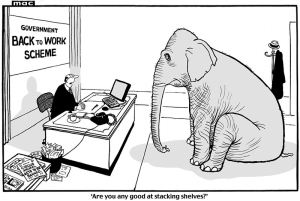
The government is pressurising people into ever more exploitative work
programmes in order to reduce unemployment figures by threatening withdrawal of
social security for non-compliance. In 2011, the Conservative and Liberal
Democrat coalition government
announced a plan to increase uptake of Workfare (the term given to
these schemes) by 100,000. They also made changes to the programme they
inherited from New Labour as follows:
1. A jobseeker who leaves a placement after 1 week loses their welfare
payments for 6 weeks. If they do this a second time, they lose them for 13
weeks. The third time, three years.
2. Placements can be mandated for up to 30 hours a week for as long as 6
months.
3. The scheme has been opened up so corporations in the private sector can
exploit this taxpayer funded, forced labour.
This means that someone who finds themselves unemployed must work up to
thirty hours a week, for up to six months at a time, stacking shelves for Tesco
or Poundland simply to receive as little as
£53 per week, which they are already entitled to as part of
the social contract of Britain. Also, Tesco isn’t paying the £53; we are,
through our taxes.
Although an interview is supposed to be guaranteed at the end of the term, it
is not required that the workfare provider has a vacancy open. An interview for
a job that doesn’t exist is no interview at all.
Corporations get free labour, the government gets to massage the unemployment
figures (
Workfare
victims are counted as employed) and the unemployed get shafted.
Anyone doubting this critique would do well to read the findings of the DWP’s
own analysis of the performance of their work programmes. These schemes cost
the taxpayer
£5bn,
yet only
1
in 10 people found employment lasting up to 3 months. The figures are even
worse for the sick and disabled people forced into the work programmes – only
1
in 20 finding lasting employment.
The picture doesn’t get any rosier for those who have managed to find
employment either.
Employers are less likely to provide real jobs than ever. As the market
favours the employer, there has been an unprecedented month on month fall in
wages
through
the entire 36 months of the Coalition government, and wages were
already
falling before they arrived.
On top of hidden unemployment, the UK also has an ever growing problem with
underemployment; the case of people unable to find jobs with sufficient
hours/pay to meet their needs.
A recent paper by researchers at the University of Stirling revealed that
underemployment rose from
6.2%
in 2008 to
9.9%
in 2012. The rate hit
30%
among 16 to 24 year olds.
We have also seen the rise of ‘zero hour’ contracts. Almost unheard of a few
years ago,
more
than a million UK workers are now under these contracts. These contracts
have no specified working hours – meaning that an employee is placed on
permanent stand by until or unless the employer needs them. While classed as
employed, the person has no wage security as they cannot guarantee their pay
from one week to the next. They also receive no sick pay, leave or other basic
terms and conditions.
The Resolution Foundation recently published a
review of
‘Zero Hours’ contracts which found serious issues of the spike in their use:
- Those on ‘Zero Hours’ contracts earn less
than half the average wage (£236 vs. £482 per week) of those on proper
contracts.
- Workplaces using ‘Zero Hours’ contracts have a higher
proportion of staff on low pay(within £1.25 of minimum wage) than those who
do not.
These factors have allowed the UK Labour Market in recent years to combine
a
relatively
high level of employment and an unprecedented squeeze on wages.
- Those on ‘Zero Hours’ contracts work 10
hours a week less, on average, than those who are not (21hrs – 31hrs).
- 18% of
those on ‘Zero Hours’ contracts are seeking alternative employment or more hours
versus 7% of those in ordinary contracts
These factors have contributed to the
rise
in underemployment in the UK since 2008. An ONS survey last year revealed
more than
1
million people had been added to the rank of the underemployed since the
2008 bailout of the banks.
- ‘Zero Hours’ contracts are hitting young people the hardest, with 37% of
those on such contracts aged between 16-24.
- ‘Zero Hours’ contracts are more likely to be held by those
without a degree, and with a GCSE as their highest level of education.
- Non UK Nationals are 15% more
likely to be employed on such a contract than UK Nationals.
It is not difficult to see the advantages of ‘Zero Hours’ contracts to
employers – they can achieve maximum flexibility of their workforce, effectively
retaining them on a pay as you go basis. It is also clear that in the short
term, the government of the day also enjoy the advantage of hiding the true
effects of their cut throat economic policies. But the ordinary human being
seeking to meet the rising cost of living is losing on all counts.
Between 2008 and 2012, inflation rose
17%
according to the Consumer Price Index, while incomes increased just
7%
– this translates to a real terms pay cut of 10% for working people. But the
Consumer Price Index measurement tracks the rising cost of an imaginary list of
products and services that the poorest workers are unlikely to ever buy. The
UK
Essentials Index however tracks inflation of the bare essentials that would
the poorest would buy – and these have risen by an eye watering
33%
during the same period. This means that not only is the impact of unemployment
hitting the country disproportionately, but underemployment and exploitative
employment conditions are too – with the poorest being the worst affected.
Economic Recovery? For Who?
There was a piece on the Guardian this morning talking about the
triple
boost to the UK economy of increased factory output, house prices and car
sales, and trumpeting this as a sign of economic recovery.
But what is the point of this increased GDP if it is won at the expense of
people wages and livelihoods? Surely, if the inequality in the UK between rich
and poor is growing, unemployment is rising, underemployment is rising and wages
are falling – this is a recession. It speaks volumes for the broken economic
measures of growth at play here that a real world recession for the majority, is
applauded as a recovery, when all that is recovered are the profits for
transnational corporations and incomes of high earners, most of whom pay little
or no contributions in tax.
Get Involved
Boycott Workfare – get involved
in the campaign to outlaw workfare
UKUncut – get involved in demanding
proper tax contributions from those corporations benefitting from these
nightmare employment schemes.
DPAC – Disabled People Against Cuts do
extraordinary work highlighting the state’s assault on disabled people. Please
support them