Government's own adviser on fuel poverty says chancellor's attack on Energy Company Obligation is 'completely inequitable'
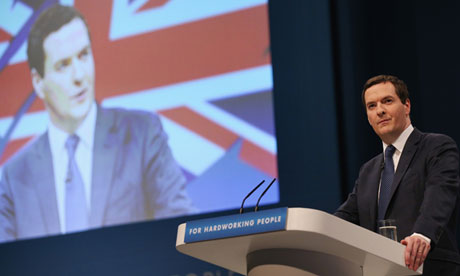
George Osborne delivers his speech to the
Conservative party conference in Manchester last month. Photograph: Oli
Scarff/Getty Images
George Osborne's
plan to cut financial support for energy
efficiency in poorer households is an "unforgivable" attack, according to
the government's own adviser on fuel poverty.
With a political
row raging over soaring energy bills, inflamed further by an 8% rise from
the "big six" energy company SSE on
Thursday, Osborne and No 10 sources have repeatedly
indicated that the Energy Company
Obligation (ECO) is being targeted for cuts
or delays to reduce the government levies imposed on consumer energy bills.
But Derek Lickorish, chair
of the government's Fuel
Poverty Advisory Group, said: "It is completely inequitable to attack the
only measure that is doing something for the fuel poor in England. It is
unforgivable when we have energy prices that are going only in one
direction."
On Friday the business secretary, Vince Cable, said it would be "short-sighted and foolish" to ditch green levies that make up just under 10% of the average bill.
"The rise in energy prices is due to a whole variety of things, by far the most important of which is what's happening in world energy markets," he told BBC Radio 4's Today programme.
"We've had over a period of years very rapidly rising demand in Asia, particularly in China. We've had restrictions on supply from countries like Iran. A combination of these things has pushed up oil and gas prices and that is what has fed through to consumers."
His comments followed a suggestion from the CEO of SSE, Alistair Phillips-Davies, that his company's 8.2% price hike announced on Thursday was "helpful" to focus the nation's spending priorities.
Phillips-Davies told
the Daily Telegraph: "A price rise is never a good thing to do, but if it
focuses everyone on to a debate about what we as a nation should be spending
money on, then in one way it will be helpful.
"We need to think about what people really want to pay for; maybe it's time
to retreat from decarbonisation and focus more on the cost of living. I think we
have to have a debate about it. "Do we want to be replacing one bit of [energy] generation that we can keep going for a bit longer with a new bit of generation that's going to cost more?"
According to the Department of Energy and Climate Change, the ECO costs billpayers £1.3bn a year and makes up 4% – or £47 – of an average annual energy bill.
The Lib Dem energy
secretary, Ed Davey, launched a pre-emptive
strike against cuts to the ECO on Tuesday by writing to energy companies,
most of whom oppose the ECO scheme, demanding greater transparency over how much
the policy actually costs them to implement.
A Lib Dem source said the
party would try to block Conservative cuts to the ECO: "The scheme is about
improving the energy efficiency of the homes of poorer people and pensioners. If
anyone is saying let's rip up ECO and stop thousand and thousands of homes
getting energy efficiency measures … it's not happening." Conservative sources
declined to comment. The coalition partners are also in dispute over the subsidies
given to renewable energy.
Lickorish, who worked in
the energy industry
for more than 40 years including a period at energy giant EDF, said: "It's
devastating how much energy prices have outstripped incomes. Fuel poverty has
increased and it is well known that this is a contributory factor to the UK's
unenviable record of winter deaths. We fully expect those deaths to have risen
when the new figures are announced in November."
On Thursday, SSE stated:
"This year's ECO costs per customer will be over 5% higher than those of the
similar government-imposed schemes last year". The company said the "cost of
delivering ECO is expected to continue to increase as the scheme goes on". In a
letter
to party leaders on 1 October, SSE's Phillips-Davies proposed shifting the
current £110 of annual green and social policy costs from customer bills into
general taxation, "shifting the cost away from those [in fuel poverty] who can't
afford to pay and on to those who can."
The National Insulation Association (NIA) warned on Thursday that the government's energy efficiency measures were "currently not delivering as expected by government with cavity wall installations 65% down and solid wall insulation over 70% down". In contrast to energy companies' call for a delay on meeting ECO targets, the NIA urged acceleration of ECO delivery.

Graphic: Paul Scruton for the Guardian
Guardian
