Friday, March 27, 2015

Forced CBT: The power of positive thinking is really political gaslighting


The power of positive thinking.
The government invests a lot of time and money in making people accept the unacceptable.

George Osborne announced in the budget that the government will be funding a “package of measures” to improve “employment outcomes” which will entail putting Cognitive Behaviour therapists in more than 350 job centres to provide “support” to those with “common mental health conditions” who are claiming employment support allowance (ESA) and job seekers allowance (JSA).

The government have put up an online contract notice which specifically states: “This provision is designed to support people with common mental health conditions to prepare for and move into work, with intervention at the earliest possible point in a claim to benefit or access to the Fit for Work service.”

We really must question the ethics of linking receipt of welfare with “state therapy,” which, upon closer scrutiny, is not therapy at all. Linked to such a narrow outcome – getting a job – this is nothing more than a blunt behaviour modification programme. The fact that the Conservatives plan to make receipt of benefits contingent on participation in “treatment” worryingly takes away the fundamental right of consent.

Cognitive Behaviour Therapy (CBT) is used to change how you think (“Cognitive”) and what you do (“Behaviour”). It bypasses emotions, personal history and narrative, to a large extent, and tends to focus on the “here and now.”

CBT is an approach that facilitates the identification of “negative thinking patterns” and associated “problematic behaviours” and challenges them. This approach is at first glance a problem-solving approach, however, it is of course premised on the assumption that interpreting situations “negatively” is a bad thing, and that thinking positively about bad events is beneficial.

The onus is on the individual to adapt by perceiving their circumstances in a stoical and purely rational way.
So we need to ask what are the circumstances that the government are expecting people claiming benefits to accept stoically. Sanctions? Work fare? Being forced to accept very poorly paid work, abysmal working conditions and no security? The loss of social support, public services and essential safety nets ? Starvation and destitution?

Read more...

Thursday, March 26, 2015

Massive survey majority believes ‘inhuman’ DWP causes and then covers-up claimant deaths


Please note: there are repeated references to suicide in the final section of this article, headed: “Is there anything else you would like to tell us about issues covered in this survey?“

A Benefits and Work survey has revealed an overwhelming distrust of the DWP, with the majority of respondents considering that the department:
  • has negatively affected their own health
  • treats claimants inhumanly
  • causes claimants’ deaths
  • covers up the poverty, suffering and deaths it causes
Benefits and Sanctions deaths survey

In the last Benefits and Work newsletter we published a link to a ‘Benefits sanctions and deaths’ survey.

Two things prompted us to create the survey:
    the preceding week Conservative business minister Nick Boles told charity volunteers that some benefits sanctions were ‘inhuman’ – then changed his mind.
  • Channel 4’s Dispatches revealed that that more than 30 secret reviews carried out following the deaths of benefit claimants called for improvements by the DWP.
We received over 1,000 responses to our survey in just two days, with almost 50% of respondents also leaving detailed comments.  We’ve published around 100 of those comments below – we apologise that we couldn’t publish them all.

The results below have been rounded to one decimal place, so do not always add up to exactly 100%.


Bar chart for first survey question
The results for our first question “Do you think that the benefits system is ‘inhuman’ in the way it treats claimants?” were overwhelmingly critical of the DWP and its partners.

99% of respondents said that, at least sometimes, the benefits system is inhuman.

Yes 88.1%
No 0.6%
Sometimes 11.1%
I don’t know 0.2%


Bar chart for question 2 on health
A very strong majority of respondents, 88.7%, said that their health has suffered because of difficulties with the benefits system, with fewer than 10% saying that it hasn’t.

Yes 88.7%
No 9.6%
I don’t know 3.7%


Bar chart for question 3 on deaths
A massive majority of respondents, 97.3% , consider that DWP sanctions, cuts and unfairness have been responsible for the deaths of claimants.

There is uncertainty about the numbers involved, but 82.5% believe it is in the hundreds or even thousands.

No 0.7%
Yes, a small number 14.8%
Yes, probably hundreds 44.0%
Yes, probably thousands 38.5%
I don’t know 2.2%


Bar chart for question 4 on DWP cover-ups
A huge majority are also sure that the DWP is involved in a cover up about poverty, suffering and benefits-related deaths.

96% believe this to be the case, whilst fewer than 1% think the DWP is being open about these issues.

Yes 96.0%
No 0.9%
I don’t know 3.1%

Read more...

Monday, March 23, 2015

TV Licence Violates Terrorism Act: Man Wins Lawsuit against BBC for 9/11 Cover Up


‘Tony Rooke, in an act of civil disobedience, refused to pay the mandatory £130 TV license fee claiming it violates Section 15 of the Terrorism Act. Rooke’s accusation was aimed at the BBC who reported the collapse of WTC 7 over 20 minutes before it actually fell, and the judge accepted Rooke’s argument. While it was not a public inquiry into 9/11, the recognition of the BBC’s actions on September 11th are considered a small victory, one that was never reported in the US.

“Today was an historic day for the 9/11 truth movement,” Peter Drew of AE911Truth UK told Digital Journal, “with over 100 members of the public attending, including numerous journalists from around the UK as well as from across other parts of Europe.”’

Read more: BBC Foreknowledge of 9/11 Collapse of WTC Building Seven: British Man Won Law Suit against BBC for 9/11 Cover Up

Thursday, March 19, 2015

Benefit Sanctions National day of action - Thursday 19 March 2015


No Sanctions logo


Please join an event near you on Thursday 19 March to stop benefit sanctions in your community.   

We will continue to add new actions on a regular basis, so please check back.

For further information please email your Unite community coordinator

Northern Ireland - Albert Hewitt
Scotland - Jamie Caldwell 
North West - Sheila Coleman


Monday, March 9, 2015

Father says daughter took own life over benefits cut


Julia Kelly
Julia Kelly Credit: ITV News Anglia
A father says his daughter took her own life because she was worried her disability benefits could be cut.
Julia Kelly from Northamptonshire suffered from chronic pain and took her own life days after receiving a letter from the Department for Work and Pensions.


Julia with her parents
Julia with her parents Credit: ITV News Anglia
At her inquest the coroner said the threat of losing her benefits triggered her to end her life...


Watch Sarah Cooper's ITV report here

ITV


Widow’s treatment by DWP ‘has been inhumane and cruel’


A disabled widow has accused the government of subjecting her and her late husband to “inhumane and cruel” treatment, after the Department for Work and Pensions (DWP) argued that it was not responsible for supporting them.

Laurel Duut’s husband Peter died in October 2011 at the age of 42, just seven months after being told he was not entitled to claim employment and support allowance (ESA) or jobseeker’s allowance (JSA), because he was a Dutch national and was not “active in the labour market”.

They had returned to the UK in 2008, although Peter had spent most of his life working in the Netherlands. He worked as a carpenter, firstly in London – commuting six hours a day from their home in Suffolk – and then closer to home for a housing association.

But in March 2011 Peter lost his job, and was told he was not entitled to JSA because he was a Dutch national.

They were forced to survive on Laurel’s disability living allowance (high rate care and lower rate mobility), and the carer’s allowance that Peter claimed. This left them just a few pence every week for food after paying their bills.

Peter became ill with undiagnosed cancer in April 2011, but his health deteriorated rapidly from June 2011, and he began to lose weight. He was six feet three inches tall, but his weight fell from 11 stone four pounds to just nine stone two.

After being told by Jobcentre Plus that he would need to travel to find work – despite writhing in pain during the interview – Peter walked in despair to his local newspaper and told them how he was being treated.
He told the Cambridge News that he and Laurel were living on just 12p a day each for food.

Laurel finally received about two weeks’ worth of ESA for her husband, but it only arrived after Peter died in October 2011. She put it towards the cost of his funeral...

Read more...

No Such Thing As A Fair Benefit Sanction - And They Are Not A Tory Invention


Iain Duncan Smith’s mass use of benefit sanctions is driving people to their deaths.  But it began under Labour, and was not opposed by most trade unions or charities established to support people living in poverty.

In 2008 the Labour government published a green paper entitled ‘No one written off: reforming welfare to reward responsibility’ (PDF).  Gordon Brown himself wrote the forward to the document pledging “tough responsibilities that respect tax payers” for all of those on some form of out of work benefit.

Even for a Government which had already introduced workfare and the despised Work Capability Assessment, some of the measures proposed were shocking.  These included mandatory work related activity – a vague term that often means workfare – for both sick and disabled claimants and lone parents with children over 5.  Other proposals included a policy that long term unemployed people should be sent on workfare for “as long as needed”.  Those with a drug problem would be required to undertake mandatory treatment regimes and possibly even drug testing.  Benefit sanctions would be strengthened. A new and privatised ‘Fit For Work’ service would be introduced to encourage people to go back to work quickly if they became ill.  And all those currently claiming sickness or disability benefits would be ‘frequently’ re-assessed at the notorious Work Capability Assessments which were being run by French IT company Atos.

Atos were far from the only private company set to rake in huge sums from Labour’s savage attack on the poor.  The green paper proposed that private providers would be able to bid for any welfare-to-work service.  This was based on a recommendation from David Freud, now better known as Lord Fraud, the current Tory Minister for Welfare Reform.

Except for mandatory treatment for drug users, all of these measure were eventually introduced, some by Labour and some by the Tories.  Many of Iain Duncan Smith’s most vicious policies were actually first proposed by Labour.

Read more...

Saturday, March 7, 2015

Protests in Ireland against Austerity Measures, Political Policing and Imprisonments


‘My name is Paul Kiernan and I am a resident of Tallaght, Dublin, Republic of Ireland. I was politically arrested on Monday 16th February 2015 and face a possible charge of false imprisonment (which has a maximum sentence of 15 years imprisonment) of our Tanaiste Joan Burton (Labour party leader, Deputy Prime Minister and Minister for Social Protection).

I am 1 of 23 people arrested (with a reported 41 due to be arrested) so far which include men and women aged in their 40,s, 50,s and 60,s and children aging from 12-18 years old. There was also 1 TD (MP) and 3 local councilors from the AAA (Anti Austerity Alliance) arrested. At this very moment there are 4 people imprisoned and 1 which will be when he returns from holiday with sentences of 28 days and 56 days for breaching a court injunction which banned them from been within 20 meters from Irish Water Meter Installers.

These arrests and imprisonments and others taken place throughout Ireland are taken place against people that are taken part in civil disobedience against a corrupt and inept political system and government.’

Read more: Protests in Ireland against Austerity Measures, Political Policing and Imprisonments

Britain’s Horrific VIP Paedophile Cover-Up


‘A newspaper editor was handed startling evidence that Britain’s top law enforcement official knew there was a VIP pedophile network in Westminster, at the heart of the British government. What happened next in the summer of 1984 helps to explain how shocking allegations of rape and murder against some of the country’s most powerful men went unchecked for decades.

Less than 24 hours after starting to inquire about the dossier presented to him by a senior Labour Party politician, the editor was confronted in his office by a furious member of parliament who threatened him and demanded the documents. “He was frothing at the mouth and really shouting and spitting in my face,” Don Hale told The Daily Beast. “He was straight at me like a raging lion; he was ready to knock me through the wall.”

Despite the MP’s explosive intervention, Hale refused to hand over the papers which appeared to show that Leon Brittan, Margaret Thatcher’s Home Secretary, was fully aware of a pedophile network that included top politicians.’

Read more: Britain’s Horrific VIP Paedophile Cover-Up

One In Five Hammered By Benefit Sanctions, Says Expert


Originally posted on UNEMPLOYED IN TYNE & WEAR:


Nearly one in five (18.4%) jobseekers were affected by punitive benefit sanctions in 2013-14, new analysis suggests.

Analysis of official Government figures by Dr David Webster, a researcher from the University of Glasgow, shows that 568,430 of the 3,097,630 individuals who claimed Jobseeker’s Allowance (JSA) during 2013/14 were sanctioned – with some seeing their benefits stopped more than once.

Furthermore, 22.3% of the total 8,232,560 individuals who claimed JSA between 2009/10 to 2013/14 (inclusive) have seen their benefits removed. Equivalent to 1,833,035 people.

The findings draw into question claims from DWP ministers, who insist only a “tiny number” of people are sanctioned and that they are only ever used as a “last resort”.

Statistically, the percentage of JSA claimants sanctioned each month stands at an average 6.5%.

However, according to the analysis, this headline statistic fails to account for the cumulative effect of benefit sanctions, which can last for a…

View original 276 more words

'Die in Six Months Or We’ll Prosecute You' - DWP To Terminally Ill Claimant

Originally posted on Same Difference:


A lady came in to see me today. She was beside herself as the DWP had treated her very badly over numerous different aspects of her claim. She had been misled and lied to, but this is the thing that’s making me want to roll some heads…

Her phone call to DWP last year….

Lady: I am calling to inform you of changes to my health; I now have cancer.
DWP: Well?
Lady: I was told to inform you of any changes to my health.
DWP: Well, are you going to die?
Lady: I’m not sure. I’ve only just been diagnosed.
DWP: Well, I can put you through on the special rules for terminal claimants, but if you don’t die within six months we will prosecute you.

She was so taken aback, she didn’t get…

View original 18 more words

RIP Julia Kelly: Another Tragic Suicide After DWP Threats


Originally posted on the void:

julie-kelly1

A woman who founded a charity to help people suffering with chronic pain committed suicide after a battle to claim disability benefits ended with the DWP demanding that she repay £4000 in backdated payments.

Julia Kelly was just 39 when she took ker own life at the end of last year.  In an  inquest into her death the Northampton Chronicle reported that the coronor believed the “upset caused by the potential withdrawal of her benefits had been the trigger for her to end her life.”

According to a statement made by her father at the inquest, Ms Kelly had attended three tribunals in her attempts to gain disability benefits.  Mr Kelly said he “firmly believed” correspondance from the DWP triggered her death adding:

“Not to be believed by the DWP that she was suffering chronic back pain and also to be accused of wrongdoing and be told her payments might…

View original 158 more words

Dad-of-three killed himself after benefits were stopped and he was threatened with eviction


” Pathologist Dr Mohammed Aslan, who performed a post-mortem examination on Mr McDonald, gave the medical cause of death as hanging.

He said toxicology tests had found no evidence of drugs or alcohol other than a small dosage of Sertraline, an anti-depressant.

Concluding Mr McDonald had taken his own life while suffering from depression, Mr Taylor said:
“Something must have happened to make him behave the way he did, because He had so much more to live for, especially his relationship with his daughter.

“At the time, his money had been stopped, he had no form of income, and he said he was threatened with eviction from his home – all matters that can play one someone’s mind very much.

“The appropriate conclusion for me today is that while he was suffering from a significant bout of depression, he took his own life.”

Read more...

DWP’s Mandatory Reconsiderations have “effectively destroyed” independent Tribunals


Originally posted on www.refuted.org.uk:

Benefit Sanctions Briefing – 18 February 2015: The DWP’s latest release updates the sanctions statistics to the end of September 2014. For the first time it includes the results of mandatory reconsiderations.

Download briefing – view online
Highlight:  “The Mandatory Reconsideration system, introduced on 28 October 2013, has fundamentally changed the whole appeal process, introducing additional steps and a new Jobcentre Plus structure. MR has cut the proportion of JSA sanctions which are challenged by claimants from about one third (33%) to about 20-25%. ESA sanction challenges have returned to below their pre-MR level, at about 45%. The independent element in the system offered by Tribunals has been effectively destroyed, completely in the case of ESA and almost completely for JSA, where only 0.14% of sanction decisions are now being taken to…

View original 91 more words

First Human Death Confirmed From Eating GMO


’31-year-old Juan Pedro Ramos died from anaphylaxis shock after consuming tomatoes containing fish genes that triggered the deadly allergic reaction. Doctors of the Carlos III hospital in Madrid Spain have confirmed this in a press conference shortly after his death and autopsy. The young Spaniard’s health rapidly declined immediately  following the severe allergic reaction.  The drugs administered to counter the anaphylaxis were completely inefficient. The team of medical experts concluded the genetically modified tomatoes that the victim ate during his lunch break resulted in his demise.’

Read more: First Human Death Confirmed From Eating GMO

Friday, February 27, 2015

Britain leading the charge against basic human rights


Increased surveillance in Britain, along with the reduction of access to justice, have contributed to one of the worst assaults on human rights in Europe since the fall of the Berlin Wall, according to a damning assessment by Amnesty International.

In its annual State of the World’s Human Rights report published today, Amnesty  says the Coalition had rushed through legislation such as anti-terror measures and invasive surveillance powers without adequate time for parliamentary debate.

The NGO condemns David Cameron for not only “leading the charge” in attacking the European Convention on Human Rights, but also for passing legislation that, while designed to increase public safety, has come at the cost of basic civil liberties.

The Prime Minister has confirmed that a future Conservative government would also repeal the Human Rights Act and replace it with a British Bill of Rights, with a view to limiting the influence of the European Court of Human Rights, which enforces the Convention.

Amnesty’s report warns that those draft proposals threaten significant restrictions on rights. At the same time legal aid cuts “continue to restrict access to justice”.

In its assessment Amnesty says the influence of “nationalist, thinly veiled xenophobic attitudes” was particularly evident in increasingly restrictive migration policies and anti-EU tirades, with human rights a particular target.

The report says: “The UK and Switzerland led the charge, with ruling parties in both countries openly attacking the European Court of Human Rights and discussing withdrawal from the Convention system. In short, at no time since the fall of the Berlin Wall had the integrity of, and support for, the international human rights framework in the Europe and Central Asia region appeared quite so brittle.”

Referring to the Data Retention and Investigatory Powers Act, which came into force last July, extending the reach of authorities’ interception powers, the report says “sufficient safeguards were not in place to ensure that such surveillance was authorised and carried out in conformity with the rights to privacy and freedom of expression”…

Read more...

Wednesday, February 25, 2015

UK-wide Day of Action at Jobcentres - 25 Feb

Support Tony Cox from the Scottish Unemployed Workers’ Network, who was arrested after assisting a claimant at Arbroath Jobcentre.


SOLIDARITY WITH UNEMPLOYED ACTIVIST ARRESTED FOR REPRESENTING A JOBSEEKER


TAKE PART IN A DAY OF ACTION AT JOBCENTRES BRITAIN-WIDE 25 FEBRUARY 2015

Scottish Unemployed Workers Network activist Tony Cox was arrested on 29th January after Arbroath Jobcentre management called police to stop him representing a vulnerable jobseeker. We urge you to join a Day of Action on 25th February at Jobcentres round Britain to show your solidarity.

We must fight back against this clear attempt to intimidate claimants and deny us the right to be accompanied and represented. Tony will be in court in Forfar on 25th February facing charges of “threatening behaviour, refusing to give his name and address and resisting arrest”. That same day we call on people to descend on jobcentres round Britain to show their solidarity with Tony and distribute information to claimants urging them to exercise their right to be accompanied and represented at all benefits interviews.

As we face unprecedented sanctions and benefits cuts, it’s more important than ever that we support each other and stand up to the DWP bullies. The Scottish Unemployed Workers Network, Dundee Against Welfare Sanctions and other groups have established a strong presence at the Jobcentres in Dundee and in nearby towns and cities like Arbroath, Perth and Blairgowrie, supporting claimants in opposing sanctions and harassment.

On 29 January Tony was accompanying a vulnerable woman claimant, who suffers from severe dyslexia and literacy problems. The claimant, D, had been signed up to the Universal Job Match (UJM), the computerised job search system, and was being forced to complete five job searches per day, the pressure of which had led to her having several panic attacks. Tony proposed that D’s UJM account be closed, and that her number of job searches be significantly reduced. The adviser refused to consider this, and so Tony and D met with the Jobcentre manager.

The manager likewise refused to even look at the issue, falsely claiming that all jobseekers had to be registered with UJM. She even suggested to D that she should arrange another meeting without Tony or any other witness or rep present. Despite the pressure D was being put under by the manager, she replied that she would not attend another meeting without Tony. At this point the manager demanded that Tony leave the building or the police would be called. Tony refused to leave, but the meeting ended when it was agreed that a further meeting be arranged to discuss the issue further. Tony was arrested after he left the Jobcentre.

The right of claimants to be accompanied to interviews, and for the accompanier to have the right to speak, has been established by groups like Edinburgh Coalition Against Poverty, who have forced the DWP locally and Britain-wide to apologise for calling the police on ECAP reps, and to affirm claimants’ right to representation. The DWP clearly state “Claimants accessing Department for Work and Pensions (DWP) benefits and services can have someone to accompany them to act on their behalf…”

The attack on benefits and claimants is part of the austerity assault on the entire working class. We call on all unemployed and claimants groups, anti cuts and anti austerity groups, human rights groups, workplace activists, and all working class people, waged and unwaged, to show solidarity with Tony and the right of the unemployed and all claimants to organise collectively to fight back.

Visit your local Jobcentre on 25th February with banners and placards and distribute leaflets to claimants on Tony’s case and the right to be accompanied to all benefits interviews.
Call out by Edinburgh Coalition Against Poverty - ecap@lists.riseup.net
Supported by Scottish Unemployed Workers Network
Dundee Against Welfare Sanctions
Boycott Workfare
Please add the support of your group/organisation: email admin@scottishunemployedworkers.net & ecap@lists.riseup.net
And don’t forget Disabled People Against Cut’s Day of Action the following week on 2 March!

Boycott Workfare

Monday, February 23, 2015

Will refusing to share sensitive personal data impact your #UC claim?


If you claim Universal Credit (“UC”) the DWP intends to share your most sensitive personal data with local authorities, citizens advice bureaux, credit unions, social landlords and relevant registered charities:

  • Full name (including initials)
  • Contact details including: address, email, telephone.
  • Details of others in household, in relation to the relevant Benefit Unit.
  • Type of accommodation – private / social rented, owned, none etc.
  • Gender
  • Ethnicity *.
  • National Insurance Number.
  • Date of birth / age range.
  • Employment status / earning.
  • Debts / arrears/rent payable.
  • Benefits received including: level of payment, copy of documents (e.g. claimant commitment).
  • Health conditions / disabilities *
  • Caring responsibilities.
  • Qualifications / training status.
  • Transport situation e.g. able to drive /access to car or easy access or public transport.
  • Barriers to work.
  • Languages spoken.
  • Access to financial products such as bank / building / credit union / Post Office card account / credit card.
  • Level of personal budgeting.
  • Access to computer and internet.
  • Level of digital skills.

On the 10th December 2014 the DWP quietly published a consultation document (see link below). This does seem to be a strange time to launch a consultation exercise given the proximity of the Christmas and New Year holidays. People would be forgiven for wondering if the DWP was attempting to sneak this out without anyone finding out until it was too late.

https://www.gov.uk/government/consultations/universal-credit-data-sharing-between-dwp-and-local-support-providers


Controlling and processing any personal data like that listed above is subject to the Data Protection Act 1998 (“DPA”). In the UK we have an organisation called the Information Commissioner (“ICO”) which has a statutory role in regulating the DPA. The DWP knows this as it has consulted with it on other matters. Did the DWP invite the ICO to take part in the consultation process? It probably won’t come as a surprise to many people to hear that the DWP didn’t invite the ICO to take part and as a result people would be forgiven for wondering how seriously the DWP takes its obligations under the DPA when dealing with sensitive personal data.

When I heard about the DWP proposals I sent a copy to the ICO as I wasn’t happy with the type of information being shared and the fact that the DWP included a threat against claimants if they weren’t willing to share their data. In section 4.4 of its consultation document the DWP states:

“Objecting to information sharing may, of course, have the potential to undermine an individual’s claim – claimants will therefore need to be advised about the possible adverse consequences of objecting to information sharing.”

It seems that the DWP just can’t help itself. If it doesn’t get its own way it automatically wants to punish members of society who face the most barriers and disadvantages.

Despite having a huge workload, the ICO acted quickly and issued a response to the DWP consultation document (see link below):

https://ico.org.uk/about-the-ico/consultations/dwp-consultation-on-draft-regulations-universal-credit-data-sharing/

It is obvious from its response that the ICO is very unhappy about the DWP proposals and the fact that it wasn’t invited to take part in the consultation. The following extracts give you a taste:

“The Information Commissioner is surprised and disappointed not to have also received a copy of this consultation or his officials alerted to the proposals given his Office’s role in regulating the Data Protection Act and also having issued a statutory code of practice on data sharing – https://ico.org.uk/media/for-organisations/documents/1068/data_sharing_code_of_practice.pdf We have been consulted in the past on data sharing initiatives arising from the Welfare Reform Act such as the Troubled Families initiative and have worked closely with the Department and local support agencies in advising on data sharing and helping to overcome perceived barriers. Additionally the shortness of the consultation period, and falling over the holiday period, has meant that we have been unable to give as much consideration to the content of the consultation as we would have wished. We would welcome the opportunity to meet with the Department to discuss in further detail the data protection and privacy issues arising from the regulations which we note are intended to come into force on 13 February 2015 and be implemented the following month.”

“The document further states that ‘objecting to the sharing may have the potential to undermine an individual’s claim and so claimants will need to be advised about the possible adverse consequences of objecting to information sharing’. The Information Commissioner’s view is that consent is not appropriate where it cannot be freely given and where the data sharing is to take place regardless of the wishes of an individual or where a sanction could be imposed if agreement is not forthcoming. In this context it is also important to clarify that there is no legal opt out under the DPA but any such arrangements should be as transparent as possible and that individuals affected should be aware that the processing will be taking place.”


With so much personal data being collected and used by large organisations these days, some people may be wondering if any of this really matters. I think it does matter and that as a society we are sleep walking into a data protection nightmare. It isn’t just companies trying to sell us goods that make use of data about us. There can be some very unpleasant consequences of allowing organisations access to our sensitive data and have free reign to do what they want with it. What about if:

  • The data being shared about you is wrong and it results in the wrong decisions being made about you? (e.g. you get refused credit, your insurance costs go up or landlords won’t rent to you).
  • It allows unscrupulous companies to target members of society who face the most barriers and disadvantages and steal from them?
  • The organisations lose your data and it enters the public domain. You could end up suffering verbal or physical abuse as this Government’s ongoing demonization of people claiming benefits makes this a sad and worrying possibility.
  • You simply don’t want these organisations to know so much about you? After all it’s your life and your data.
  • The data isn’t used solely for the purposes claimed? Sharing such sensitive information as part of your UC claim relies on you being able to trust the DWP and the organisations listed.

Only you know if you are happy to share your information so widely, which is why the DPA states that each of us must give our consent for our data to be shared. However, some of the data on the DWP is treated differently and is called sensitive personal data (“SPD”). For this to be shared the DWP needs your explicit consent. This means you have to freely agree (i.e. not subject to threat or other coercion) in unambiguous terms that you are happy for specific data to be shared for specific purposes.

The ICO data sharing code of practice defines consent as:

“Consent (explicit consent for sensitive personal data) is one of the conditions the DPA provides to legitimise processing. The Data Protection Directive on which the UK’s DPA is based defines ‘the data subject’s consent’ as: ‘any freely given specific and informed indication of his wishes by which the data subject signifies his agreement to personal data relating to him being processed’. “There must therefore be some form of active communication where the individual knowingly indicates consent. Whilst consent will provide a basis on which organisations can share personal data, the ICO recognises that it is not always achievable or even desirable. If you are going to rely on consent as your condition you must be sure that individuals know precisely what data sharing they are consenting to and understand its implications for them. They must also have genuine control over whether or not the data sharing takes place. It is bad practice to offer individuals a ‘choice’ if the data sharing is going to take place regardless of their wishes, for example where it is required by statute or is necessary for the provision of an essential service.”
 

The DPA definition of what counts as SPD is shown below. The data items marked with an “*” in the list of data that the DWP intends to share is SPD. Other data (e.g. language spoken) could also be SPD if they also disclose information listed below:

  1. the racial or ethnic origin of the data subject,
  2. his political opinions,
  3. his religious beliefs or other beliefs of a similar nature,
  4. whether he is a member of a trade union (within the meaning of the M1TradeUnion and Labour Relations (Consolidation) Act 1992),
  5. his physical or mental health or condition,
  6. his sexual life,
  7. the commission or alleged commission by him of any offence, or
  8. any proceedings for any offence committed or alleged to have been committed by him, the disposal of such proceedings or the sentence of any court in such proceedings.

I believe that allowing organisations to have access to SPD is as much a matter of trust as anything else. Do you trust the DWP to do what it says and only use the data for what states in the consultation document? Personally I don’t trust the DWP due to its historic behaviour and how it plans to share your data with these organisations using a new IT system...

Read more...

Sunday, February 22, 2015

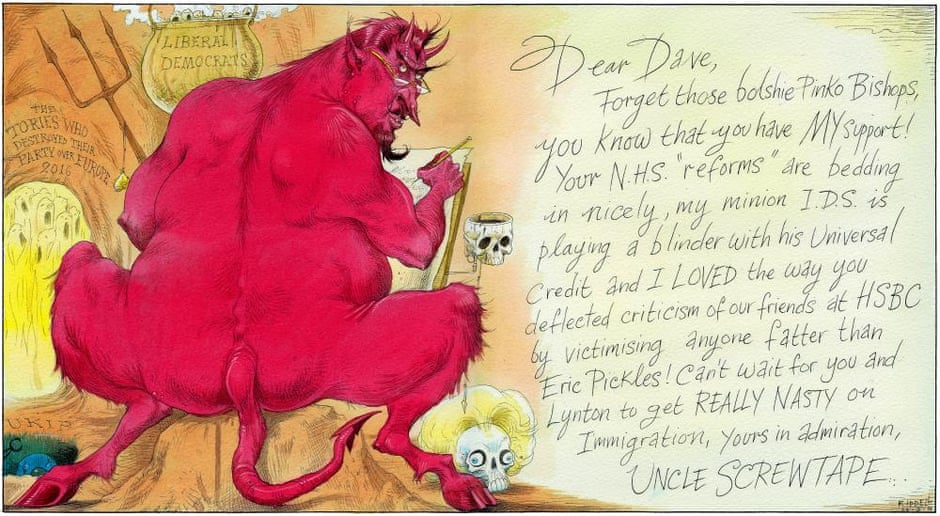
A letter to David Cameron from the devil – cartoon

Chris Riddell on the bishops’ letter to voters

Chris Riddell 22.02.2015

More workfare, less pay #GE2015


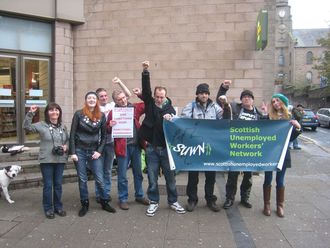
Solidarity protest at Arbroath Job Centre to support Tony Cox and affirm claimants' right to be accompanied
Solidarity protest at Arbroath Job Centre to support Tony Cox and affirm claimants’ right to be accompanied


This week the Conservatives announced in their manifesto they would introduce a new ‘community’ workfare scheme, specifically targeted at young people.

This is odd because chancellor George Osbourne had already launched just such a workfare scheme last year – and neither David Cameron, Osbourne, nor the media appear to remember it. Our first thought was that Cameron, Osbourne and co have been quaffing the Bolly to the point of extinguishing a massive complement of brain cells and memories.

However, there’s more going on here than over-indulgence in expensive champagne.

What does this workfare reboot really tell us? That workfare as a policy must be in enormous trouble if it has to be rebranded and relaunched on a yearly basis. Successful polices don’t need constant spin and retreads. And this tells us that the public is just not buying workfare. But then why would they when it replaces  jobs?

But then this latest ‘new’ workfare announcement is just more poorly thought out PR masquerading as a manifesto policy. A large number of workfare schemes already exist, and it is a proven fact that they do not work. They are very expensive failures. The Work Programme for example is a £5 billion failure, while the existing Community Work Placement scheme costs £235 million alone and is faltering badly with over 500 charities pledging not to take part in the scheme – and with more signing up every week.

More recently, the DWP evaluated the London Mayor’s ‘Day One Support for Young People’ (DOSfYP) workfare scheme. The DOSfYP scheme, like this new community workfare scheme presently touted by the Tories, was also targeted at young people. It cost £12 million and its chief outcome was to deter young people from claiming JSA – while making no difference to young people’s employment chances at all (see p. 28 of the evaluation here).

This post-election workfare scheme will be backed by benefit sanctions, which the Trussell Trust has linked to the huge increase in the use of foodbanks.  Among other things, workfare schemes deter people from accessing the welfare payments that they are entitled to. We see this in the fact that disengagement is now a real issue at local level, with one million unemployed people not claiming any benefit and ‘falling between the gaps’.

Our campaign has shown that once people discover a charity is using workfare, it becomes immensely damaging for its brand. People now know that implementing workfare means implementing poverty. The 500+ signatories of the Keep Volunteering Voluntary campaign also demonstrate that workfare is not what the third sector wants or needs.

Nobody, not least young people, should be sanctioned, stigmatised and sent on workfare for what are wider political and economic policy failures. Workfare and sanctions are social disasters and nobody – especially the third sector – should be involved.

Feel the same as we do? Then take action on the 25 February in solidarity with a member of the Scottish Unemployed Workers Network who was arrested coming out of Arbroath Job Centre. His only crime was advising a claimant of her rights.

Boycott Workfare

Labour: the First 100 Days #ILVision #SaveILF #Sanctions #ScrapWCA


The Save the ILF Campaign was successful in all parts of the UK except England, where the Labour Party repeatedly refused to save it. Then Shadow Minister for Disabled People Kate Green said “I do need to start by being clear that it’s not Labour’s position to retain the ILF”.


September 2015: The Legacy of the First 100 Days of a Labour government elected with a majority. Disabled people throughout the devolved nations of the UK are celebrating the continuing existence of their own Independent Living Funds. Yet in England those with the same support needs have little to cheer about as Labour themselves abandoned disabled people in England and continued forcing through the closure of the ILF, refusing disabled people the right to have the support they need to continue to live independently in the community.
Labour kept its pre-election promises on cuddly animals, and unfortunately kept to it's pre-election policies on disability as well
Labour kept its pre-election promises on cuddly animals, and unfortunately kept to it’s pre-election policies for disabled people  as well
But resilient as ever disabled people are cheering the fact that under Labour there are a significant number of improved rights for animals. After all we accept that not being pretty and fluffy and not enjoying being patted on the head by people passing us on the street- we were never likely to get the same sort of attention as cute little animals.Besides which, after 5 years of Condem austerity measures we’ve come to accept that the main political parties view us as stock with no human rights.

One of the first acts of the new Labour Government was to pass legislation to improve the lives of dogs and cats-they must now all be fed daily, be allowed out to go to the toilet regularly and have a daily walk. Not so for disabled people who have lost their care and support funding and who can only watch wistfully the new freedoms that pets have- imprisoned as they now are inside the walls of their homes unable to leave and take any active part in society. Many social services have introduced toileting regimes allowing disabled people to go to the toilet only at set times, or replaced human support with incontinence pads and catheters.

Fresh food has become a distant memory as more and more 3 minute short visits are all that is available to humans. Along with the wild animals which Labour is protecting by banning them from being used in circuses some of us are also being relocated to new ‘homes’. Sadly for disabled people this means we’re being removed totally from society and pushed out of sight and mind since the closure of the ILF in England...

Read more...

Saturday, February 21, 2015

Advocacy is NOT a crime


Scottish Unemployed Workers' Network logo

The so-called Welfare Reforms, started by New Labour and ramped up by the ConDem Coaltion, are nothing less than major cuts that undermine the very idea of social security.


They have led to a blizzard of attacks on the rights of people who find themselves caught within the web of an increasingly ‘Orwellian’ benefit system, which measures its success by how many ‘claimants’ it is able to push ‘off benefits’. A target-driven punitive system of administration has come into being that withdraws the means of livelihood from some of the poorest and most vulnerable for minor misdemeanours such as turning up to an appointment a few minutes late.


This increasingly punitive welfare regime is also having an impact on the right of the unemployed to be represented at DWP meetings, and also on the rights of ordinary people and welfare rights activists to represent the unemployed, despite these rights being enshrined in law.

The gathering attack on the right of the unemployed to representation is underlined by the case of Tony Cox, a Scottish Unemployed Workers’ Network (SUWN) activist, who was arrested on charges of threatening behaviour, refusing to give his name and address and resisting arrest, whilst representing a highly vulnerable woman in a meeting at Arbroath Jobcentre on the 29th January. The meeting had been arranged specifically to renegotiate what the woman felt was a highly punishing claimant commitment agreement, but when Tony attempted to help negotiate more suitable terms, the Jobcentre manager responded by telling him to leave the building and calling the police.

By the time the police came, Tony and the unemployed woman had left (with the promise of a further meeting), but he was still arrested and charged. This case has serious implications for Tony personally and also for welfare activists everywhere.

This example of harassment of welfare activists is far from an isolated incident, and must by challenged in the most determined fashion. We demand that welfare activists are not prevented from conducting their work and nothing be put in the way of benefit claimants’ fundamental right to advice and representation.

We call on activists and welfare rights groups to organise protests at their local job centres to coincide with the national day of protest on February 25th (when Tony will be appearing at Forfar Sheriff Court) called by Boycott Workfare.

Please also sign our petition: https://you.38degrees.org.uk/petitions/advocacy-is-not-a-crime-1

If you want to get a bit of help and advice, to find out more about what we do, or to join
the struggle, please give us a ring on 0789 9798979 or 07803 052239, or find us online: www.scottishunemployedworkers.net
www.facebook.com/scottishunemployedworkersnetwork
admin@scottishunemployedworkers.net

Friday, February 20, 2015

Suicides at 10 year high and linked to benefits


Figures released today by the Office for National Statistics show that suicide rates, which had fallen consistently since 1981, have been climbing since 2007 and are now at their highest in over a decade. It is primarily male suicides which have increased.

The figures for 2013 give a total of 6,233 deaths by suicide, 252 more than in 2012.

Suicide rates appear to be highest in areas of high unemployment, with the North-East  having the highest rate and London the lowest.

Older males are now the most at risk, with 45-59 year olds having the highest rate.

The link between benefits issues and increased suicide risk is being highlighted by charities such as Mind.

Speaking to the Guardian, Tom Pollard, policy and campaigns manager at Mind, said:

“Pressurising people by threatening to stop their benefits causes a great deal of financial problems and emotional distress, with some people attempting to take their own lives as a result.”


Workfare Is A Betrayal Of Our Children And We Will All Pay The Price In Time


wham-rap

Most of the UK’s successful creative people were probably once a NEET – meaning someone under 25 who is not in education, employment or training.  Tom Jones was famously revealed as workshy by his Jobcentre records before going on to become one of the most successful recording artists the UK has ever seen.  Top pop star George Michael even rapped about his experience of unemployment early in his career.  And he turned out all right.  Mostly.

There are just under one million NEETs in the UK, but most of them don’t stay that way for long.  Few make a perfectly seamless transition from education to work, so almost every 16-25 year old will have been a NEET at some point.  Around 15% of NEETs are currently unable to work due to sickness or disability.  Some of them will be in hospital.  Many NEETs are mothers with very young children or babies.  Others will be posh kids, dicking about on gap years or frittering away trust funds.  Prince Harry was a NEET for a while.  The term isn’t very helpful to describe an economic or social group. But it serves its real purpose, to smear the young as lazy or feckless...

Read more...

Wednesday, February 18, 2015

ESA Sanctions Hit New Record High


Sanctions against employment and support allowance (ESA) claimants in the work-related activity group have hit a new record high, according to DWP figures released today.

In September 2014, the most recent month for which statistics are available, 3,828 ESA claimants were hit with a sanction. The total for the preceding month was 3,096.

3,453 of the September sanctions were for alleged failure to participate in work-related activity, the remainder for failure to attend a mandatory interview.

The DWP continue to refuse to supply any explanation as to why ‘new regime’ sanctions have more than trebled from 1,091 in December 2012 to their current level.

Read more...

Bishops condemn demonising of claimants


The House of Bishops of the Church of England have told Christians they have a duty to vote in the general election and condemned the demonising of benefits claimants and the targeting of the least well off for cuts.

In a 52 page letter to the people and parishes of the Church of England published today, the Bishops say

“Unless we exercise the democratic rights that our ancestors struggled for, we will share responsibility for the failures of the political classes. It is the duty of every Christian adult to vote, even though it may have to be a vote for something less than a vision that inspires us.”

In a clear attack on the language used by politicians and the media about benefits claimants, they add that:

“It is particularly counter-productive to denigrate those who are in need, because this undermines the wider social instinct to support one another in the community. For instance, when those who rely on social security payments are all described in terms that imply they are undeserving, dependent, and ought to be self-sufficient, it deters others from offering the informal, neighbourly support which could ease some of the burden of welfare on the state.”

The Bishops also point out that austerity has not been experienced equally by all:

“It has been widely observed that the greatest burdens of austerity have not been born by those with the broadest shoulders – that is, those who enjoy a wide buffer zone before they fall into real need. Those whose margin of material security was always narrow have not been adequately protected from the impact of recession.”

You can download the full letter, ‘Who is my neighbour’ from this link.

Source

Cameron's plan to exploit our children as a source of free labour


In February 2015 David Cameron attempted to distract attention away from the massive scale of tax-dodging by the wealthy establishment class (and the flow of millions of pounds into Tory party coffers from these tax-dodging individuals) with some predictable displays of Tory scapegoating.

Scapegoating and distraction

First *while the Chancellor George Osborne was still hiding from quastions about what he know about the HSBC tax-dodging scandal) David Cameron announced a policy of sanctioning benefits claimants who are overweight. It was soon revealed that this attempt at a headline grabbing scapegoat policy would only actually affect fewer than 2,000 people according to the government's own statistics. Additionally it surely must have caused disorientating bouts of cognitive dissonance to anyone who believes the Tory rhetoric about Labour being the "nanny state party" that interferes in people's lives and the Tories being "the party of freedom" from state interference, and also to anyone who knows who Eric Pickles is.

After this effort to grab headlines with an attack on the overweight went down so badly that even hacks in the notoriously right-wing Telegraph ended up referring to the policy as "the sadistic hounding of the obese", Cameron and the Tories decided to switch their attention to another minority; the young.

As the HSBC tax-dodging scandal rumbled on, and more serious politicians began to draw parallels between the dodgy way in which political parties are funded and the inexorable rise of political dissatisfaction and outright apathy, Cameron decided to launch a policy that young people (18-21 year olds) should be immediately forced onto unpaid labour schemes if they can't find a real job...


Read more...

Hungry, thirsty and forced to attend the work programme.


Imagine this situation if you can. You have no money either because your sanctioned or your income is so low that you don’t have a spare penny. You are forced to attend your local work programme provider and have to attend everyday from 8.30am until 5pm. You are told that you have to spend all that time looking on their computers if there is one available for non existent jobs, which prevent you from going out and looking for real work. You feel demoralised, depressed and feel that your future is going nowhere. Let’s just add this to the equation. Your work programme provider refuses to provide you with even a glass of water. You have no money to bring sandwiches and haven’t got enough money to bring a flask. You ask for a drink and they say no we aren’t going to provide anyone with a drink. You aren’t allowed any real breaks and those with food have to eat it at the computer. Those without food and a drink look longingly at the people eating and drinking wishing that they could have a drink. By now they are dehydrated and the smell of cooked food from the cafe on the lower floor is really getting to you. So near but so far away.

Sounds like a chapter from a book by Engles or Charles Dickens but unfortunately it isn’t. This is an everyday reality at a local work programme provider in my town. I know it to be true because I know a person attending quite well...

Read more...

Saturday, February 14, 2015

900 Terminally Ill People Reassessed For PIP

Seen on Twitter:


https://pbs.twimg.com/media/B9v-mxaIQAAY9r7.jpg

Read more...

Tories Launch ‘Hate Sick And Disabled Claimants Week’


The Conservatives have launched a week long campaign aimed at stirring up hatred against welfare benefits claimants in general, and sick and disabled claimants in particular. The project appears to be an attempt to move the spotlight off tax avoidance at a time when polls suggest that the HSBC scandal is costing the Tories votes.

The campaign began today with a threat to stop the benefits of obese claimants as well as those who are dependent on alcohol and drugs, unless they take part in treatment programmes.

Cameron has announced that Dame Carol Black, responsible for the ‘Fit Note’ amongst other things, has been asked to carry out a rapid review of whether it would be possible to stop the benefits of people who refuse treatment.

Announcing the review, David Cameron claimed:

“Some have drug or alcohol problems, but refuse treatment.

“In other cases people have problems with their weight that could be addressed – but instead a life on benefits rather than work becomes the choice.

“It is not fair to ask hardworking taxpayers to fund the benefits of people who refuse to accept the support and treatment that could help them get back to a life of work.”


“Pathetic”

The move has already been widely condemned.

Former Labour spin doctor and recovering alcoholic Alistair Campbell, who is an Alcohol Concern ambassador, told LBC radio:

“I actually do think when you have got real leaders like Merkel doing the things that they are doing, it is embarrassing that we have a PM who does this sort of stuff. The fact that he is making a speech about it is pathetic.”

“People that are walking around London and the rest of the rest of the country today, as they walk over people in sleeping bags on the streets, just ask themselves if those people really, really chose to be there. They did not choose to be there – they are alcoholics or drug addicts because it is a disease, it is an illness, that is how it should be treated.

“To say we are not going to give you benefit because you are fat, we are not going to give you benefit because you drink too much, just think about what we have become as a country that that is our Prime Minister and that is how they treat a serious illness.”


Tough week ahead

Today’s announcement is just the first of a week of attacks on welfare benefits claimants by the conservatives as they try to prevent the press concentrating on tax dodging. And it’s probably just a small foretaste of what is to come in the weeks leading up to the election.

So, if you’d like to feel that you are fighting back rather than simply being a target, here’s three suggestions for ways to make life harder for the conservatives.

Read more...